 Back
BackBiochemistry: The Chemistry of Life – Study Notes for Introductory Chemistry
Study Guide - Smart Notes
 Tailored notes based on your materials, expanded with key definitions, examples, and context.
Biochemistry: The Chemistry of Life
The Living Cell
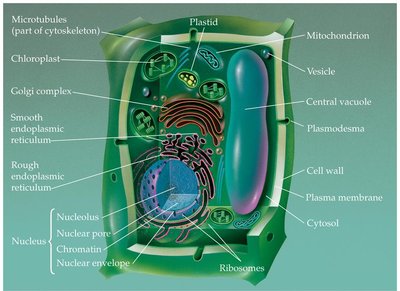
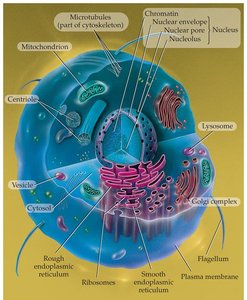
Biochemistry is the study of the chemical processes and substances that occur within living organisms. The cell is the fundamental structural and functional unit of all living things. Cells are surrounded by a cell membrane that regulates the movement of substances in and out. Plant cells also have a cell wall made of cellulose for additional support.
Nucleus: Contains genetic material (DNA) and controls heredity.
Ribosomes: Sites of protein synthesis.
Mitochondria: Organelles where energy production occurs.
Chloroplasts: Found only in plant cells; site of photosynthesis.
Energy in Biological Systems
Green plants use chloroplasts to convert solar energy into chemical energy stored in glucose through photosynthesis:
Plants can convert carbohydrates to fats and proteins.
Animals must obtain energy by consuming plants or other animals.
Metabolism is the sum of all chemical reactions in a cell, divided into:
Catabolism: Breakdown of molecules to release energy.
Anabolism: Synthesis of complex molecules from simpler ones.
Carbohydrates
Classification and Structure
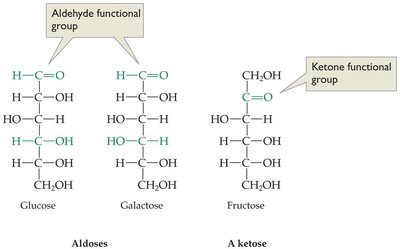
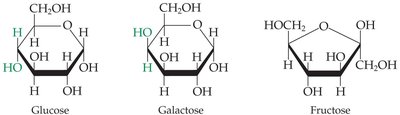
Carbohydrates are polyhydroxy aldehydes or ketones, or compounds that yield these upon hydrolysis. They are classified as:
Monosaccharides: Simple sugars that cannot be hydrolyzed further (e.g., glucose, galactose, fructose).
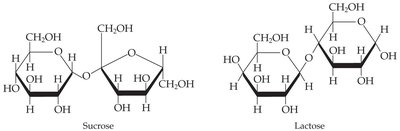
Disaccharides: Composed of two monosaccharide units (e.g., sucrose, lactose).
Polysaccharides: Large molecules made of many monosaccharide units (e.g., starch, cellulose, glycogen).
Polysaccharides: Starch, Cellulose, and Glycogen
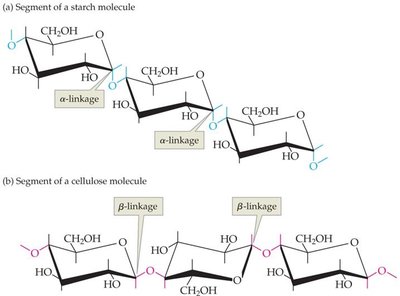
Starch and cellulose are both polymers of glucose but differ in their glycosidic linkages:
Starch: Contains α-linkages; digestible by humans.
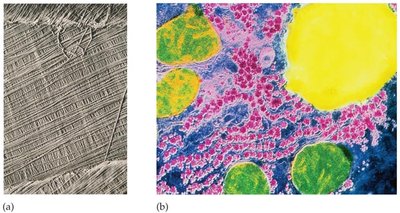
Cellulose: Contains β-linkages; indigestible by humans, serves as dietary fiber.
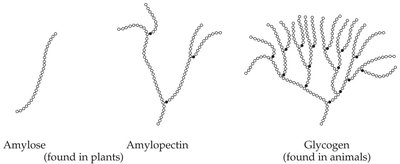
Starch is composed of two polymers:
Amylose: Unbranched chains of glucose.
Amylopectin: Branched chains of glucose.
Glycogen is the animal storage form of glucose, similar to amylopectin but more highly branched.
Carbohydrates in the Diet
Monosaccharides like glucose and fructose are absorbed directly. Disaccharides are hydrolyzed before absorption:
Sucrose: Hydrolyzed to glucose and fructose.
Lactose: Hydrolyzed to glucose and galactose; lactose intolerance results from enzyme deficiency.
Starch provides 4 kcal/g of energy. Cellulose acts as dietary fiber. Glycogen stores excess glucose in animals; excess is converted to fat.
Fats and Other Lipids
Structure and Types
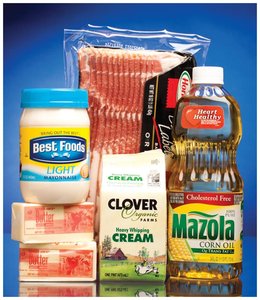
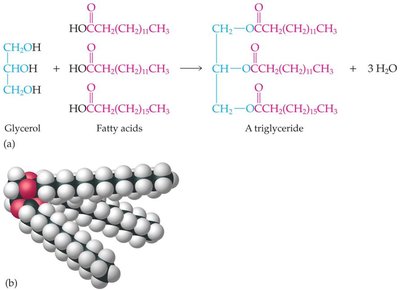
Lipids are water-insoluble, nonpolar biological molecules. Fats (triglycerides) are esters of glycerol and long-chain fatty acids.
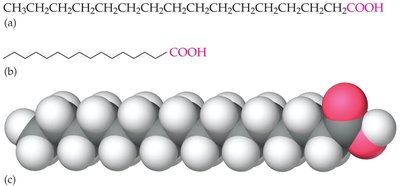
Saturated fatty acids: No double bonds; solid at room temperature.
Monounsaturated fatty acids: One double bond.
Polyunsaturated fatty acids: Two or more double bonds; liquid at room temperature.
Digestion and Metabolism of Fats
Fats are digested by lipases in the small intestine, producing fatty acids and glycerol. Fats are stored in adipose tissue and provide 9 kcal/g of energy.

Cholesterol and Lipoproteins
Cholesterol is a steroid found in animal tissues and transported in the blood by lipoproteins:
Class | Abbreviation | Protein (%) | Density (g/mL) | Main Function |
|---|---|---|---|---|
Very-low-density | VLDL | 5 | 1.006–1.019 | Transport triglycerides |
Low-density | LDL | 25 | 1.019–1.063 | Transport cholesterol to cells |
High-density | HDL | 50 | 1.063–1.210 | Transport cholesterol to liver |
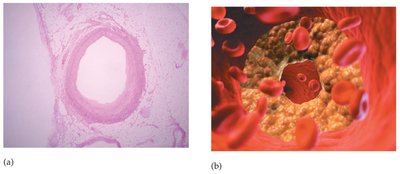
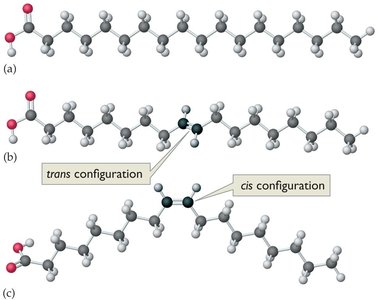
LDL is considered "bad" cholesterol; HDL is "good" cholesterol. High intake of saturated and trans fats increases LDL levels and risk of cardiovascular disease.
Proteins
Amino Acids and Peptide Bonds
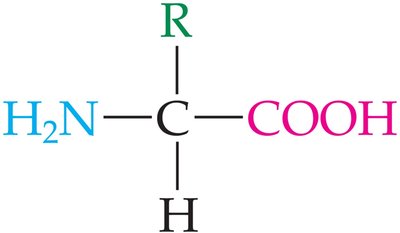
Proteins are polymers of amino acids, which contain both an amine group and a carboxyl group attached to the same carbon (the alpha carbon). At physiological pH, amino acids exist as zwitterions (dipolar ions).
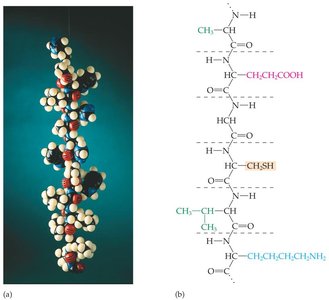
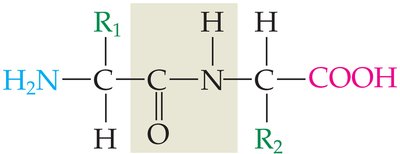
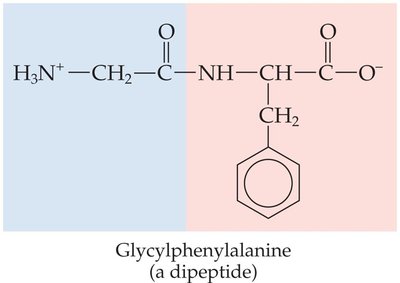
Amino acids are linked by peptide bonds (amide linkages) to form polypeptides and proteins.
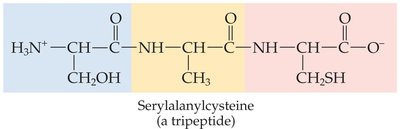
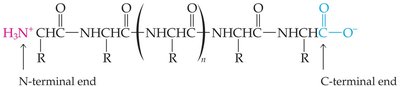
Levels of Protein Structure
Primary structure: Sequence of amino acids.
Secondary structure: Local folding (e.g., alpha helix, beta-pleated sheet) due to hydrogen bonding.
Tertiary structure: Overall 3D shape due to interactions between side chains.
Quaternary structure: Arrangement of multiple polypeptide chains.
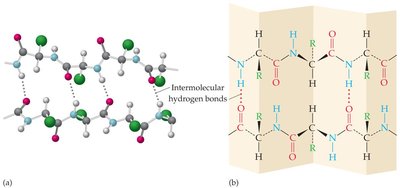
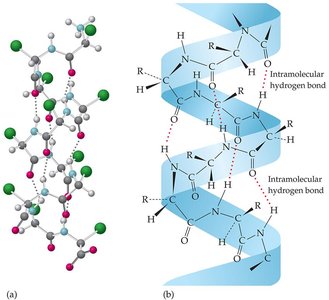
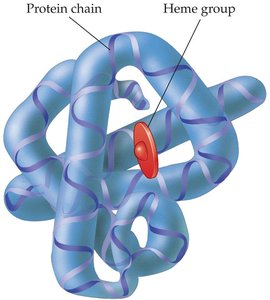
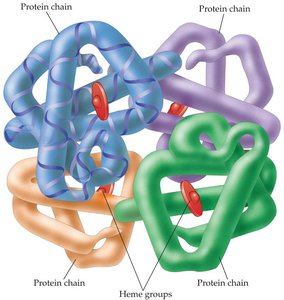
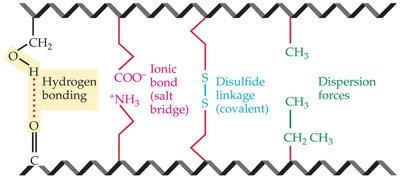
Protein chains are stabilized by hydrogen bonds, ionic bonds (salt bridges), disulfide linkages, and dispersion forces. Nonpolar groups tend to be internal, while polar groups are external.
Enzymes
Function and Mechanism
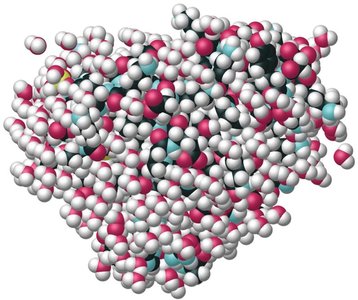
Enzymes are biological catalysts, mostly proteins, that speed up chemical reactions. They are highly specific for their substrates. The induced-fit model describes how substrates bind to the enzyme's active site, forming an enzyme–substrate complex.
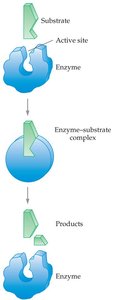
Enzyme activity can be inhibited by molecules that bind elsewhere on the enzyme, altering its shape and preventing substrate binding.
Some enzymes require cofactors (inorganic ions or organic molecules) for activity. A coenzyme is a nonprotein organic cofactor. The protein part alone is called an apoenzyme.
Enzymes are used in medical diagnostics, industry, and everyday products such as stain removers and meat tenderizers.
Nucleic Acids
DNA and RNA Structure
Nucleic acids are the information and control centers of the cell. The two main types are DNA (deoxyribonucleic acid) and RNA (ribonucleic acid). Both are polymers of nucleotides, each consisting of a sugar, a phosphate, and a nitrogenous base.
DNA is a double helix stabilized by hydrogen bonds between complementary bases: adenine pairs with thymine, and cytosine pairs with guanine. RNA is typically single-stranded.
Genetic Information and Protein Synthesis
During protein synthesis, genetic information is transcribed from DNA to messenger RNA (mRNA). The genetic code is read in triplets (codons), each coding for a specific amino acid. Transfer RNA (tRNA) brings the correct amino acid to the ribosome during translation.
DNA Base | Complementary RNA Base |
|---|---|
Adenine (A) | Uracil (U) |
Thymine (T) | Adenine (A) |
Cytosine (C) | Guanine (G) |
Guanine (G) | Cytosine (C) |
Genomics and Genetic Engineering
DNA replication ensures genetic information is passed during cell division. Techniques such as polymerase chain reaction (PCR) and recombinant DNA technology are used in genetic testing and gene therapy. Genetic engineering holds promise for medicine and agriculture but also raises ethical concerns.
