 Back
BackCalculations Involving Molar Mass: Converting Between Mass and Moles
Study Guide - Smart Notes
 Tailored notes based on your materials, expanded with key definitions, examples, and context.
Calculations Involving Molar Mass
Introduction to Molar Mass
The concept of molar mass is fundamental in chemistry for converting between the mass of a substance and the amount in moles. Molar mass is defined as the mass of one mole of a substance, typically expressed in grams per mole (g/mol). This conversion is essential for quantitative chemical calculations and stoichiometry.
Molar mass acts as a conversion factor between grams and moles.
It allows chemists to convert the amount of a substance (in moles) to its mass (in grams), and vice versa.
The molar mass of an element or compound can be found on the periodic table or calculated by summing the atomic masses of its constituent atoms.
Using Molar Mass as a Conversion Factor
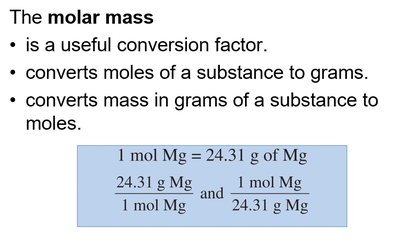
To convert between moles and grams, use the molar mass as a ratio. The two possible conversion factors are:
From moles to grams:
From grams to moles:
For example, the molar mass of magnesium (Mg) is 24.31 g/mol. This means:
Conversion factors: or
Converting Moles to Grams
To find the mass of a substance when given the number of moles, multiply the number of moles by the molar mass:
Formula:
Example: If the design for a piece of jewelry requires 0.750 mole of silver (Ag), how many grams of silver are needed?
Find the molar mass of Ag: 107.87 g/mol
Calculate:

Converting Grams to Moles
To determine the number of moles in a given mass of a substance, divide the mass by the molar mass:
Formula:
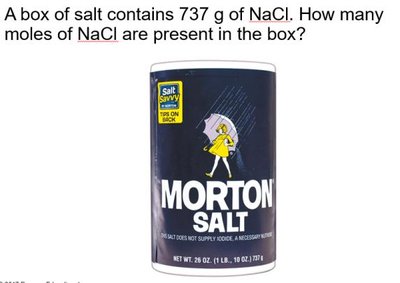
Example: A box of salt contains 737 g of sodium chloride (NaCl). How many moles of NaCl are present in the box?
Find the molar mass of NaCl: 58.44 g/mol
Calculate:
Summary Table: Molar Mass Conversions
Given | Conversion Factor | Find |
|---|---|---|
Moles | Molar mass (g/mol) | Grams |
Grams | 1 / Molar mass (mol/g) | Moles |
Additional info:
These conversions are foundational for stoichiometry, allowing chemists to relate quantities of reactants and products in chemical reactions.
Always ensure units cancel appropriately when setting up conversion factors.
