Back
BackChapter 1 Chemistry Exam Study Guide: The Chemical World & Measurement
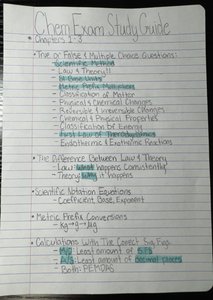
Study Guide - Smart Notes
 Tailored notes based on your materials, expanded with key definitions, examples, and context.
Chapter 1: The Chemical World & Measurement
Scientific Method and Theory
The scientific method is a systematic approach used by scientists to investigate natural phenomena. It involves making observations, forming hypotheses, conducting experiments, and developing theories.
Law: A concise statement that describes a fundamental relationship or regularity of nature (e.g., Law of Conservation of Mass).
Theory: An explanation of why and how a phenomenon occurs, supported by evidence and experimentation.
Difference: Laws describe what happens; theories explain why it happens.
Example: Newton's Law of Gravity describes the attraction between masses; the theory explains the mechanism.
Measurement and Units
Measurement is fundamental in chemistry for quantifying substances and reactions. Units provide a standard for expressing measurements.
SI Units: The International System of Units is used in scientific measurement (e.g., meter, kilogram, second).
Scientific Notation: Used to express very large or small numbers. Format:
Example: (Avogadro's number)
Matter and Its Properties
Matter is anything that has mass and occupies space. It can be classified based on its physical and chemical properties.
Physical Properties: Characteristics that can be observed without changing the substance (e.g., color, melting point).
Chemical Properties: Characteristics that describe a substance's ability to change into another substance (e.g., flammability).
Physical Changes: Changes that do not alter the chemical identity (e.g., melting, boiling).
Chemical Changes: Changes that result in the formation of new substances (e.g., rusting, combustion).
Energy and Chemical Reactions
Energy is involved in all chemical reactions. Reactions can be classified based on energy changes.
Exothermic Reactions: Release energy to the surroundings (e.g., combustion).
Endothermic Reactions: Absorb energy from the surroundings (e.g., photosynthesis).
Scientific Notation Equations
Scientific notation is used to simplify calculations with very large or small numbers.
Format:
Exponent Rules: When multiplying, add exponents; when dividing, subtract exponents.
Example:
Metric Prefix Conversions
Metric prefixes are used to express multiples or fractions of units.
Kilo (k): units
Mega (M): units
Example:
Calculations with Significant Figures
Significant figures reflect the precision of a measurement. Calculations must account for the correct number of significant digits.
Least Amount of Sig Figs: The result of a calculation should have the same number of significant figures as the measurement with the least.
Least Amount of Decimal Places: For addition/subtraction, the result should have the same number of decimal places as the measurement with the least.
Both Methods: Apply the correct rule based on the operation performed.
Example: (2 significant figures)