 Back
BackChapter 1: The Chemical World – Foundations of Chemistry
Study Guide - Smart Notes
 Tailored notes based on your materials, expanded with key definitions, examples, and context.
Chapter 1: The Chemical World
Introduction to Chemistry
Chemistry is the study of matter and the changes it undergoes. Everything around us, from the air we breathe to the food we eat, involves chemistry. Understanding chemistry provides insight into the physical world and its processes.
Chemistry: The scientific study of matter, its properties, and the transformations it undergoes.
Matter: Anything that occupies space and has mass. Examples include air, gold, wood, and glass.
Mass: The measure of the amount of matter in an object, typically measured in grams.
Weight: The measure of the force of gravity acting on an object. Weight varies with location, mass does not.
Example: An astronaut's mass remains the same on Earth and Mercury, but their weight changes due to different gravitational forces.
Characteristics of Science
Science is a systematic approach to understanding the natural world. It relies on observation, hypothesis, experimentation, and theory development. Scientific knowledge is always tentative and subject to revision.
Testable: Scientific ideas must be testable through experiments.
Reproducible: Results must be reproducible by others.
Explanatory: Science seeks to explain natural phenomena.
Predictive: Science can predict future events or behaviors.
Tentative: Scientific theories are subject to change as new evidence emerges.
Scientific Process: Observation → Hypothesis → Experiment → Theory → Scientific Law
Scientific Models and Limitations
Scientific models are used to represent invisible processes, such as the motion of molecules. Science is limited by our ability to observe and analyze data, and by variables that may affect experiments.
Example: The kinetic molecular theory models gas molecules as billiard balls.
Limitations: Preconceived ideas and uncontrolled variables can influence scientific interpretation.
Risks and Benefits of Technology
Technology is the application of scientific knowledge to modify materials for human needs. Not all technology is beneficial; risk-benefit analysis is used to evaluate its desirability.
Desirability Quotient:
Example: Nuclear energy, flying, pharmaceuticals.
Chemistry as the Central Science
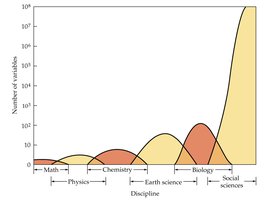
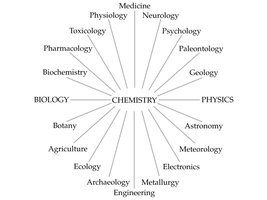
Chemistry connects and overlaps with many other scientific disciplines, including biology, physics, earth science, and social sciences. It is often referred to as the central science because of its foundational role.
Properties and Classification of Matter
Physical and Chemical Properties
Matter can be described by its physical and chemical properties. Physical properties do not change the chemical composition, while chemical properties describe how a substance reacts with other matter.
Physical Properties: Color, hardness, odor, melting point.
Chemical Properties: Reactivity, flammability, acidity.
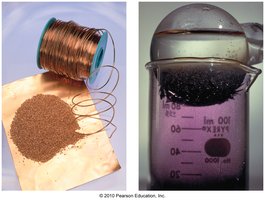
Physical Change: No change in chemical composition (e.g., melting ice).
Chemical Change: Change in chemical composition (e.g., milk curdling).
Classification of Matter
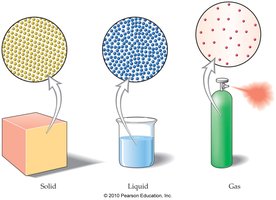
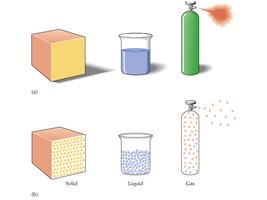
Matter can be classified by its state (solid, liquid, gas) and by its composition (substance or mixture).
States of Matter:
Solid: Maintains shape and volume.
Liquid: Definite volume, takes shape of container.
Gas: No definite shape or volume, expands to fill container.
Substances and Mixtures
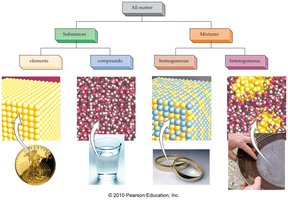
Substances have a fixed composition, while mixtures contain two or more substances that retain their identities and can be separated by physical means.
Substance: Pure matter (e.g., pure gold, pure water).
Mixture: Variable composition; can be homogeneous (uniform) or heterogeneous (non-uniform).
Elements and Compounds
Substances can be elements or compounds. Elements are fundamental substances that cannot be broken down further. Compounds are made of two or more elements chemically combined.
Element: Represented by a unique chemical symbol (e.g., H for hydrogen).
Compound: Represented by a formula with two or more element symbols (e.g., H2O for water).
Atoms and Molecules
An atom is the fundamental particle of an element. Molecules are groups of atoms bonded together, forming the smallest unit of a compound.
Atom: Single type of particle in an element.
Molecule: Two or more atoms bonded together (e.g., H2, H2O).
Elements and Their Symbols
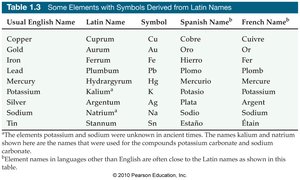
Each element has a unique chemical symbol, often derived from its Latin name. Some elements have symbols that differ from their English names.
Usual English Name | Latin Name | Symbol | Spanish Name | French Name |
|---|---|---|---|---|
Copper | Cuprum | Cu | Cobre | Cuivre |
Gold | Aurum | Au | Oro | Or |
Iron | Ferrum | Fe | Hierro | Fer |
Lead | Plumbum | Pb | Plomo | Plomb |
Mercury | Hydrargyrum | Hg | Mercurio | Mercure |
Potassium | Kalium | K | Potasio | Potassium |
Silver | Argentum | Ag | Plata | Argent |
Sodium | Natrium | Na | Sodio | Sodium |
Tin | Stannum | Sn | Estaño | Étain |
Common Elements and Their Properties
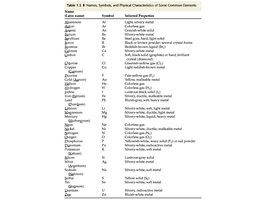
Elements have unique physical characteristics. Knowing their names, symbols, and properties is essential for chemistry students.
Measurement and the Metric System
SI Units and Metric System
The metric system is based on the International System of Units (SI), using base units for each type of measurement. Prefixes are used to indicate multiples or fractions of base units.
Base Units: Meter (length), Gram (mass), Liter (volume), Second (time), Kelvin (temperature).
Prefixes: Centi- (100 times smaller), Milli- (1000 times smaller), Kilo- (1000 times larger).
Example: 1000 meters = 1 kilometer.
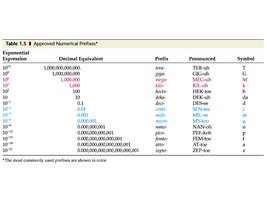
Approved Numerical Prefixes
Numerical prefixes are used to express large or small quantities in the metric system.
Exponential Expression | Decimal Equivalent | Prefix | Pronounced | Symbol |
|---|---|---|---|---|
103 | 1,000 | kilo | KIL-oh | k |
10-2 | 0.01 | centi | SEN-tee | c |
10-3 | 0.001 | milli | m | |
10-6 | 0.000001 | micro | MY-kroh | μ |
10-9 | 0.000000001 | nano | NAN-oh | n |
10-12 | 0.000000000001 | pico | PEE-koh | p |
106 | 1,000,000 | mega | MEG-ah | M |
109 | 1,000,000,000 | giga | GIG-ah | G |
Dimensional Analysis
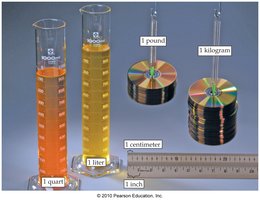
Dimensional analysis is a method for converting units using equivalence statements. It ensures accuracy in scientific calculations.
Example Equivalences:
2.54 cm = 1 inch
454 g = 1 pound
0.946 liter = 1 quart
Precision and Accuracy
Precision refers to how close measurements are to each other, while accuracy refers to how close measurements are to the true value.
Precision: Consistency of repeated measurements.
Accuracy: Closeness to the accepted value.

Density
Density is a physical property that helps distinguish materials. It is defined as mass per unit volume.
Formula:
Units: g/mL for liquids, g/cm3 for solids
Note: 1 mL = 1 cm3 = 1 cc
Heat vs. Temperature
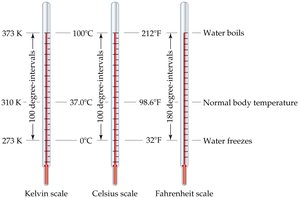
Heat is the total energy contained in a sample, while temperature measures the intensity of heat or the energy of particles.
Heat: Measured in calories (cal), kilocalories (kcal), or joules (J).
Temperature: Measured in degrees Fahrenheit (°F), Celsius (°C), or Kelvin (K).
Formula:
Critical Thinking in Science
Critical thinking is essential in scientific inquiry. It involves falsifiability, logic, reproducibility, and sufficiency of evidence.
Falsifiability: Can the hypothesis be proven false?
Logic: Are the conclusions logically derived?
Reproducibility: Can results be repeated?
Sufficiency: Is there enough evidence?
