 Back
BackChapter 1: The Chemical World – Introduction to Chemistry
Study Guide - Smart Notes
 Tailored notes based on your materials, expanded with key definitions, examples, and context.
The Chemical World
What Is Chemistry?
Chemistry is the science that seeks to understand what matter does by studying what atoms and molecules do. Everything around us is composed of chemicals, from the air we breathe to the food we eat and the objects we use daily.
Matter is anything that has mass and occupies space.
Atoms are the tiny particles that compose all common matter.
Molecules are groups of atoms bonded together by chemical bonds.
Chemical bonds are the attachments that hold atoms together in molecules.
Atoms and Molecules in Everyday Life
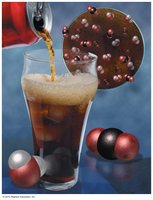
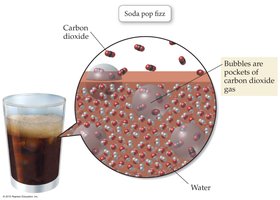
Atoms and molecules are the building blocks of all substances. For example, soda pop is a mixture containing water molecules, carbon dioxide molecules, and other substances that contribute flavor and color. A single drop of soda pop contains about one billion trillion (1 × 109 × 1012) atoms.
Soda pop fizzes because carbon dioxide gas escapes from the liquid when the pressure is released.
The bubbles in soda pop are pockets of carbon dioxide gas.
Structure of Molecules
The properties of substances depend on the types and arrangements of atoms in their molecules.
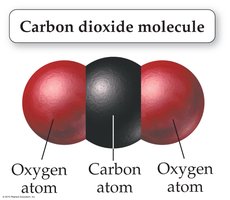
Carbon dioxide (CO2) molecules consist of one carbon atom and two oxygen atoms arranged in a straight line.
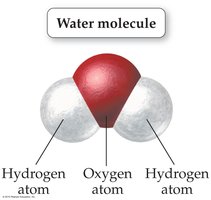
Water (H2O) molecules consist of one oxygen atom and two hydrogen atoms arranged in a bent shape.
The structure of these molecules determines their physical properties, such as being a gas or liquid at room temperature.
Soda Pop Fizz: A Molecular View
In a sealed can, carbon dioxide gas is dissolved in water under pressure. When the can is opened, the pressure is released, and carbon dioxide escapes as bubbles.
Bubbles are visible evidence of carbon dioxide gas leaving the solution.
This process illustrates how molecular behavior explains observable phenomena.
Chemicals Compose Ordinary Things
Chemicals in Everyday Life
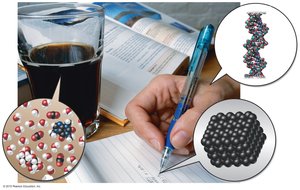
Everything you can touch or see is made of chemicals, not just laboratory substances. Common items such as air, water, toothpaste, and even medicines are composed of chemicals.
People often mistakenly think of chemicals only as dangerous substances, but chemicals are essential to life and everyday objects.
The Scientific Method: How Chemists Think
Overview of the Scientific Method
The scientific method is a systematic way of learning about the world that emphasizes observation and experimentation. Chemists use this method to produce reliable knowledge about matter and its behavior.
Observation: Measuring or observing some aspect of nature.
Hypothesis: A tentative interpretation or explanation of the observations. A good hypothesis is falsifiable.
Experiment: Controlled observations designed to test hypotheses.
Law: A brief statement that summarizes past observations and predicts future ones.
Theory: A model that explains and gives the underlying causes for observations and laws.
Example: Law of Conservation of Mass
Antoine Lavoisier observed that the mass of a closed container does not change during combustion. This led to the law of conservation of mass:
Law of Conservation of Mass: In a chemical reaction, matter is neither created nor destroyed.
From Hypotheses to Theories
When a hypothesis is repeatedly confirmed by experiments, it may become a scientific theory. Theories provide deep explanations and can predict new phenomena. For example, Dalton's atomic theory explained the law of conservation of mass by proposing that all matter is made of small, indestructible particles called atoms.
Classification of Scientific Statements
Statement | Classification |
|---|---|
When a metal is burned in a closed container, the mass does not change. | Observation |
Matter is made of atoms. | Theory |
Matter is conserved in chemical reactions. | Law |
When wood is burned in a closed container, its mass does not change. | Observation |
Success in Chemistry
Skills and Attitudes for Learning Chemistry
To succeed in chemistry, students should be curious, imaginative, and committed to regular study and practice. Quantification—making precise measurements—is a key skill in chemistry, as it allows for accurate comparisons and understanding of matter.
Be willing to do calculations and measurements.
Commit to regular study and homework.
Develop curiosity about how and why things happen at the molecular level.
Chapter 1 in Review
Chemistry seeks to understand matter by studying molecules and atoms.
The scientific method involves observation, hypothesis, experiment, law, and theory.
The law of conservation of mass and atomic theory are foundational concepts in chemistry.
Chemical Skills Learning Objectives
Recognize that chemicals make up virtually everything in our world.
Understand that all things are made of atoms and molecules.
Identify and understand the key characteristics of the scientific method: observation, hypothesis, experiment, law, and theory.
