 Back
BackChapter 1: The Chemical World – Introductory Chemistry Study Notes
Study Guide - Smart Notes
 Tailored notes based on your materials, expanded with key definitions, examples, and context.
The Chemical World
Definition of Chemistry
Chemistry is the science that seeks to understand how matter behaves by studying what atoms and molecules do. Virtually everything around us is composed of chemicals, making chemistry a central science for understanding the material world.
Atoms: The Building Blocks of Matter
All matter is composed of tiny particles called atoms. Atoms are incredibly small—so small that a single grain of sand contains more atoms than there are grains of sand on a large beach. These atoms combine in various ways to form all substances.

Atoms and Molecules in Matter
Atoms can join together to form molecules, which are groups of two or more atoms held together by chemical bonds. The properties of a molecule depend on the types of atoms it contains and their arrangement (shape). All common matter is composed of these tiny particles—atoms and molecules.
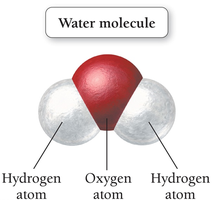
Water Molecules
A water molecule consists of one oxygen atom and two hydrogen atoms, arranged in a bent shape. This bent structure is crucial: it makes water a liquid at room temperature. If water molecules were linear, water would be a gas under normal conditions. Water’s ability to remain a liquid over a wide temperature range is essential for sustaining life.
Chemicals Compose Ordinary Things
Everything you can hold or touch is made of chemicals. People often think of chemicals only as dangerous substances, but chemicals also make up ordinary things such as air, water, toothpaste, medicines, and even toilet paper. Chemistry helps us understand the properties and behaviors of these substances by studying the molecules that compose them.

The Scientific Method: How Chemists Think
Overview of the Scientific Method
The scientific method is a systematic way of learning about the world that emphasizes observation and experimentation. Unlike ancient philosophies that relied on pure reason, the scientific method relies on evidence gathered through the senses and experiments.
Key Components of the Scientific Method
Observation: Measuring or describing some aspect of nature, either with the naked eye or with instruments.
Hypothesis: A tentative explanation for observations. A good hypothesis is falsifiable, meaning it can be proven wrong by experiment.
Law: A statement that summarizes the results of many observations and predicts future ones (e.g., the Law of Conservation of Mass).
Theory: A model that explains the underlying reasons for observations and laws, supported by extensive evidence.

Observation in Science
Observations are the foundation of scientific inquiry. They can be qualitative (descriptive) or quantitative (measured). For example, observing that a substance changes color when heated is qualitative, while measuring its temperature is quantitative.
Formulating and Testing Hypotheses
Scientists use observations to develop hypotheses, which are then tested through experiments. If experimental results do not support a hypothesis, it must be revised or replaced. This process ensures that scientific knowledge is continually refined and improved.
Experiments and Validation
Experiments are controlled procedures designed to test hypotheses, laws, and theories. Only through repeated experimentation can scientific ideas be validated or refuted.
Example: Combustion and the Law of Conservation of Mass
Antoine Lavoisier, a French chemist, conducted experiments on combustion by burning substances in closed containers and measuring their mass before and after burning. He found that the mass did not change, leading to the Law of Conservation of Mass:
Law of Conservation of Mass: In a chemical reaction, matter is neither created nor destroyed.

The Atomic Theory
The idea that all matter is made of atoms is a scientific theory supported by over 200 years of experimental evidence. Modern technology allows us to visualize atoms directly, confirming their existence and arrangement.
Classifying Scientific Statements
Observation: When a metal is burned in a closed container, the mass does not change.
Theory: Matter is made of atoms.
Law: Matter is conserved in chemical reactions.
Observation: When wood is burned in a closed container, its mass does not change.
Analyzing and Interpreting Data
Scientific Data
Scientists collect measurements as part of their observations. These measurements, or data, are analyzed to identify patterns and relationships. Data can be presented in tables or visualized using graphs.
Interpreting Graphs
When analyzing a graph, it is important to understand what each axis represents. For example, a graph showing atmospheric carbon dioxide concentration over time can reveal trends and changes in the environment.
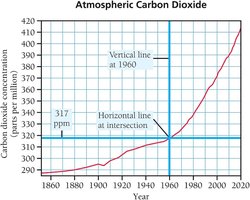
Example: Atmospheric Carbon Dioxide
By examining the graph, you can determine the concentration of carbon dioxide in specific years and calculate the increase over time. For instance, the concentration in 1970 and 2020 can be compared to assess environmental changes.
Success in Chemistry
Curiosity and Imagination
Success in chemistry requires curiosity, imagination, and a desire to understand the 'why' behind phenomena. Chemists must be willing to ask questions and seek explanations.
Calculation and Quantification
Chemistry often involves calculations and quantifying observations. For example, measuring the temperature of water samples can reveal differences not detectable by touch alone. Quantification is a key tool in scientific investigation.
Commitment and Consistency
Regular and careful work is essential for mastering chemistry. Consistent effort leads to a deeper understanding of the molecular world and its underlying principles.

Additional Info
Equation for Law of Conservation of Mass:
