 Back
Chapter 10: Chemical Bonding – Structured Study Notes
Study Guide - Smart Notes
 Tailored notes based on your materials, expanded with key definitions, examples, and context.
Chemical Bonding
Bonding Models and Drug Design
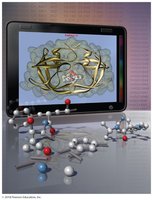
Bonding theories are essential for understanding how atoms combine to form molecules, which is crucial in fields such as drug design. For example, the structure of HIV-protease was used to design drugs that inhibit its function, preventing the virus from replicating in the human body. These drugs, known as protease inhibitors, have significantly improved the life expectancy of HIV-infected individuals.
Bonding Theories
Overview of Bonding Theories
Bonding theories predict how atoms bond to form compounds and explain why certain combinations are stable. They also help determine molecular shapes, which influence physical and chemical properties.
Lewis Theory: Uses dot structures to represent valence electrons and predict molecular stability.
Advanced Theories: Used for more accurate predictions but Lewis theory is preferred for quick, everyday applications.
Lewis Theory: Representing Valence Electrons
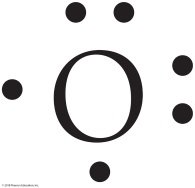
In Lewis theory, valence electrons are shown as dots around the element symbol. The number of valence electrons for main-group elements (except helium) equals the group number.
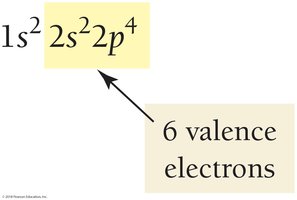
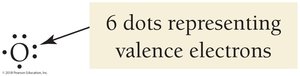
Dot Structure: Each dot represents a valence electron, with a maximum of two dots per side.
Octet: Atoms with eight valence electrons are particularly stable.

Writing Lewis Structures for Elements
To write a Lewis structure, place the correct number of dots (valence electrons) around the element symbol.
Example: Phosphorus (Group 5A) has five valence electrons.

Helium: An Exception
Helium has two valence electrons, forming a stable duet rather than an octet.

Lewis Theory of Chemical Bonding
Types of Chemical Bonds
Lewis theory states that chemical bonds involve the sharing or transfer of electrons to achieve stable electron configurations.
Ionic Bond: Electrons are transferred (metal to nonmetal).
Covalent Bond: Electrons are shared (nonmetal to nonmetal).
The octet rule states that atoms transfer or share electrons to obtain eight electrons in their outer shell, except for hydrogen, lithium, and beryllium, which achieve stability with two electrons (duet).
Lewis Structures of Ionic Compounds
When metals bond with nonmetals, electrons are transferred, forming cations and anions. The attraction between these ions forms ionic compounds.


Example: Potassium transfers its valence electron to chlorine, forming K+ and Cl−.

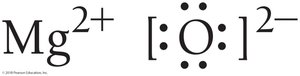
Lewis Structure of MgO
Magnesium loses two electrons to oxygen, forming Mg2+ and O2−.

Predicting Chemical Formulas for Ionic Compounds
Lewis theory helps predict the correct formula by balancing electron transfer.
Example: Sodium (Na) and sulfur (S) form Na2S, as two sodium atoms are needed to provide two electrons for sulfur.


Covalent Lewis Structures: Electrons Shared
Covalent Bonding
Nonmetals form molecular compounds by sharing electrons, allowing each atom to achieve an octet (or duet for hydrogen).


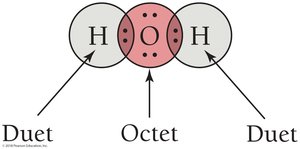
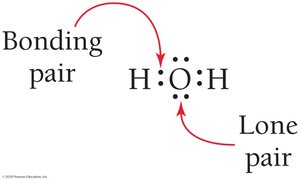
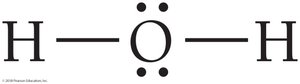
Bonding Pair Electrons: Shared between atoms, represented by dashes.
Lone Pair Electrons: Not shared, located on one atom.
Halogens and Diatomic Molecules
Halogens form diatomic molecules by pairing together to achieve octets.


Hydrogen as H2
Hydrogen atoms share electrons to form H2, achieving a stable duet.

Double and Triple Bonds
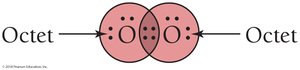
Atoms can share more than one pair of electrons to achieve octets. Double bonds involve two pairs, triple bonds involve three pairs.
Example: O2 forms a double bond; N2 forms a triple bond.




Writing Lewis Structures for Covalent Compounds
Steps for Writing Lewis Structures
Write the correct skeletal structure for the molecule.
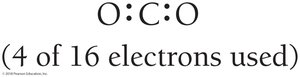
Calculate the total number of valence electrons.
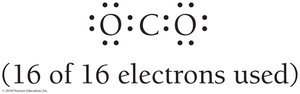
Distribute electrons to give octets (or duets for hydrogen).
If any atoms lack an octet, form double or triple bonds as needed.
Example: CO2 Lewis Structure
CO2 has a linear structure with two double bonds between carbon and oxygen.

Polyatomic Ions and Resonance
Lewis Structures for Polyatomic Ions
For polyatomic ions, adjust the electron count for the ion's charge and enclose the structure in brackets with the charge indicated.
Example: CN− ion has a triple bond between C and N.



Exceptions to the Octet Rule
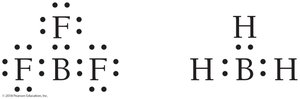
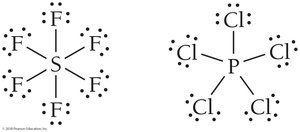
Some molecules have odd numbers of electrons (free radicals) or fewer/more than eight electrons around the central atom (e.g., BF3, BH3, SF6, PCl5).

Resonance Structures
Some molecules, like SO2, have multiple valid Lewis structures. The actual structure is an average (resonance) of these forms.





Predicting Molecular Shapes
VSEPR Theory
Valence Shell Electron Pair Repulsion (VSEPR) theory predicts molecular shapes based on the repulsion between electron groups around the central atom.
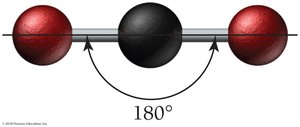
Linear Geometry: CO2 has a bond angle of 180°.
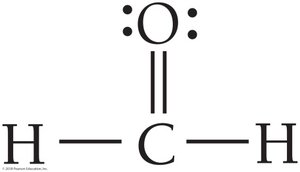
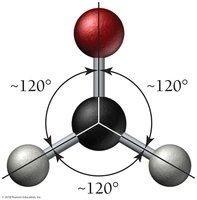
Trigonal Planar: H2CO has bond angles of ~120°.
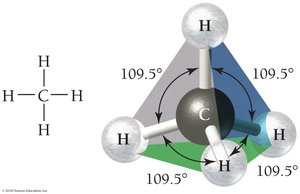
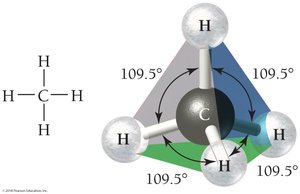
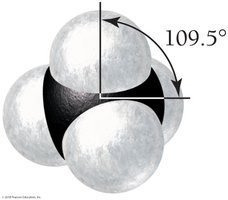
Tetrahedral: CH4 has bond angles of 109.5°.

Molecules with Lone Pairs
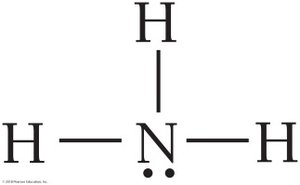
Lone pairs affect molecular geometry. For example, NH3 is trigonal pyramidal, and H2O is bent.
Electronegativity and Polarity
Electronegativity
Electronegativity is the ability of an atom to attract electrons in a bond. Differences in electronegativity lead to polar covalent bonds, with partial charges and dipole moments.
Example: In water, oxygen is more electronegative than hydrogen, resulting in a partial negative charge on oxygen and a partial positive charge on hydrogen.
Bond Types Based on Electronegativity Difference
Pure Covalent: Identical electronegativities (e.g., Cl2).
Ionic: Large difference (e.g., NaCl).
Polar Covalent: Intermediate difference (e.g., HF).
Polar Bonds and Polar Molecules
Polar bonds do not always result in polar molecules. The overall molecular geometry determines whether dipole moments cancel or add.
Example: CO2 is nonpolar due to linear geometry; H2O is polar due to bent geometry.
Everyday Chemistry: Soap and Molecular Interactions
How Soap Works
Soap molecules have a polar head and a nonpolar tail, allowing them to interact with both water (polar) and grease/oil (nonpolar), enabling the removal of grease from surfaces.
Chapter 10 Review
Lewis Theory: Explains ionic and covalent bonding.
Molecular Shapes: Predicted by Lewis and VSEPR theories.
Electronegativity: Determines bond polarity.
Polarity: Polar bonds may or may not result in polar molecules.
Chemical Skills Learning Objectives
Write Lewis structures for elements and compounds.
Predict chemical formulas for ionic compounds.
Write resonance structures.
Predict molecular shapes.
Determine molecular polarity.
Free Radicals and Aging
Free Radicals
Free radicals are molecules with an odd number of valence electrons and an unpaired electron, making them highly reactive. They are implicated in aging and disease processes.
