 Back
BackChapter 11: Chemical Reactions – Study Notes
Study Guide - Smart Notes
 Tailored notes based on your materials, expanded with key definitions, examples, and context.
Chemical Reactions
Introduction to Chemical Reactions
Chemical reactions are processes in which substances (reactants) are transformed into new substances (products) with different properties. Understanding chemical reactions is fundamental to chemistry, as it explains how matter changes and interacts in the natural world and in laboratory settings.
Law of Conservation of Mass: In any chemical reaction, mass is conserved; the total mass of reactants equals the total mass of products.
Predicting Products: Knowledge of reaction types helps predict the products of chemical reactions.
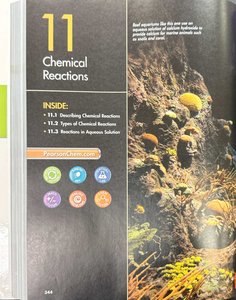
11.1 Describing Chemical Reactions
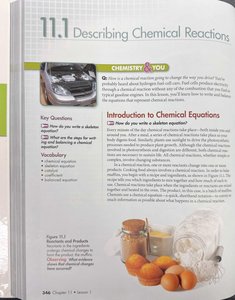
Introduction to Chemical Equations
Chemical equations are symbolic representations of chemical reactions. They show the substances involved, their physical states, and the proportions in which they react and are produced.
Reactants: Substances present before the reaction.
Products: Substances formed as a result of the reaction.
Word Equations: Describe reactions using words (e.g., methane + oxygen → carbon dioxide + water).
Skeletal Equations: Use chemical formulas but may not be balanced (e.g., CH4 + O2 → CO2 + H2O).
Writing and Balancing Chemical Equations
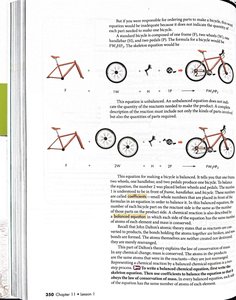
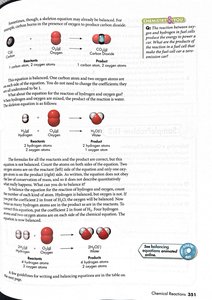
Balanced chemical equations reflect the conservation of mass by ensuring the same number of each type of atom on both sides of the equation. Coefficients are used to balance equations.
Steps to Balance Equations:
Write the correct formulas for all reactants and products.
Count the number of atoms of each element on both sides.
Add coefficients to balance the atoms.
Check your work to ensure mass is conserved.
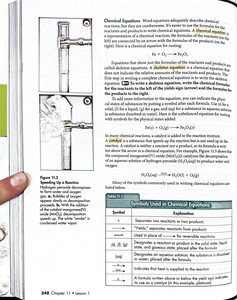
Symbols Used in Equations:
Symbol
Explanation
+
Separates two reactants or two products
→
Yields or produces
(s)
Solid state
(l)
Liquid state
(g)
Gaseous state
(aq)
Dissolved in water (aqueous)
Δ
Heat is supplied to the reaction
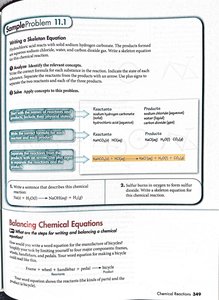
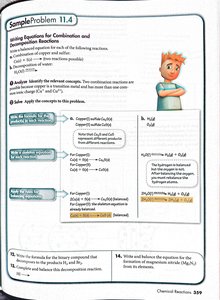
Sample Problem: Writing and Balancing Equations
Example: Sodium reacts with water to produce sodium hydroxide and hydrogen gas.
Skeletal Equation: Na + H2O → NaOH + H2
Balanced Equation: 2Na + 2H2O → 2NaOH + H2
Visualizing Balancing with Models
Balancing equations can be compared to assembling objects from parts, ensuring the same number and type of parts on both sides. Molecular models help visualize the conservation of atoms.
11.2 Types of Chemical Reactions
Classification of Chemical Reactions
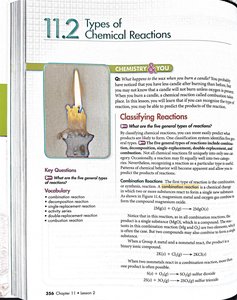
Chemical reactions are classified into five main types based on the patterns of chemical change. Recognizing these types helps predict products and understand reaction mechanisms.
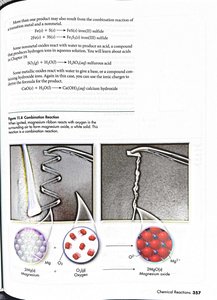
Combination (Synthesis) Reaction: Two or more substances combine to form a single product.
General equation:
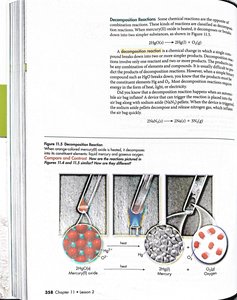
Decomposition Reaction: A single compound breaks down into two or more simpler substances.
General equation:
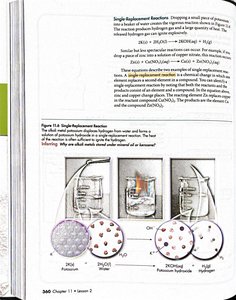
Single-Replacement Reaction: One element replaces another in a compound.
General equation:
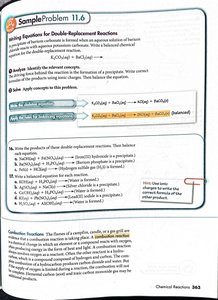
Double-Replacement Reaction: Exchange of ions between two compounds.
General equation:
Combustion Reaction: A substance reacts with oxygen, releasing energy, usually as heat and light.
General equation:
Examples and Visualizations of Reaction Types
Combination:
Decomposition:
Single-Replacement:
Double-Replacement:
Combustion:
Sample Problems: Writing Equations for Reaction Types
Practice problems help reinforce the identification and balancing of different reaction types.
Example (Combination):
Example (Decomposition):
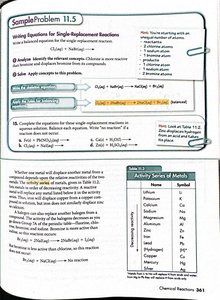
Example (Single-Replacement):
Example (Double-Replacement):
Example (Combustion):
11.3 Reactions in Aqueous Solution
Reactions in Water
Many chemical reactions occur in aqueous solution, where water acts as the solvent. Double-replacement reactions are common in this context, often resulting in the formation of a precipitate, gas, or water.
Precipitation Reaction: Two soluble salts react to form an insoluble product (precipitate).
Gas Formation: Some double-replacement reactions produce a gas that escapes from the solution.
Neutralization: Acid-base reactions in aqueous solution produce water and a salt.
Activity Series of Metals
The activity series is a list of metals ranked by their reactivity. It helps predict whether a single-replacement reaction will occur. A more reactive metal will replace a less reactive metal from a compound.
Metal | Symbol |
|---|---|
Potassium | K |
Sodium | Na |
Calcium | Ca |
Magnesium | Mg |
Aluminum | Al |
Zinc | Zn |
Iron | Fe |
Lead | Pb |
Hydrogen | H |
Copper | Cu |
Silver | Ag |
Gold | Au |
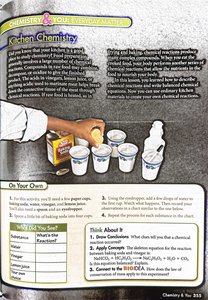
Kitchen Chemistry and Everyday Applications
Chemical Reactions in Daily Life
Chemical reactions are not limited to the laboratory; they occur in everyday activities such as cooking, cleaning, and even in biological processes. Understanding these reactions helps explain phenomena like food spoilage, cleaning tarnished silver, and the functioning of batteries.
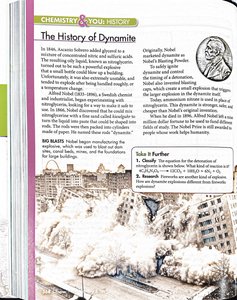
History and Impact of Chemical Reactions
The History of Dynamite
The invention of dynamite by Alfred Nobel revolutionized construction and mining by providing a safer way to handle nitroglycerin. This historical example illustrates the profound impact of chemical reactions on society and technology.
Summary Table: Types of Chemical Reactions
Type | General Equation | Example |
|---|---|---|
Combination | ||
Decomposition | ||
Single-Replacement | ||
Double-Replacement | ||
Combustion |
Key Takeaways
Chemical reactions involve the transformation of reactants into products, following the law of conservation of mass.
Chemical equations must be balanced to accurately represent reactions.
There are five main types of chemical reactions: combination, decomposition, single-replacement, double-replacement, and combustion.
Understanding reaction types and the activity series helps predict the outcomes of reactions.
Chemical reactions are central to both laboratory science and everyday life.
