 Back
BackChapter 11: Gases – Structured Study Notes for Introductory Chemistry
Study Guide - Smart Notes
 Tailored notes based on your materials, expanded with key definitions, examples, and context.
Gases
Introduction to Gases
Gases are one of the fundamental states of matter, characterized by their ability to expand and fill the shape and volume of their container. Understanding the behavior of gases is essential in chemistry, as it explains phenomena ranging from breathing to air pressure and weather patterns.
Pressure and Its Origin
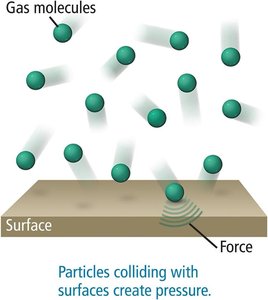
Pressure is the force exerted by gas molecules as they collide with surfaces. It is a key property of gases and is responsible for many everyday phenomena, such as drinking through a straw and inflating tires.
Definition: Pressure is the force per unit area resulting from molecular collisions.
Formula:
Atmospheric Pressure: At sea level, atmospheric pressure averages 101,325 Pa (1 atm).
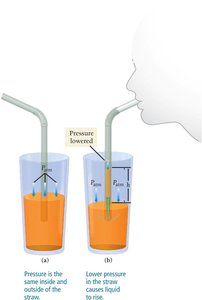
Example: Drinking from a straw creates a pressure difference, allowing atmospheric pressure to push liquid up the straw.
Units of Pressure
Pressure can be measured in several units, each relevant in different contexts.
Atmosphere (atm): Average pressure at sea level.
Pascals (Pa): SI unit;
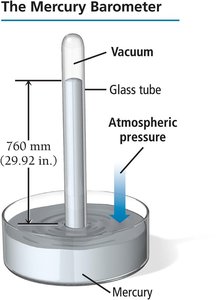
Millimeters of Mercury (mm Hg): Based on the height of mercury in a barometer;
Torr:
Pounds per square inch (psi):
Unit | Average Air Pressure at Sea Level |
|---|---|
Pascals (Pa) | 101,325 Pa |
Atmosphere (atm) | 1 atm |
Millimeter of mercury (mm Hg) | 760 mm Hg |
Torr | 760 torr |
Pounds per square inch (psi) | 14.7 psi |
Inches of mercury (in. Hg) | 29.92 in. Hg |
Kinetic Molecular Theory
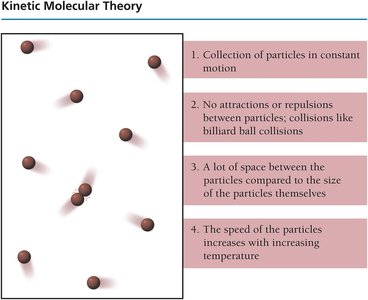
The kinetic molecular theory provides a model for understanding the behavior of gases. It explains their properties based on the motion and interactions of particles.
Gas particles are in constant, straight-line motion.
No attractions or repulsions between particles.
Lots of space between particles compared to their size.
Average kinetic energy is proportional to temperature (in kelvin).
Properties of Gases
Compressibility: Gases can be compressed because there is much empty space between particles.
Shape and Volume: Gases assume the shape and volume of their container.
Low Density: Gases have much lower density than liquids or solids.
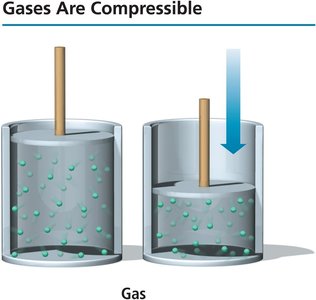
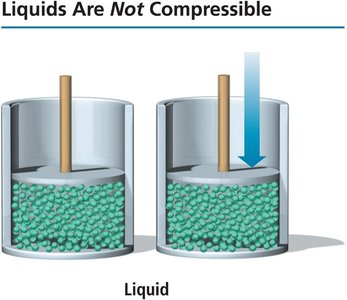

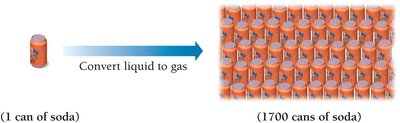
Gas Laws
Gas laws describe the relationships between pressure, volume, temperature, and the amount of gas.
Boyle’s Law: Pressure and Volume
Boyle’s law states that the volume of a gas is inversely proportional to its pressure at constant temperature and amount.
Formula:
Example: Compressing a gas increases its pressure and decreases its volume.
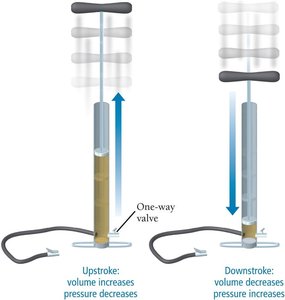
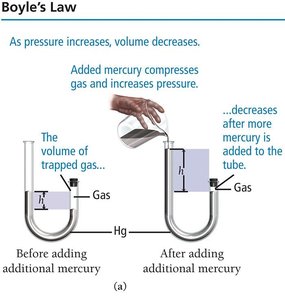
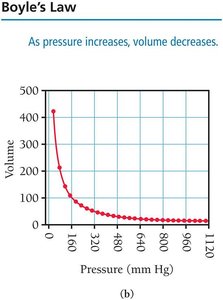
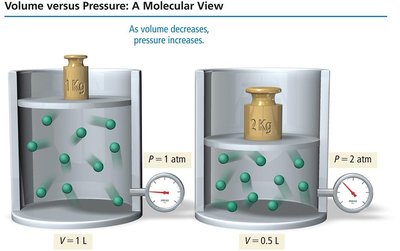
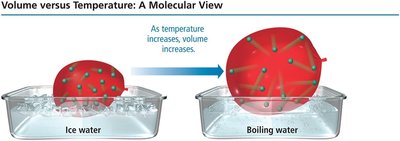
Charles’s Law: Volume and Temperature
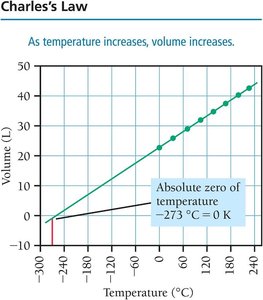
Charles’s law states that the volume of a gas is directly proportional to its temperature (in kelvin) at constant pressure and amount.
Formula:
Absolute Zero: The temperature at which gas volume would be zero is -273°C (0 K).
Example: Heating a balloon causes it to expand.

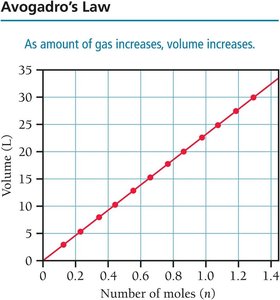
Avogadro’s Law: Volume and Moles
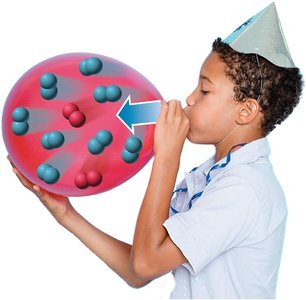
Avogadro’s law states that the volume of a gas is directly proportional to the number of moles at constant temperature and pressure.
Formula:
Example: Adding more gas to a balloon increases its volume.
The Combined Gas Law
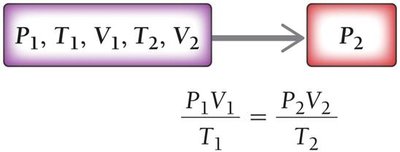
The combined gas law relates pressure, volume, and temperature when the amount of gas is constant.
Formula:
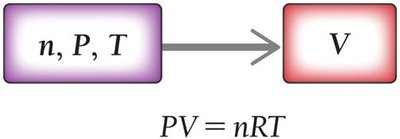
The Ideal Gas Law
The ideal gas law combines Boyle’s, Charles’s, and Avogadro’s laws into a single equation.
Formula:
R (Ideal Gas Constant):
Units: Pressure in atm, volume in L, amount in mol, temperature in K.
Partial Pressures and Gas Mixtures
In a mixture of gases, each gas exerts its own pressure independently, called partial pressure. Dalton’s law states that the total pressure is the sum of the partial pressures.
Formula:
Partial Pressure: Partial pressure of a component = Fractional composition × Total pressure
Gases in Chemical Reactions
Gases often participate in chemical reactions, and their amounts are commonly measured by volume at a given temperature and pressure. The ideal gas law is used to convert between volume and moles.
Formula:
Stoichiometry: Use balanced equations to relate moles of reactants and products.
Molar Volume at Standard Temperature and Pressure (STP)
At STP (0°C, 1 atm), 1 mole of any ideal gas occupies 22.4 L.
Conversion:
Air Pollution and Environmental Chemistry
Air pollution is caused by various gaseous pollutants, including sulfur dioxide, carbon monoxide, ozone, and nitrogen dioxide. Legislation such as the Clean Air Act has significantly reduced pollutant levels in major cities.
Sulfur dioxide (SO2): Lung and eye irritant, precursor to acid rain.
Carbon monoxide (CO): Displaces oxygen in blood, emitted by vehicles.
Ozone (O3): Eye and lung irritant, damages lungs.
Nitrogen dioxide (NO2): Causes haze, eye and lung irritant.
Pollutant | Change, 1980−2021 |
|---|---|
SO2 | −94% |
CO | −87% |
O3 | −29% |
NO2 | −64% |
Summary Table: Simple Gas Laws and Ideal Gas Law
Simple Gas Law | Relationship | Formula |
|---|---|---|
Boyle's Law | V and P (n, T constant) | |
Charles's Law | V and T (n, P constant) | |
Avogadro's Law | V and n (T, P constant) | |
Combined Gas Law | P, V, T (n constant) | |
Ideal Gas Law | P, V, n, T |
Learning Objectives
Describe how kinetic molecular theory predicts the main properties of a gas.
Identify and explain the relationship between pressure, force, and area.
Convert among pressure units.
Restate and apply Boyle’s law, Charles’s law, Avogadro’s law, and the ideal gas law.
Apply Dalton’s law of partial pressures.
Apply stoichiometry to chemical reactions involving gases.
