Back
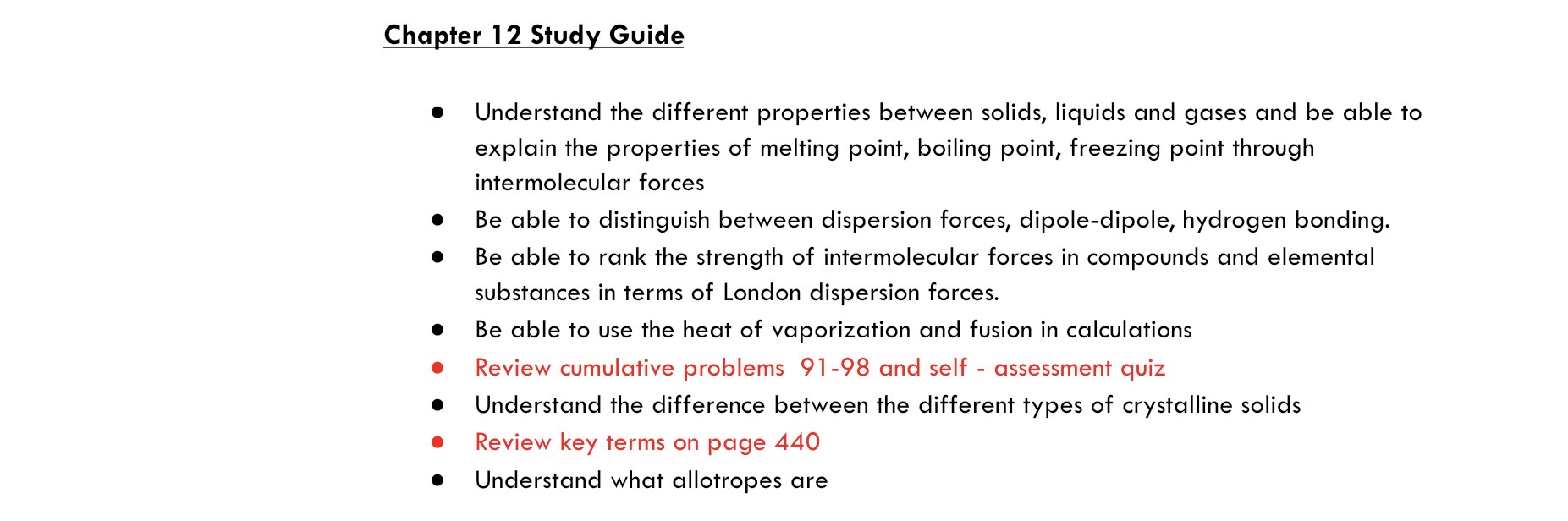
BackChapter 12: Liquids, Solids, and Intermolecular Forces - Study Guide
Study Guide - Smart Notes
 Tailored notes based on your materials, expanded with key definitions, examples, and context.
Liquids, Solids, and Gases
Properties and Phase Changes
The three primary states of matter—solids, liquids, and gases—exhibit distinct physical properties due to differences in the arrangement and movement of their particles. Understanding these properties is essential for explaining phase changes such as melting, boiling, and freezing, which are governed by intermolecular forces.
Solids: Particles are tightly packed in a fixed structure, resulting in definite shape and volume.
Liquids: Particles are close together but can move past one another, giving liquids a definite volume but an indefinite shape.
Gases: Particles are far apart and move freely, resulting in indefinite shape and volume.
Melting Point: The temperature at which a solid becomes a liquid. Boiling Point: The temperature at which a liquid becomes a gas. Freezing Point: The temperature at which a liquid becomes a solid. Intermolecular Forces: The strength of these forces determines the melting, boiling, and freezing points of substances. Example: Water has a high boiling point due to strong hydrogen bonding.
Intermolecular Forces
Types and Strengths
Intermolecular forces are the attractions between molecules, influencing physical properties such as boiling and melting points.
Dispersion Forces (London Dispersion): Weak forces present in all molecules, especially nonpolar ones, caused by temporary dipoles.
Dipole-Dipole Forces: Occur between polar molecules due to permanent dipoles.
Hydrogen Bonding: A strong type of dipole-dipole interaction, occurring when hydrogen is bonded to highly electronegative atoms (N, O, F).
Ranking Strength: Hydrogen bonding > Dipole-dipole > Dispersion forces. Example: In water, hydrogen bonding is much stronger than dispersion forces in methane.
Quantitative Aspects of Phase Changes
Heat of Vaporization and Fusion
The heat required for phase changes can be calculated using specific enthalpy values.
Heat of Vaporization (ΔHvap): Energy required to convert a liquid to a gas.
Heat of Fusion (ΔHfus): Energy required to convert a solid to a liquid.
Formula: where q is the heat absorbed or released, m is the mass, and ΔH is the enthalpy of the phase change. Example: Calculating the energy needed to melt 10 g of ice using ΔHfus.
Crystalline Solids
Types and Properties
Crystalline solids are classified based on the nature of their constituent particles and the forces holding them together.
Ionic Solids: Composed of ions, held together by ionic bonds (e.g., NaCl).
Molecular Solids: Composed of molecules, held together by intermolecular forces (e.g., ice).
Covalent Network Solids: Atoms connected by covalent bonds (e.g., diamond).
Metallic Solids: Composed of metal atoms, held together by metallic bonding (e.g., copper).
Example: Table salt (NaCl) is an ionic solid, while diamond is a covalent network solid.
Allotropes
Definition and Examples
Allotropes are different structural forms of the same element in the same physical state. The properties of allotropes can vary significantly due to differences in atomic arrangement.
Example: Carbon exists as diamond, graphite, and fullerenes, each with distinct properties.
Summary Table: Types of Intermolecular Forces
Comparison of Intermolecular Forces
Type | Strength | Occurs In | Example |
|---|---|---|---|
Dispersion Forces | Weakest | All molecules, especially nonpolar | Helium, Methane |
Dipole-Dipole | Intermediate | Polar molecules | Acetone |
Hydrogen Bonding | Strongest | H bonded to N, O, F | Water |
Summary Table: Types of Crystalline Solids
Classification of Crystalline Solids
Type | Constituent Particles | Bonding | Example |
|---|---|---|---|
Ionic | Ions | Ionic Bonds | NaCl |
Molecular | Molecules | Intermolecular Forces | Ice |
Covalent Network | Atoms | Covalent Bonds | Diamond |
Metallic | Metal Atoms | Metallic Bonds | Copper |
Key Terms
Essential Vocabulary
Intermolecular Forces
Melting Point
Boiling Point
Heat of Vaporization
Heat of Fusion
Crystalline Solid
Allotrope
Additional info:
Key terms and cumulative problems referenced in the guide are standard for exam review and reinforce understanding of the chapter's concepts.