 Back
BackChapter 14: Water – Properties, Distribution, and Environmental Chemistry
Study Guide - Smart Notes
 Tailored notes based on your materials, expanded with key definitions, examples, and context.
Water: Unique Properties and Molecular Structure
Physical Properties of Water
Water is a remarkable substance with several unique physical properties that distinguish it from most other liquids. These properties are essential for supporting life and shaping Earth's environment.
High Density (as a liquid): Water has a relatively high density compared to other common liquids, which is crucial for aquatic life and climate regulation.
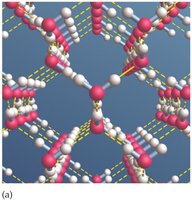
Expansion Upon Freezing: Unlike most substances, water expands when it freezes, making ice less dense than liquid water. This allows ice to float, insulating aquatic environments in cold climates.
High Heat of Vaporization: Water requires a large amount of energy to change from liquid to gas, which moderates Earth's climate and helps organisms regulate temperature through sweating and transpiration.
Molecular Structure and Hydrogen Bonding
The unique properties of water arise from its molecular structure and the presence of hydrogen bonds between water molecules.
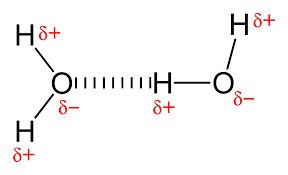
Polarity: The water molecule (H2O) is polar, with a partial negative charge on the oxygen atom and partial positive charges on the hydrogen atoms.
Hydrogen Bonding: The attraction between the hydrogen atom of one water molecule and the oxygen atom of another creates strong intermolecular forces known as hydrogen bonds. These bonds are responsible for water's high boiling point, surface tension, and other unique properties.
Amphoteric Nature of Water
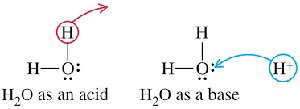
Water is amphoteric, meaning it can act as either an acid or a base depending on the chemical environment. This property is fundamental to many chemical reactions, including those in biological systems.
As an acid: H2O can donate a proton (H+).
As a base: H2O can accept a proton (H+).
Energy, Heat, and Specific Heat Capacity
Units of Energy
Energy in chemistry is commonly measured in joules (J), the SI unit, or in calories (cal), a non-SI unit still widely used in thermochemistry.
1 calorie (cal) = 4.184 joules (J)

Specific Heat Capacity
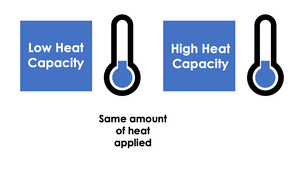
Specific heat capacity (c) is the amount of energy required to raise the temperature of 1 gram of a substance by 1 Kelvin (K) or 1 degree Celsius (°C).
Water has a high specific heat capacity (4.18 J/g·K), which allows it to absorb or release large amounts of heat with little temperature change.
This property stabilizes temperatures in organisms and environments.
Mathematical Relationships
The relationship between heat (q), mass (m), specific heat (c), and temperature change (ΔT) is given by:
Where:
q = heat absorbed or released (J)
m = mass (g)
c = specific heat (J/g·K)
ΔT = temperature change (K or °C)
Example Problem: Calculating Specific Heat
Given: 0.59 kg brass candlestick, initial temperature 98.0°C, final temperature 6.8°C, heat removed = 21,100 J. Find the specific heat capacity of brass.
Solution:
m = 590 g
ΔT = 98.0°C – 6.8°C = 91.2°C
q = 21,100 J
Using :
J/g·K
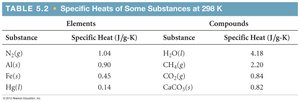
Specific Heats of Common Substances
Substance | Specific Heat (J/g·K) |
|---|---|
H2O (l) | 4.18 |
Al (s) | 0.90 |
Fe (s) | 0.45 |
CO2 (g) | 0.84 |
CaCO3 (s) | 0.82 |
Hg (l) | 0.14 |
Water in Nature and the Water Cycle
Distribution of Water on Earth
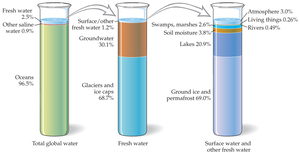
Water covers about 75% of Earth's surface, but most of it is not directly usable by humans.
97% is seawater (saline)
2% is frozen in ice caps and glaciers
Only about 1% is accessible as freshwater in rivers, lakes, and groundwater
The Water Cycle
The water cycle describes the continuous movement of water on, above, and below the surface of the Earth. Key processes include:
Evaporation: Liquid water is converted to vapor by heat.
Condensation: Water vapor cools and forms liquid droplets.
Precipitation: Water droplets combine and fall as rain, snow, etc.
Runoff: Water flows over land to lakes and oceans.
Transpiration: Water is released from plants into the atmosphere.
Infiltration: Water seeps into the ground, replenishing aquifers.
Water Pollution and Environmental Chemistry
Types and Sources of Water Pollution
Coliform Bacteria: Indicate contamination by fecal matter; can cause disease.
Heavy Metals: Such as lead and mercury; toxic and can accumulate in organisms.
Persistent Organic Pollutants (POPs): Synthetic chemicals that resist degradation and can bioaccumulate.
Oxygen-Depleting Pollution: Organic matter that, when decomposed, reduces dissolved oxygen in water.
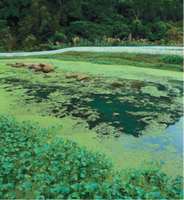
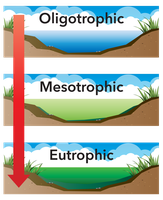
Nutrient Pollution: Excess nitrogen and phosphorus promote algae growth, leading to eutrophication.
Point Source vs. Nonpoint Source Pollution
Point Source: Pollution from a single, identifiable source (e.g., factories, water treatment plants).
Nonpoint Source: Pollution from diffuse sources (e.g., agricultural runoff, stormwater).
Chemical and Biological Contamination
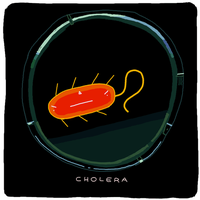
Waterborne Diseases: Pathogenic organisms in water cause diseases such as cholera and diarrhea, leading to millions of deaths annually.
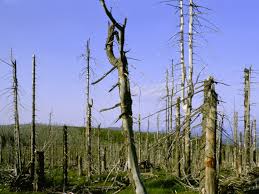
Acid Rain: Sulfur and nitrogen oxides form acids in the atmosphere, lowering the pH of water bodies and damaging ecosystems.
Eutrophication: Excess nutrients cause overgrowth of algae, which blocks sunlight and depletes oxygen as algae decompose, harming aquatic life.
Water Use, Stress, and Conservation
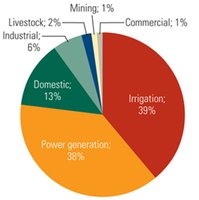
Water Withdrawal and Consumption
Withdrawal: Water taken from a source, some of which may be returned (e.g., power plant cooling).
Consumption: Water permanently removed from its source (e.g., irrigation).
Water Stress and Environmental Impact
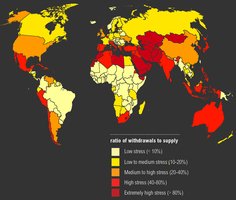
Water Stress: Occurs when demand exceeds supply, leading to resource depletion.
Regions with water stress are often arid, densely populated, or have water-intensive agriculture.
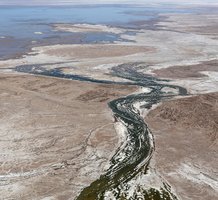
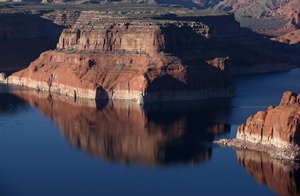
Impacts include reduced river flow, lower lake levels, and land subsidence.

Desalination and Water Conservation
Desalination: Removal of salt from seawater by distillation or reverse osmosis; produces brine waste and is energy-intensive.
Conservation: Focuses on efficient irrigation (e.g., drip systems), reducing leaks, and using drought-tolerant landscaping (xeriscaping).

Water Treatment and Wastewater Management
Making Water Fit to Drink
The U.S. Safe Drinking Water Act authorizes the EPA to set and enforce standards for drinking water quality.
Water treatment plants use coagulation, filtration, and disinfection (chlorination or ozonation) to purify water.
Municipal Water Treatment Steps
Coagulation: Addition of slaked lime and alum to form precipitates that remove particles and bacteria.
Filtration: Water passes through sand, gravel, and charcoal to remove impurities and odors.
Disinfection: Chlorine or ozone is added to kill remaining microorganisms.
Fluoridation: Fluoride is added to prevent tooth decay, though excessive fluoride can discolor teeth.
Wastewater Treatment
Primary Treatment: Settling ponds allow solids to precipitate as sludge.
Secondary Treatment: Effluent is filtered and aerated; bacteria break down organic matter (e.g., activated sludge method).
Tertiary Treatment: Advanced processes such as charcoal filtration, reverse osmosis, and distillation remove remaining contaminants.
Alternative Sewage Treatment
Sludge can be used as fertilizer.
Natural wetlands and composting toilets offer sustainable alternatives for sewage treatment.
