 Back
BackChapter 16: Oxidation and Reduction – Introductory Chemistry Study Guide
Study Guide - Smart Notes
 Tailored notes based on your materials, expanded with key definitions, examples, and context.
Oxidation and Reduction
Introduction to Redox Reactions
Oxidation and reduction (redox) reactions are fundamental to chemistry, involving the transfer of electrons between substances. These reactions are central to processes such as energy production, corrosion, and biological functions.
Oxidation: Loss of electrons or gain of oxygen.
Reduction: Gain of electrons or loss of oxygen.
Oxidizing agent: Substance that is reduced (gains electrons).
Reducing agent: Substance that is oxidized (loses electrons).
Mnemonic: OIL RIG – Oxidation Is Loss (of electrons); Reduction Is Gain (of electrons).
Oxidation States: Electron Bookkeeping
Oxidation states are assigned to atoms in compounds to track electron transfer during reactions. This helps identify which atoms are oxidized and which are reduced.
All shared electrons are assigned to the most electronegative element.
The oxidation state is calculated based on the number of electrons assigned.
Oxidation state is not the same as ionic charge.
Rules for Assigning Oxidation States
Free element: Oxidation state = 0
Monatomic ion: Oxidation state = ion charge
Sum of oxidation states in a neutral molecule = 0
Sum of oxidation states in a polyatomic ion = ion charge
Group I metals: +1; Group II metals: +2
Nonmetals: Follow hierarchical rules (priority table)
Identifying Oxidation and Reduction
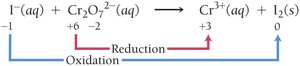
Oxidation and reduction can be identified by changes in oxidation states during a reaction.
Increase in oxidation state: Oxidation
Decrease in oxidation state: Reduction
Example: In the reaction , Iodine is oxidized and chromium is reduced.
Balancing Redox Reactions
Half-Reaction Method
Redox reactions are often balanced using the half-reaction method, which separates the overall reaction into oxidation and reduction half-reactions.
Assign oxidation states to all atoms.
Divide the reaction into two half-reactions.
Balance each half-reaction for mass and charge (add electrons as needed).
Equalize the number of electrons lost and gained by multiplying half-reactions.
Add the half-reactions together and verify balance.
Balancing in Acidic and Basic Solutions
Acidic: Balance O by adding , H by adding .
Basic: After balancing as in acid, neutralize by adding to both sides.
Applications of Redox Reactions
Fuel Cell Technology
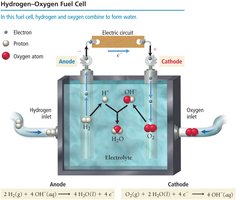
Fuel cells use redox reactions to generate electricity. The hydrogen–oxygen fuel cell is a prominent example, where hydrogen is oxidized and oxygen is reduced, producing water and electrical current.
Hydrogen loses electrons (oxidized).
Oxygen gains electrons (reduced).
Electrons flow through an external circuit, powering devices.
Photosynthesis and Respiration
Photosynthesis and respiration are biological processes involving redox reactions. Photosynthesis reduces carbon, storing energy, while respiration oxidizes carbon, releasing energy.
Photosynthesis:
Respiration:

The Activity Series: Predicting Spontaneous Redox Reactions
Activity Series of Metals
The activity series ranks metals by their tendency to lose electrons (be oxidized). Metals higher in the series are more reactive and more easily oxidized.
Top: Most easily oxidized, most reactive (e.g., lithium, potassium).
Bottom: Least easily oxidized, least reactive (e.g., gold, silver).
Spontaneous reactions occur when a metal higher in the series reacts with ions of a metal lower in the series.
Examples of Spontaneous Redox Reactions
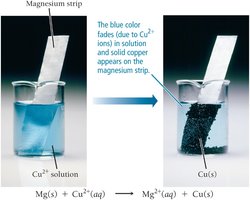
When magnesium is placed in copper(II) ion solution, magnesium is oxidized and copper is reduced, resulting in a spontaneous reaction.
Reaction:
The blue color fades as copper ions are reduced to solid copper.
Acids Dissolving Metals
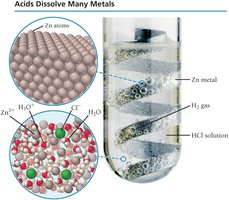
Acids dissolve metals by reducing hydrogen ions to hydrogen gas and oxidizing the metal to its ion. Metals above hydrogen in the activity series dissolve in acids.
Example: Zinc dissolves in hydrochloric acid, producing hydrogen gas.
Batteries and Electrochemical Cells
Voltaic (Galvanic) Cells
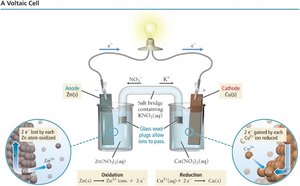
Voltaic cells generate electrical current from spontaneous redox reactions. They consist of two half-cells connected by a wire and a salt bridge.
Anode: Site of oxidation (negative terminal).
Cathode: Site of reduction (positive terminal).
Electrons flow from anode to cathode.
Salt bridge allows ion flow to maintain charge balance.
Electrical Voltage and Current
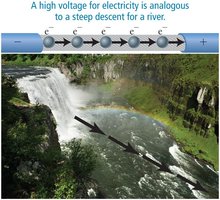
Voltage is the driving force for electron flow, analogous to the steepness of a river. Electrical current is the flow of electrons through a wire.
High voltage: Strong driving force, more current.
Low voltage: Weak driving force, less current.
Understanding a Dead Battery
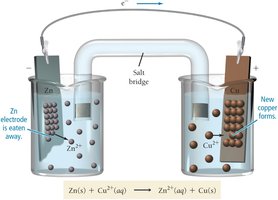
As a voltaic cell operates, reactants are depleted and products accumulate, eventually causing the battery to stop functioning. Rechargeable batteries can be restored by reversing the current.
Dry-Cell Batteries
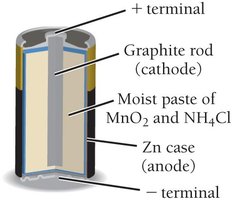
Dry-cell batteries, such as those used in flashlights, use a zinc case as the anode and a graphite rod as the cathode, with a moist paste of manganese dioxide and ammonium chloride.
Voltage produced: About 1.5 volts per cell.
Multiple cells can be connected in series for higher voltage.
Lead-Acid Storage Batteries
Automobile batteries are lead-acid storage batteries, consisting of six cells producing a total of 12 volts. Both electrodes are immersed in sulfuric acid, and the battery can be recharged by reversing the current.
Fuel Cells and Electrolysis
Hydrogen–Oxygen Fuel Cell
Hydrogen–oxygen fuel cells generate electricity by combining hydrogen and oxygen to form water. The only emission is water, making them environmentally friendly.

Electrolysis
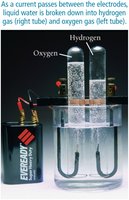
Electrolysis uses electrical current to drive nonspontaneous redox reactions, such as splitting water into hydrogen and oxygen. Electrolytic cells are used for this purpose.
Electrolysis of water:
Hydrogen produced can be used in fuel cells.
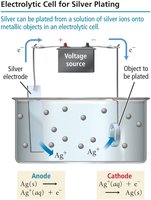
Electrolytic Cell for Silver Plating
Electrolysis can be used to plate metals, such as silver, onto other metals. Silver is oxidized at the anode and reduced at the cathode, coating the object with solid silver.
Corrosion: Undesirable Redox Reactions
Rusting of Iron
Corrosion is the oxidation of metals, most commonly seen as rusting of iron. Rusting is a redox reaction where iron is oxidized and oxygen is reduced.
Rust (iron oxide) flakes off, exposing more iron to further oxidation.
Other metals, like aluminum, form protective oxide coatings.
Paint and coatings can prevent rust by keeping iron dry.

Preventing Corrosion
Corrosion can be prevented by using a sacrificial anode, which is a more active metal that oxidizes in place of iron. Galvanized nails are coated with zinc, which protects the underlying iron.
Everyday Chemistry Applications
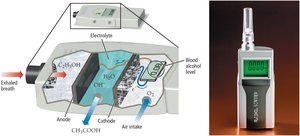
Fuel-Cell Breathalyzer
Fuel-cell breathalyzers measure blood alcohol levels by oxidizing ethyl alcohol at the anode and reducing oxygen at the cathode. The electrical current produced is proportional to the alcohol concentration.
Review and Learning Objectives
Define and identify oxidation and reduction.
Identify oxidizing and reducing agents.
Assign oxidation states and use them to identify redox processes.
Balance redox reactions using the half-reaction method.
Predict spontaneous redox reactions using the activity series.
Describe the function of voltaic and electrolytic cells.
Explain corrosion and methods to prevent it.
