 Back
BackChapter 16: Oxidation and Reduction – Study Notes for Introductory Chemistry
Study Guide - Smart Notes
 Tailored notes based on your materials, expanded with key definitions, examples, and context.
Oxidation and Reduction: Fundamental Concepts
Introduction to Redox Chemistry
Oxidation and reduction (redox) reactions are central to many chemical and biological processes. These reactions involve the transfer of electrons between substances, resulting in changes in oxidation states. Understanding redox reactions is essential for topics such as energy production, corrosion, and environmental chemistry.
Redox Reactions and Fuel Cell Technology
Fuel Cell Technology
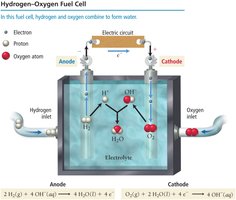
Fuel cells generate electricity through redox reactions, most commonly using hydrogen and oxygen. In a hydrogen–oxygen fuel cell, hydrogen is oxidized (loses electrons) and oxygen is reduced (gains electrons), producing water as the only emission. This technology is environmentally friendly and is being developed for use in electric vehicles.

Definitions and Key Terms
Oxidation and Reduction
Oxidation: Loss of electrons by a substance; increase in oxidation state.
Reduction: Gain of electrons by a substance; decrease in oxidation state.
Oxidizing Agent: The substance that is reduced (gains electrons).
Reducing Agent: The substance that is oxidized (loses electrons).
Mnemonic devices to remember:
OIL RIG: Oxidation Is Loss (of electrons); Reduction Is Gain (of electrons).
LEO the lion says GER: Lose Electrons Oxidation; Gain Electrons Reduction.
Oxidation States: Electron Bookkeeping
Assigning Oxidation States
Oxidation states (or numbers) are assigned to atoms in compounds to track electron transfer in redox reactions. The rules for assigning oxidation states are hierarchical:
The oxidation state of an atom in a free element is 0.
The oxidation state of a monoatomic ion equals its charge.
The sum of oxidation states in a neutral molecule is 0; in a polyatomic ion, it equals the ion's charge.
Group I metals: +1; Group II metals: +2 in compounds.
Nonmetals are assigned oxidation states based on a priority table (e.g., F: –1, H: +1, O: –2, etc.).
Do not confuse oxidation state with ionic charge; covalent compounds also have assigned oxidation states.
Using Oxidation States to Identify Redox Processes
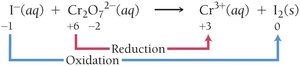
By comparing oxidation states before and after a reaction, you can identify which element is oxidized and which is reduced.
Balancing Redox Reactions
The Half-Reaction Method
Redox reactions, especially in aqueous solutions, are balanced using the half-reaction method:
Assign oxidation states to all atoms.
Separate the reaction into two half-reactions (oxidation and reduction).
Balance each half-reaction for mass (all elements except H and O first).
Balance O by adding H2O; balance H by adding H+ (for acidic solutions).
Balance charge by adding electrons.
Multiply half-reactions to equalize electrons transferred.
Add the half-reactions and verify mass and charge balance.
Redox Reactions in Everyday Life
Photosynthesis and Respiration
Photosynthesis and respiration are biological processes driven by redox reactions. In photosynthesis, plants use sunlight to reduce carbon dioxide to glucose. In respiration, glucose is oxidized to release energy for living organisms.

Corrosion and Rusting
Corrosion is the oxidation of metals, most commonly seen as the rusting of iron. Rust forms when iron reacts with oxygen and water, producing iron oxides that flake off and expose more metal to oxidation. Other metals, like aluminum, form protective oxide layers.

The Activity Series of Metals
Predicting Spontaneous Redox Reactions
The activity series ranks metals by their tendency to lose electrons (be oxidized). Metals higher in the series are more easily oxidized and more reactive. A metal will spontaneously reduce the ions of any metal below it in the series.
Metal | Reactivity (Tendency to Lose Electrons) |
|---|---|
Potassium (K) | Highest |
Magnesium (Mg) | High |
Zinc (Zn) | Moderate |
Copper (Cu) | Low |
Gold (Au) | Lowest |
Additional info: Table inferred from standard activity series. |
Examples of Spontaneous Redox Reactions
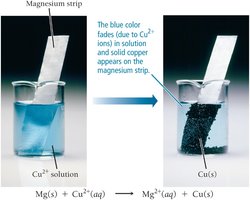
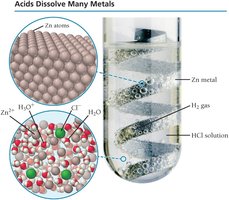
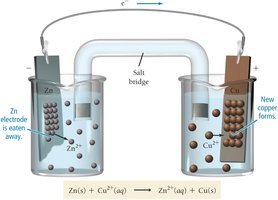
When magnesium metal is placed in a copper(II) ion solution, magnesium is oxidized and copper is reduced, resulting in the deposition of copper metal.
Acids dissolve metals above hydrogen in the activity series, producing hydrogen gas.
Batteries and Electrochemical Cells
Voltaic (Galvanic) Cells
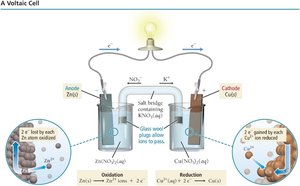
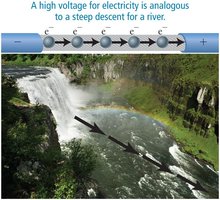
Voltaic cells generate electrical current from spontaneous redox reactions. They consist of two half-cells connected by a wire and a salt bridge. The anode is where oxidation occurs (negative terminal), and the cathode is where reduction occurs (positive terminal). Electrons flow from anode to cathode.
Dry-Cell Batteries
Dry cells are common in household batteries. They use a zinc case as the anode and a graphite rod as the cathode, with a moist paste of MnO2 and NH4Cl as the electrolyte. The cell produces about 1.5 volts.
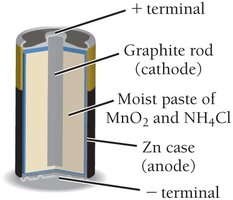
Lead-Acid Storage Batteries
Lead-acid batteries are used in automobiles. They consist of multiple cells connected in series, each producing about 2 volts. Both electrodes are immersed in sulfuric acid, and the battery can be recharged by reversing the current.
Electrolysis and Electrolytic Cells
Electrolysis
Electrolysis uses electrical current to drive nonspontaneous redox reactions. Electrolytic cells are used for processes such as water splitting, metal extraction, and electroplating.
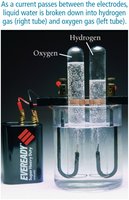
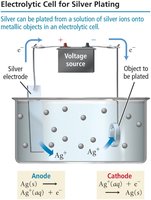
Electrolytic Cell for Silver Plating
Silver plating involves the oxidation of silver at the anode and reduction of silver ions at the cathode, coating another metal with silver.
Applications and Everyday Chemistry
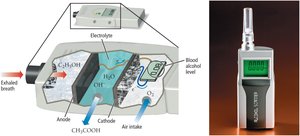
Fuel-Cell Breathalyzer
Fuel-cell breathalyzers use redox reactions to measure blood alcohol content. Ethanol in breath is oxidized at the anode, and the resulting current is proportional to the alcohol concentration.
Summary Table: Key Concepts in Redox Chemistry
Concept | Definition |
|---|---|
Oxidation | Loss of electrons; increase in oxidation state |
Reduction | Gain of electrons; decrease in oxidation state |
Oxidizing Agent | Substance that is reduced |
Reducing Agent | Substance that is oxidized |
Voltaic Cell | Produces electricity from spontaneous redox reaction |
Electrolytic Cell | Uses electricity to drive nonspontaneous redox reaction |
Activity Series | Ranks metals by ease of oxidation |
Learning Objectives
Define and identify oxidation and reduction.
Identify oxidizing agents and reducing agents.
Assign oxidation states and use them to identify redox processes.
Balance redox reactions using the half-reaction method.
Predict spontaneous redox reactions using the activity series.
Describe the function of voltaic and electrolytic cells.
Explain the process of corrosion and methods to prevent it.
