 Back
Chapter 17: Radioactivity and Nuclear Chemistry - Study Notes
Study Guide - Smart Notes
 Tailored notes based on your materials, expanded with key definitions, examples, and context.
Radioactivity and Nuclear Chemistry
Introduction to Radioactivity
Radioactivity is a fundamental concept in nuclear chemistry, involving the emission of energetic particles from the nuclei of unstable atoms. This process is harnessed in nuclear medicine to obtain clear images of internal organs and diagnose diseases such as appendicitis.
Radioactivity: The spontaneous emission of particles or energy from unstable atomic nuclei.
Nuclear medicine: Uses radioactive substances to image and diagnose internal conditions.
Example: Radioactively tagged antibodies accumulate in infected tissues, allowing detection via emitted radiation.
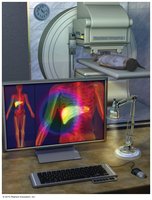
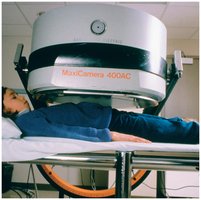
The Discovery of Radioactivity
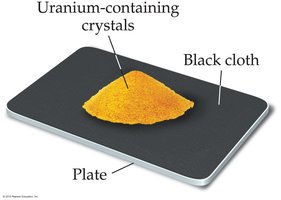
The phenomenon of radioactivity was first discovered by Antoine-Henri Becquerel in 1896. He observed that uranium-containing crystals could expose photographic plates even in the absence of light, indicating the emission of invisible rays.
Becquerel's experiment: Used potassium uranyl sulfate crystals and photographic plates to detect emissions.
Uranic rays: The term Becquerel used for the emissions from uranium.
Marie Curie: Expanded on Becquerel's work, discovering polonium and radium, both highly radioactive.
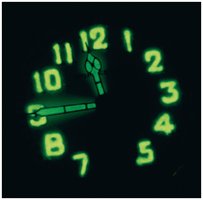

Types of Radioactivity
Alpha, Beta, Gamma, and Positron Decay
Radioactive emissions are classified into several types, each with distinct properties and effects. The stability of atomic nuclei depends on their size and neutron-to-proton ratio.
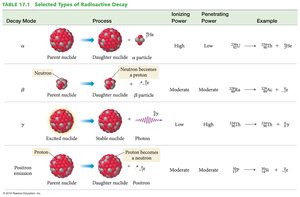
Alpha (α) rays: Emission of 2 protons and 2 neutrons.
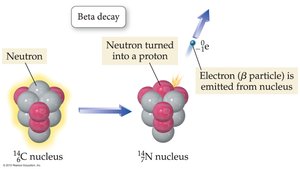
Beta (β) rays: Emission of electrons when a neutron turns into a proton.
Gamma (γ) rays: High-energy photons, electromagnetic radiation.
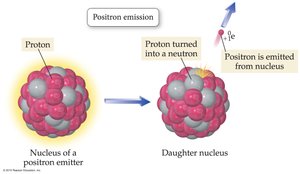
Positron emission: Emission of a positron when a proton turns into a neutron.
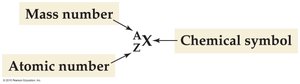
Isotope Notation
Isotopes are represented using a notation that includes the mass number, atomic number, and chemical symbol.
Alpha Radiation
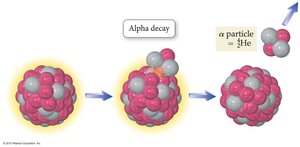
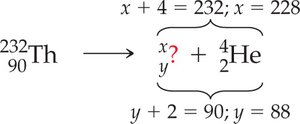
Alpha radiation occurs when an unstable nucleus emits an alpha particle, which consists of two protons and two neutrons. This process changes the identity of the element.
Alpha particle:
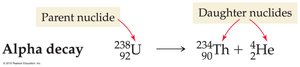
Example: Uranium-238 undergoes alpha decay to form thorium-234.
Balancing Nuclear Equations
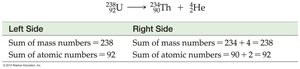
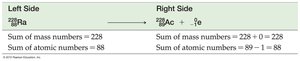
Nuclear equations must be balanced so that the sum of atomic numbers and mass numbers are equal on both sides.
Parent nuclide: The original atom before decay.
Daughter nuclide: The product atom after decay.
Assessing Radiation Damage
Radiation can damage biological molecules by ionizing them. The ionizing power and penetrating power of radiation determine its potential for harm.
Ionizing power: Ability to create ions and damage molecules.
Penetrating power: Ability to pass through matter.
Alpha particles: High ionizing power, low penetrating power.
Beta particles: Intermediate ionizing and penetrating power.
Gamma rays: Low ionizing power, high penetrating power.
Beta Radiation
Beta radiation occurs when a neutron in the nucleus turns into a proton, emitting an electron (beta particle).
Beta particle:
Example: Radium-228 undergoes beta decay to form actinium-228.

Gamma Radiation
Gamma radiation is electromagnetic radiation emitted from the nucleus, often accompanying other types of decay. It has no mass or charge.
Gamma ray:

Positron Emission
Positron emission occurs when a proton turns into a neutron, emitting a positron. The atomic number decreases by one.
Positron:
Example: Phosphorus-30 undergoes positron emission to form silicon-30.

Summary Table: Types of Radioactive Decay
The main types of radioactive decay differ in their ionizing and penetrating power.
Detecting Radioactivity
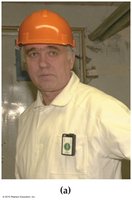
Film-Badge Dosimeters
Film-badge dosimeters are used to monitor exposure to radiation by measuring the amount of radiation that exposes photographic film.
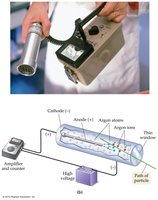
Geiger-Müller Counter
The Geiger-Müller counter detects radiation by ionizing argon gas in a chamber, producing an electrical signal.
Natural Radioactivity and Half-Life
Background Radiation
Radioactive elements in the environment decay naturally, contributing to background radiation. Elements with atomic numbers greater than 83 are inherently unstable.
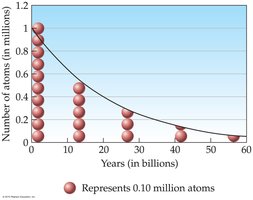
The Concept of Half-Life
The half-life is the time required for half of the parent nuclides in a sample to decay. This concept is crucial for understanding radioactive decay rates.
Half-life formula: where is the remaining amount, is the initial amount, and is the number of half-lives.


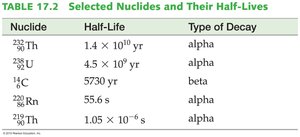
Selected Nuclides and Their Half-Lives
Each radioactive nuclide has a unique half-life, unaffected by physical or chemical conditions.
Radioactive Decay Series
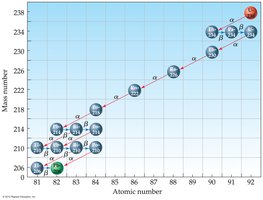
Uranium-238 undergoes a series of decays, eventually forming stable lead-206. Each step involves different types of radioactive decay.
Environmental Radon
Radon gas, a product of uranium decay, poses health risks when trapped indoors. Radon-222 has a half-life of 3.8 days.

Applications of Radioactivity
Radiocarbon Dating
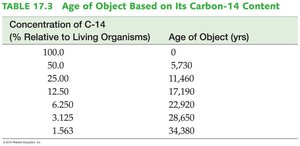
Radiocarbon dating uses the decay of carbon-14 to estimate the age of fossils and artifacts. Living organisms maintain a constant level of carbon-14, which decays after death.
Carbon-14 half-life: 5730 years
Age calculation: Based on the remaining concentration of carbon-14.
Nuclear Fission and Fusion
Nuclear Fission
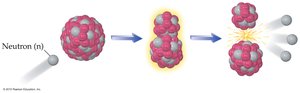
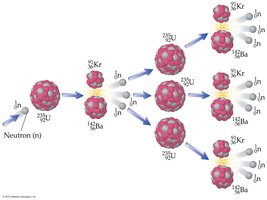
Nuclear fission is the splitting of a heavy nucleus into smaller fragments, releasing energy. Fission of U-235 produces neutrons that can initiate further fission, leading to a chain reaction.
Fission equation:
Nuclear Power Generation
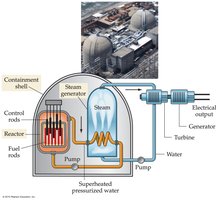
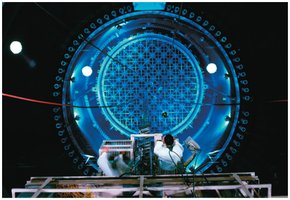
Nuclear power plants use fission to generate heat, which is used to produce steam and generate electricity. Control rods regulate the chain reaction by absorbing neutrons.
Nuclear Accidents
Accidents such as Chernobyl and Fukushima highlight the risks of nuclear power. Overheating and loss of cooling can lead to the release of radioactive material.
Nuclear Waste Disposal
Nuclear waste is highly radioactive and requires secure, long-term storage. The search for permanent disposal sites continues.
Nuclear Fusion
Nuclear fusion combines light nuclei to form heavier ones, releasing energy. Fusion powers stars and hydrogen bombs, but requires extremely high temperatures.
Fusion equation:
Effects of Radiation on Life
Acute Radiation Damage
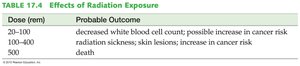
High doses of radiation can kill cells rapidly, especially those that divide quickly. Symptoms include weakened immune systems and impaired nutrient absorption.
Increased Cancer Risk
Long-term exposure to lower doses of radiation can damage DNA, increasing cancer risk. Cancerous cells grow abnormally and may form tumors.
Genetic Defects
Radiation can cause genetic defects in offspring if reproductive cells are damaged. Such effects have been observed in laboratory animals.
Measuring Radiation Exposure
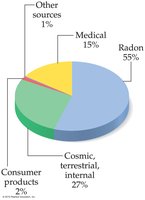
Radiation exposure is measured in units such as the curie, roentgen, and rem. The rem accounts for the ionizing power of different types of radiation.
Radioactivity in Medicine
Isotope Scans and Radiotherapy
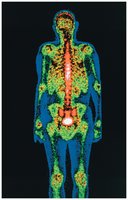
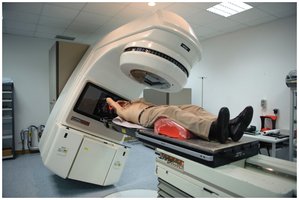
Radioactive isotopes are used in medical imaging and cancer treatment. Technetium-99, phosphorus-32, and iodine-131 are common isotopes for diagnostic purposes. Radiotherapy uses gamma rays to target tumors.
Chapter Review and Learning Objectives
Write nuclear equations for alpha, beta, and positron decay.
Use the concept of half-life to solve problems.
Apply carbon-14 content to determine the age of fossils or artifacts.
