 Back
BackChapter 17: Radioactivity and Nuclear Chemistry – Study Notes
Study Guide - Smart Notes
 Tailored notes based on your materials, expanded with key definitions, examples, and context.
Radioactivity and Nuclear Chemistry
Introduction to Radioactivity
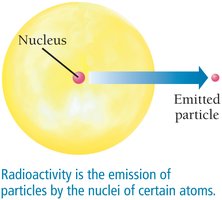
Radioactivity is a phenomenon in which unstable atomic nuclei emit energetic particles or electromagnetic radiation. This process is fundamental to nuclear chemistry and has significant applications in medicine, energy, and dating ancient artifacts.
Radioactivity is the emission of tiny, energetic particles by the nuclei of certain unstable atoms.
Atoms that emit these particles are called radioactive.
Radioactivity is used in nuclear medicine for imaging and treatment.
Discovery of Radioactivity
Becquerel and Curie
The discovery of radioactivity began with Antoine-Henri Becquerel and was advanced by Marie Curie.
Becquerel discovered that uranium salts emitted rays that could expose photographic plates, even in the absence of light.
Marie Curie discovered two new radioactive elements: polonium and radium.
Curie coined the term radioactivity and received two Nobel Prizes for her work.
Types of Radioactive Emissions
Alpha, Beta, Gamma, and Positron Emissions
Radioactive decay can occur in several forms, each with distinct properties and effects.
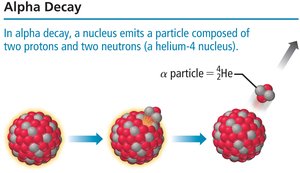
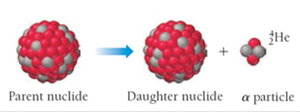
Alpha (α) decay: Emission of an alpha particle (2 protons and 2 neutrons, equivalent to a helium-4 nucleus).
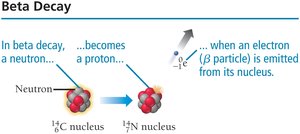
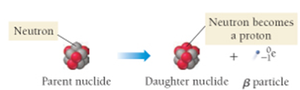
Beta (β) decay: Emission of an electron when a neutron converts to a proton.
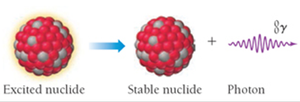
Gamma (γ) emission: Emission of high-energy photons (electromagnetic radiation).
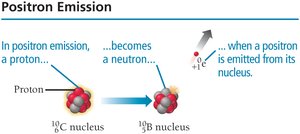
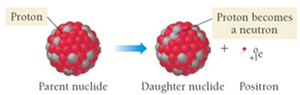
Positron emission: Emission of a positron when a proton converts to a neutron.
Nuclear Equations
Writing and Balancing Nuclear Equations
Nuclear equations represent the changes in the nucleus during radioactive decay. They must be balanced for both atomic number and mass number.
The parent nuclide is the original atom; the daughter nuclide is the product after decay.
In alpha decay, the atomic number decreases by 2 and the mass number by 4.
In beta decay, the atomic number increases by 1; in positron emission, it decreases by 1.
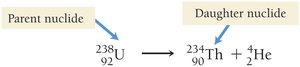
Example: Alpha Decay of Uranium-238
Example: Beta Decay
Example: Gamma Emission
Example: Positron Emission
Properties and Effects of Radiation
Ionizing and Penetrating Power
Different types of radiation have varying abilities to ionize molecules and penetrate matter.
Alpha particles: High ionizing power, low penetrating power (stopped by paper or skin).
Beta particles: Moderate ionizing and penetrating power (stopped by metal or thick wood).
Gamma rays: Low ionizing power, high penetrating power (requires lead or concrete to stop).
Positrons: Similar to beta particles in ionizing and penetrating power.
Detecting Radioactivity
Detection Methods
Radioactivity can be detected using specialized instruments.
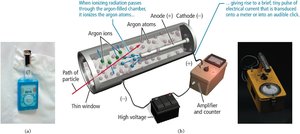
Film-badge dosimeters: Measure cumulative exposure over time.
Geiger-Müller counter: Detects ionizing particles by measuring electrical pulses generated in a gas-filled tube.
Scintillation counter: Measures light flashes produced when radiation interacts with certain materials.
Natural Radioactivity and Half-Life
Background Radiation and Decay Rates
Radioactive elements are present in the environment and decay at characteristic rates, described by their half-lives.
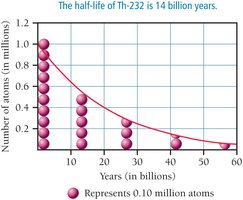
Half-life: The time required for half of the parent nuclides in a sample to decay.
Each nuclide has a unique half-life, unaffected by physical or chemical conditions.
Example: Thorium-232 has a half-life of 14 billion years.
Radioactive Decay Series
Decay Chains
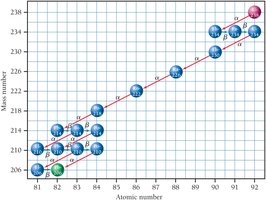
Some radioactive elements decay through a series of steps, producing a sequence of daughter nuclides until a stable isotope is formed.
Uranium-238 decays through multiple steps to form lead-206.
Intermediate products include thorium, protactinium, and radon.
Applications of Radioactivity
Environmental Radon
Radon is a radioactive gas produced in the uranium decay series. It can accumulate in buildings and increase lung cancer risk.
Radon-222 has a half-life of 3.8 days.
High radon levels are found in areas with uranium-rich soil.

Radiocarbon Dating
Radiocarbon dating uses the decay of carbon-14 to estimate the age of formerly living materials.
Carbon-14 is formed in the atmosphere and incorporated into living organisms.
After death, the amount of carbon-14 decreases with a half-life of 5715 years.
The ratio of carbon-14 to carbon-12 in a sample indicates its age.
Nuclear Fission and Fusion
Nuclear Fission
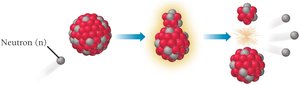
Nuclear fission is the splitting of a heavy nucleus into smaller fragments, releasing energy and neutrons.
Discovered by Meitner, Strassmann, and Hahn in 1939.
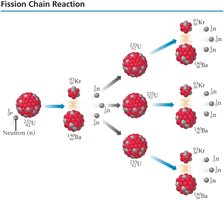
Uranium-235 undergoes fission when bombarded with neutrons, producing barium, krypton, and more neutrons.
Fission can lead to a chain reaction, which is the basis for nuclear reactors and atomic bombs.

Nuclear Power Generation
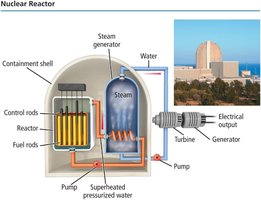
Nuclear power plants use controlled fission reactions to generate electricity.
Fuel rods containing enriched uranium-235 are used in the reactor core.
Control rods absorb neutrons to regulate the chain reaction.
Heat from fission is used to produce steam, which drives turbines to generate electricity.
Nuclear Fusion
Nuclear fusion is the combination of two light nuclei to form a heavier nucleus, releasing vast amounts of energy.
Fusion powers stars, including the sun.
Requires extremely high temperatures to overcome repulsion between nuclei.
Fusion is the basis for hydrogen bombs and is being researched for power generation.
Biological Effects and Medical Uses of Radiation
Effects of Radiation on Life
Radiation can damage living cells, leading to acute effects, increased cancer risk, and potential genetic defects.
High doses cause acute radiation sickness and can be fatal.
Lower doses over time increase cancer risk by damaging DNA.
Genetic defects may occur if reproductive cells are affected.
Measuring Radiation Exposure
Curie (Ci): Measures decay events per second.
Roentgen (R): Measures ionization in air.
Rem: Accounts for ionizing power and biological effect.
Radioactivity in Medicine
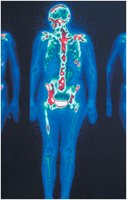
Radioactive isotopes are used for diagnosis and treatment in medicine.
Technetium-99 is used for bone scans.
Phosphorus-32 and iodine-131 are used for imaging and diagnosing tumors and thyroid disorders.
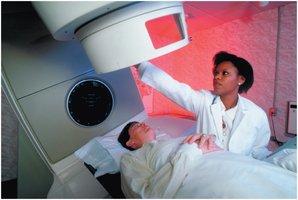
Gamma rays from cobalt-60 are used to treat cancer by targeting tumors.
Summary Table: Types of Radioactive Decay
Type | Symbol | Change in Nucleus | Ionizing Power | Penetrating Power |
|---|---|---|---|---|
Alpha (α) | −2 protons, −2 neutrons | High | Low | |
Beta (β) | Neutron → Proton | Intermediate | Intermediate | |
Gamma (γ) | No change (energy only) | Low | High | |
Positron | Proton → Neutron | Intermediate | Intermediate |
Key Learning Outcomes
Explain the discovery and nature of radioactivity.
Write and balance nuclear equations for various types of decay.
Describe methods for detecting radioactivity.
Use half-life to calculate remaining radioactive material.
Understand applications such as radiocarbon dating and nuclear power.
Compare nuclear fission and fusion.
Describe the effects of radiation on living organisms and its medical uses.
