 Back
BackChapter 2: The Periodic Table – Structure, Atomic Theory, and Electron Arrangement
Study Guide - Smart Notes
 Tailored notes based on your materials, expanded with key definitions, examples, and context.
Composition of the Atom
Atomic Structure
Atoms are the fundamental units of elements, retaining all chemical properties of the element. Each atom consists of three primary subatomic particles:
Protons: Positively charged particles found in the nucleus.
Neutrons: Neutral particles also located in the nucleus.
Electrons: Negatively charged particles that orbit the nucleus.
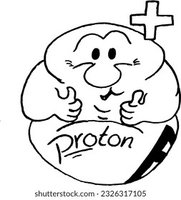
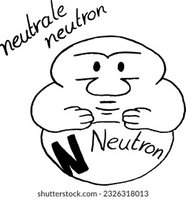

Nucleus and Atomic Scale
The nucleus is a small, dense, positively charged region at the center of the atom, containing protons and neutrons. Electrons occupy regions outside the nucleus. 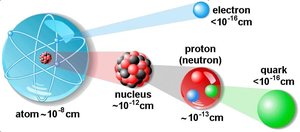
Symbolic Representation of an Element
Atomic Number and Mass Number
Elements are represented symbolically as:
X: Elemental symbol
Z: Atomic number (number of protons)
A: Mass number (sum of protons and neutrons)
Example: For chlorine: 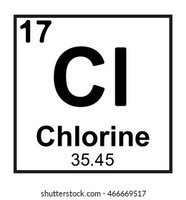
Atomic number (Z): 17
Mass number (A): 35 or 37 (for isotopes)
Isotopes
Definition and Examples
Isotopes are atoms of the same element with different numbers of neutrons, resulting in different mass numbers.
All isotopes of an element have the same number of protons.
Isotopes differ in the number of neutrons.
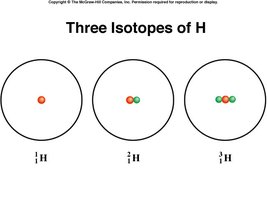
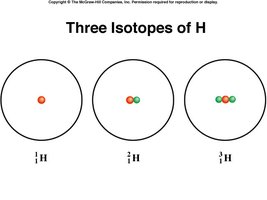
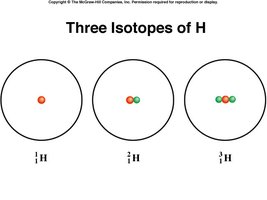
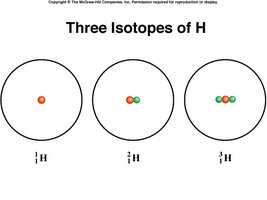
Example: Hydrogen has three isotopes:
Protium (Hydrogen-1): 1 proton, 0 neutrons
Deuterium (Hydrogen-2): 1 proton, 1 neutron
Tritium (Hydrogen-3): 1 proton, 2 neutrons
Atomic Mass and Weighted Average
The atomic mass of an element is the weighted average of the masses of its naturally occurring isotopes, based on their relative abundance. Example: Chlorine consists of chlorine-35 and chlorine-37 in a 3:1 ratio.
Atomic mass = (fraction of Cl-35 × mass of Cl-35) + (fraction of Cl-37 × mass of Cl-37)
Formula: 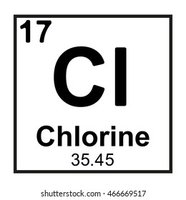
Development of Atomic Theory
Historical Models of the Atom
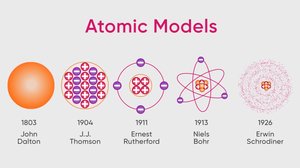
The atomic model has evolved over time:
Dalton (1803): Atoms are indivisible spheres.
Thomson (1904): Plum pudding model – electrons embedded in a positive matrix.
Rutherford (1911): Nucleus at the center, electrons orbiting.
Bohr (1913): Electrons in fixed energy levels.
Schrödinger (1926): Quantum mechanical model – electrons in orbitals.
Dalton’s Atomic Theory
Dalton’s postulates:
All matter consists of tiny particles called atoms.
Atoms cannot be created, divided, or destroyed.
Atoms of the same element are identical; atoms of different elements differ.
Atoms combine in simple ratios to form compounds.
Chemical change involves rearrangement of atoms.
Discovery of Subatomic Particles
Electrons: Discovered by J.J. Thomson (1897).
Protons: Discovered by Goldstein (1886), confirmed by Rutherford (1919).
Neutrons: Discovered by Chadwick (1932).
Light, Atomic Structure, and the Bohr Atom
Spectroscopy and Electronic Structure
Spectroscopy is the study of light absorption and emission by atoms, used to understand electronic structure. Light travels in waves, characterized by wavelength and energy.
Short wavelength = high energy
Long wavelength = low energy
Emission Spectra and Quantum Mechanics
Atoms absorb and emit energy as electrons move between energy levels. The energy emitted corresponds to specific wavelengths, producing spectral lines. Example: Hydrogen emission spectrum. 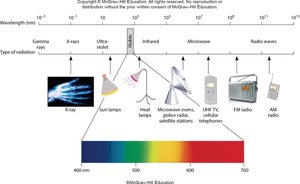
Bohr Model and Quantum Mechanical Model
Electrons exist in quantized energy levels (orbits).
Energy absorbed or emitted is the difference between energy levels.
Bohr’s model works for hydrogen but not for multi-electron atoms.
Quantum mechanical model: Electrons occupy orbitals, regions of high probability.
The Periodic Law and the Periodic Table
Periodic Law
The physical and chemical properties of elements are periodic functions of their atomic numbers.
Elements are arranged in periods (rows) and groups (columns).
Elements in the same group share similar properties.
Classification of Elements
Metals: Lose electrons, high conductivity, malleable, ductile, metallic luster.
Nonmetals: Gain electrons, brittle, powdery solids or gases.
Metalloids: Intermediate properties.
Electron Arrangement and the Periodic Table
Electron Configuration
Electron configuration describes the arrangement of electrons in atomic orbitals.
Electrons fill orbitals in order of increasing energy (Aufbau Principle).
Each orbital holds up to two electrons (Pauli Exclusion Principle).
Orbitals are half-filled before completely filled (Hund’s Rule).
Formula: electrons per principal energy level.
Sublevels and Orbitals
Sublevels: s, p, d, f (increasing energy)
Orbitals: s (spherical), p (dumbbell-shaped)
Electron Configuration Examples
Hydrogen: 1s1
Lithium: 1s22s1
Be: 1s22s2
N: 1s22s22p3
Na: 1s22s22p63s1
Valence Electrons and the Octet Rule
Valence Electrons
Valence electrons are the outermost electrons involved in chemical bonding.
Noble gases are stable due to a full complement of valence electrons.
Octet Rule
Elements react to attain the electron configuration of the nearest noble gas, usually eight valence electrons.
Metals lose electrons to form cations.
Nonmetals gain electrons to form anions.
Trends in the Periodic Table
Atomic Properties
Atomic size: Increases down a group, decreases across a period.
Ion size: Cations are smaller than parent atoms; anions are larger.
Ionization energy: Energy required to remove an electron; decreases down a group, increases across a period.
Electron affinity: Energy released when an electron is added; decreases down a group, increases across a period.
Example Table: Atomic Size and Ionization Energy Trends
Property | Trend Down Group | Trend Across Period |
|---|---|---|
Atomic Size | Increases | Decreases |
Ionization Energy | Decreases | Increases |
Electron Affinity | Decreases | Increases |
Example: Fe2+ is larger than Fe3+ due to fewer protons pulling on the same number of electrons.
Summary
Understanding atomic structure, electron arrangement, and periodic trends is fundamental to predicting chemical behavior and bonding in elements. Additional info: Some images and tables were inferred for clarity and completeness.
