 Back
Chapter 3: Matter and Energy – Structured Study Notes
Study Guide - Smart Notes
 Tailored notes based on your materials, expanded with key definitions, examples, and context.
Chapter 3: Matter and Energy
Energy: Definition and Importance
Energy is a fundamental concept in chemistry and physics, defined as the capacity to do work. Work is the result of a force acting through a distance. The behavior of matter is largely influenced by energy, making its understanding essential for studying chemical processes.
Energy: The ability to perform work or produce change.
Work: The result of a force acting over a distance.
Importance: Energy drives chemical reactions and changes in matter.
Law of Conservation of Energy
The law of conservation of energy states that energy cannot be created or destroyed; it can only be transformed or transferred. The total energy in a closed system remains constant.
Energy Transformation: Energy can change forms (e.g., potential to kinetic).
Energy Transfer: Energy can move from one object to another.
Conservation Principle: Energy is neither created from nothing nor vanishes into nothing.
Potential and Kinetic Energy
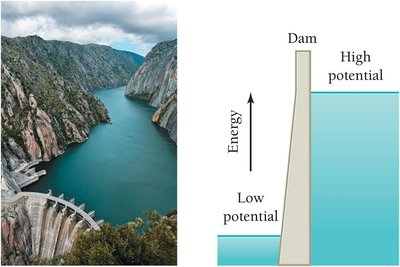
The total energy of a sample is the sum of its kinetic energy (energy of motion) and potential energy (energy due to position or composition).
Kinetic Energy: Associated with the movement of objects.
Potential Energy: Associated with the position or arrangement of objects.
Total Energy: Sum of kinetic and potential energies.
Forms of Energy
Energy exists in various forms, each relevant to chemical and physical processes.
Electrical Energy: Energy from the flow of electrical charge.
Thermal Energy: Energy from the random motion of atoms and molecules; increases with temperature.
Chemical Energy: Potential energy stored in the positions of particles within a chemical system.
Units of Energy and Conversion Factors
Energy is measured in several units, with the SI unit being the joule (J). Other units include the calorie (cal), nutritional Calorie (Cal), and kilowatt-hour (kWh).
Joule (J): SI unit of energy.
Calorie (cal): Energy needed to raise 1 g of water by 1°C.
Calorie (Cal): Nutritional unit, equal to 1000 cal.
Kilowatt-hour (kWh): Used in electricity billing.
Unit | Equivalent |
|---|---|
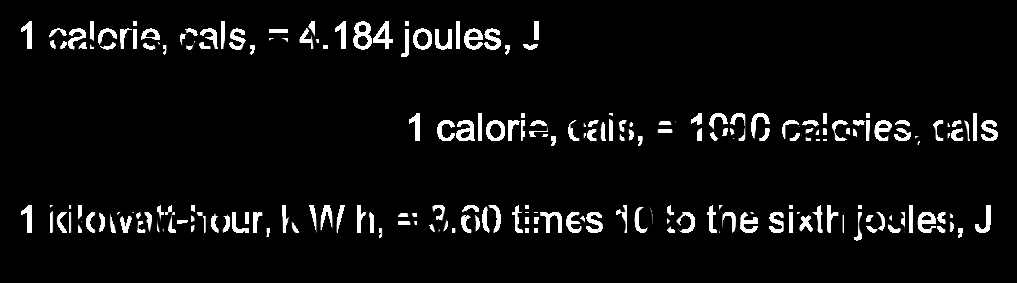
1 cal | 4.184 J |
1 Cal | 1000 cal |
1 kWh | 3.60 × 10⁶ J |
Energy Unit Conversion Example
To convert nutritional energy from Calories to joules, use the following steps:
Multiply by 1000 to convert Cal to cal.
Multiply by 4.184 to convert cal to J.
Example: A candy bar contains 225 Cal. To find the energy in joules:

Energy Changes in Physical and Chemical Processes
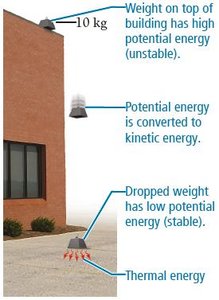
Physical and chemical changes are often accompanied by energy changes. Systems with high potential energy tend to change to lower their potential energy, becoming more stable.
High Potential Energy: Unstable, tends to decrease.
Example: A weight lifted off the ground has high potential energy and will fall to lower its energy.
Exothermic and Endothermic Reactions
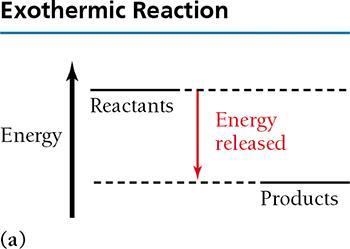
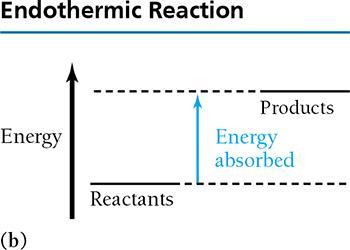
Chemical reactions can either release energy (exothermic) or absorb energy (endothermic).
Exothermic Reaction: Energy is released; products have lower potential energy than reactants.
Endothermic Reaction: Energy is absorbed; products have higher potential energy than reactants.
Example: TNT explosion is exothermic.
Temperature and Thermal Energy
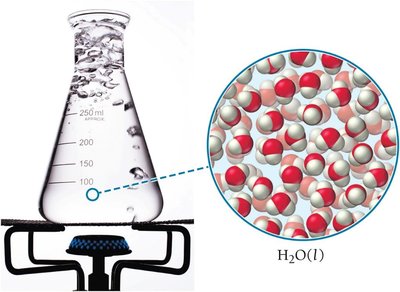
Atoms and molecules are in constant random motion, which constitutes thermal energy. Temperature measures the thermal energy of a substance.
Temperature: Indicates the average kinetic energy of particles.
Thermal Energy: Total energy from random motion.
Hotter Objects: Greater random motion and higher temperature.
Temperature vs Heat
Heat is the transfer of thermal energy due to a temperature difference, while temperature is a measure of thermal energy.
Heat: Energy transferred between substances.
Temperature: Measure of thermal energy, not the transfer.
Example: Heat flows from warm water to cold ice, causing melting.
Temperature Scales: Fahrenheit, Celsius, Kelvin
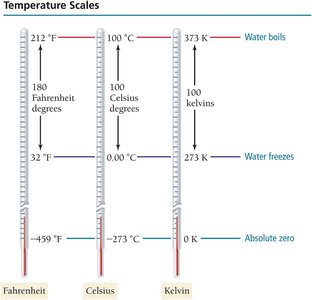
Three main temperature scales are used in chemistry: Fahrenheit (°F), Celsius (°C), and Kelvin (K).
Fahrenheit: Water freezes at 32°F, boils at 212°F.
Celsius: Water freezes at 0°C, boils at 100°C.
Kelvin: Water freezes at 273 K, boils at 373 K; absolute zero is 0 K.
Degree Size: Fahrenheit degree is 5/9 the size of a Celsius degree; Celsius and Kelvin degrees are equal.
Converting Between Temperature Scales
Temperature can be converted between scales using the following formulas:
Note: The degree symbol is used with Celsius and Fahrenheit, but not with Kelvin.
Specific Heat Capacity
Specific heat capacity is the amount of heat required to raise the temperature of 1 gram of a substance by 1°C. It varies between substances and is measured in J/g°C.
High Specific Heat: Water (4.184 J/g°C), absorbs much heat with little temperature change.
Low Specific Heat: Metals like lead and gold (0.128 J/g°C), heat up quickly.
Substance | Specific Heat Capacity (J/g°C) |
|---|---|
Lead | 0.128 |
Gold | 0.128 |
Silver | 0.235 |
Copper | 0.385 |
Iron | 0.449 |
Aluminum | 0.903 |
Ethanol | 2.42 |
Water | 4.184 |
Calculating Energy Using Specific Heat Capacity
The relationship between heat, mass, specific heat capacity, and temperature change is given by:
Where q is heat (J), m is mass (g), C is specific heat capacity (J/g°C), ΔT is temperature change (°C).
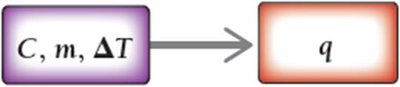
Example: To raise 2.5 g of gallium from 25.0°C to 29.9°C (C = 0.372 J/g°C):
Review: Key Concepts
Law of Conservation of Mass: Matter is conserved in chemical changes.
Law of Conservation of Energy: Energy is conserved; measured in J, cal, Cal, kWh.
Exothermic vs Endothermic: Exothermic reactions release energy; endothermic absorb energy.
Temperature: Related to random motion; measured in °F, °C, K.
Specific Heat Capacity: Determines how much temperature changes with heat absorption.
