 Back
Chapter 4: Molecules and Compounds – Structured Study Notes
Study Guide - Smart Notes
 Tailored notes based on your materials, expanded with key definitions, examples, and context.
Chapter 4: Molecules and Compounds
Introduction
This chapter explores the formation, classification, and properties of molecules and compounds, focusing on the types of chemical bonds, chemical formulas, and methods for determining chemical composition. Understanding these concepts is fundamental to the study of chemistry, as they explain how elements combine to form new substances with unique properties.
Molecules and Compounds
Formation of Molecules and Compounds
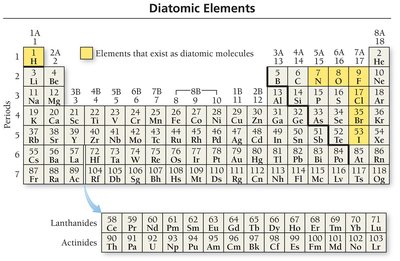
When two or more elements combine, they form a molecule. If the elements are the same, such as O2, the molecule is elemental. If the elements are different, such as H2O, the molecule is a compound. Compounds are groups of molecules with distinct chemical properties.
Molecule: Two or more atoms bonded together.
Compound: A substance formed from two or more different elements.
Example: Water (H2O) is a compound formed from hydrogen and oxygen.
Properties of Water, Hydrogen, and Oxygen
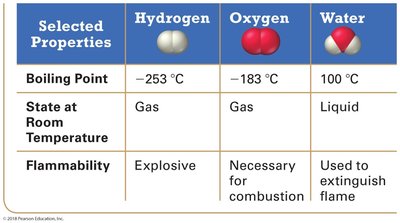
Compounds have properties distinct from their constituent elements. For example, water is a liquid at room temperature and extinguishes flames, while hydrogen and oxygen are gases and highly reactive.
Selected Properties | Hydrogen | Oxygen | Water |
|---|---|---|---|
Boiling Point | -253°C | -183°C | 100°C |
State at Room Temperature | Gas | Gas | Liquid |
Flammability | Explosive | Necessary for combustion | Used to extinguish flame |
Types of Chemical Bonds
Ionic Bonds
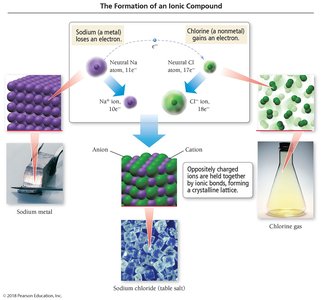
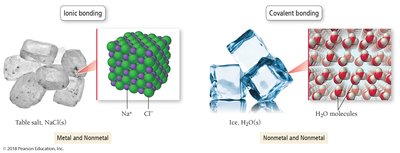
Ionic bonds occur between metals and nonmetals and involve the transfer of electrons. The metal atom loses electrons to become a cation, while the nonmetal gains electrons to become an anion. The resulting oppositely charged ions attract each other, forming a stable ionic compound.
Cation: Positively charged ion (metal loses electrons).
Anion: Negatively charged ion (nonmetal gains electrons).
Example: Sodium chloride (NaCl) is formed from Na+ and Cl-.
Covalent Bonds
Covalent bonds occur between nonmetals and involve the sharing of electrons. The shared electrons are most stable between the bonding atoms, resulting in the formation of individual molecules rather than a lattice.
Bonding pair: Shared electrons between atoms.
Lone pair: Electrons not shared, belonging to a single atom.
Example: Water (H2O) molecules are held together by covalent bonds.
Representing Compounds: Chemical Formulas and Models
Chemical Formulas
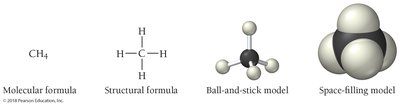
A chemical formula indicates the type and number of each atom in a molecule. Subscripts show the relative number of atoms. The order of elements typically places the more metallic element first.
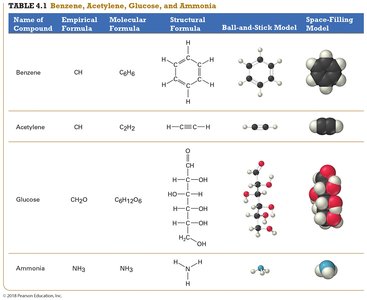
Empirical formula: Simplest whole-number ratio of atoms (e.g., CH for benzene).
Molecular formula: Actual number of atoms (e.g., C6H6 for benzene).
Structural formula: Diagram showing how atoms are bonded.
Empirical vs. Molecular Formulas
The empirical formula is the simplest ratio, while the molecular formula shows the actual number of atoms. For example, glucose has an empirical formula of CH2O and a molecular formula of C6H12O6.
Name of Compound | Empirical Formula | Molecular Formula | Structural Formula | Ball-and-Stick Model | Space-Filling Model |
|---|---|---|---|---|---|
Benzene | CH | C6H6 | Ring structure | Ball-and-stick | Space-filling |
Acetylene | CH | C2H2 | Linear | Ball-and-stick | Space-filling |
Glucose | CH2O | C6H12O6 | Ring structure | Ball-and-stick | Space-filling |
Ammonia | NH3 | NH3 | Trigonal pyramidal | Ball-and-stick | Space-filling |
Lewis Structures and the Octet Rule
Lewis Dot Model
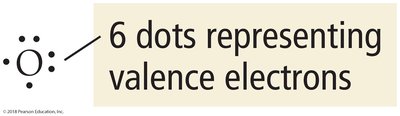
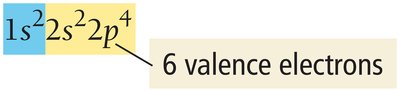
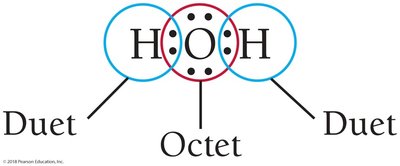
The Lewis dot model represents valence electrons as dots around the element symbol. Chemical bonding involves the transfer or sharing of these electrons to achieve a stable configuration, usually an octet (eight electrons).
Octet rule: Atoms tend to gain, lose, or share electrons to achieve eight in their outer shell.
Duet rule: Hydrogen and helium achieve stability with two electrons.
Bonding and Lone Pairs
In Lewis structures, bonding pairs are shared between atoms, while lone pairs belong to a single atom. The arrangement of these pairs determines the molecule's shape and stability.
Ionic Compounds: Structure and Properties
Crystal Lattice and Lattice Energy
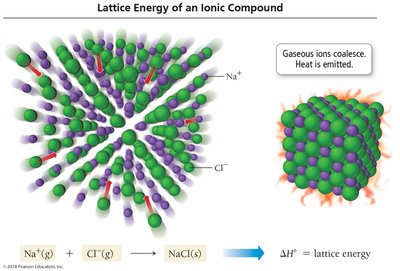
Ionic compounds form a three-dimensional network called a crystal lattice. The stability of this lattice is measured by lattice energy, which is the energy released when ions coalesce to form the solid.
Lattice energy: Proportional to the charge size and inversely proportional to the distance between ions.
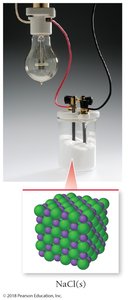
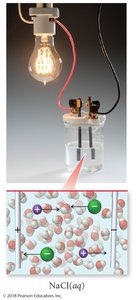
Properties: Ionic solids are hard, brittle, and do not conduct electricity unless dissolved in water.
Electrical Conductivity
Ionic solids do not conduct electricity in the solid state because ions are locked in place. When dissolved in water, ions are free to move and conduct electricity.
Nomenclature of Ionic Compounds
Types of Ionic Compounds
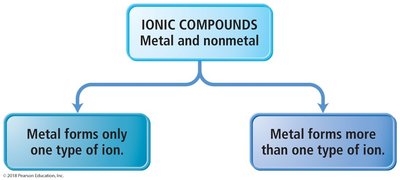
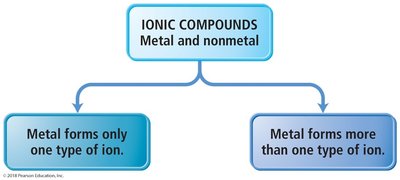
Ionic compounds are classified based on whether the metal forms only one type of ion or multiple types. This affects the naming convention used.
Naming Ionic Compounds
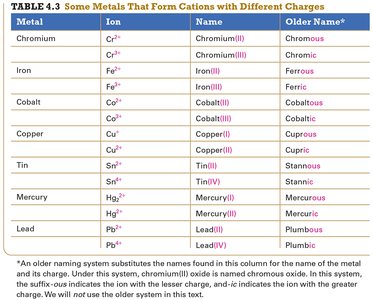
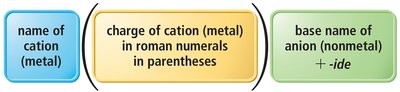
For metals that form only one type of ion, the compound is named by stating the metal followed by the base name of the nonmetal with the suffix -ide. For metals that form more than one type of ion, the charge is indicated in parentheses using Roman numerals.
Metal | Ion | Name | Older Name* |
|---|---|---|---|
Chromium | Cr2+, Cr3+ | Chromium(II), Chromium(III) | Chromous, Chromic |
Iron | Fe2+, Fe3+ | Iron(II), Iron(III) | Ferrous, Ferric |
Cobalt | Co2+, Co3+ | Cobalt(II), Cobalt(III) | Cobaltous, Cobaltic |
Copper | Cu+, Cu2+ | Copper(I), Copper(II) | Cuprous, Cupric |
Tin | Sn2+, Sn4+ | Tin(II), Tin(IV) | Stannous, Stannic |
Mercury | Hg2+, Hg22+ | Mercury(II), Mercury(I) | Mercuric, Mercurous |
Lead | Pb2+, Pb4+ | Lead(II), Lead(IV) | Plumbous, Plumbic |
Monatomic and Polyatomic Anions
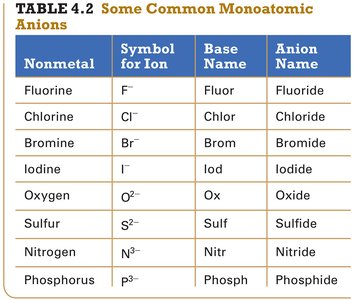
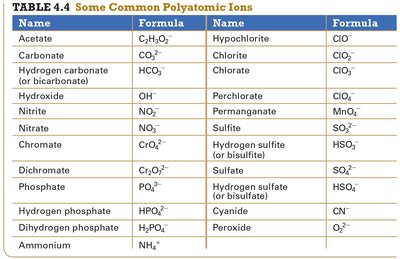
Monatomic anions are named by adding -ide to the base name. Polyatomic ions have specific names and formulas.
Nonmetal | Symbol for Ion | Base Name | Anion Name |
|---|---|---|---|
Fluorine | F- | Fluor | Fluoride |
Chlorine | Cl- | Chlor | Chloride |
Bromine | Br- | Brom | Bromide |
Iodine | I- | lod | Iodide |
Oxygen | O2- | Ox | Oxide |
Sulfur | S2- | Sulf | Sulfide |
Nitrogen | N3- | Nitr | Nitride |
Phosphorus | P3- | Phosph | Phosphide |
Name | Formula | Name | Formula |
|---|---|---|---|
Acetate | C2H3O2- | Hypochlorite | ClO- |
Carbonate | CO32- | Chlorite | ClO2- |
Hydrogen carbonate | HCO3- | Chlorate | ClO3- |
Hydroxide | OH- | Perchlorate | ClO4- |
Nitrite | NO2- | Permanganate | MnO4- |
Nitrate | NO3- | Sulfite | SO32- |
Chromate | CrO42- | Sulfate | SO42- |
Dichromate | Cr2O72- | Hydrogen sulfate | HSO4- |
Phosphate | PO43- | Cyanide | CN- |
Hydrogen phosphate | HPO42- | Peroxide | O22- |
Dihydrogen phosphate | H2PO4- | Ammonium | NH4+ |
Covalent Bonding and Molecular Compounds
Single, Double, and Triple Bonds
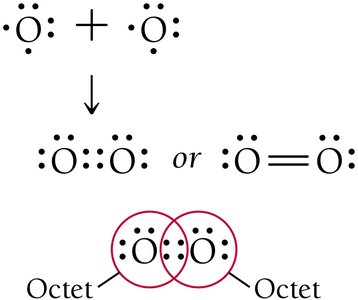
Covalent bonds can involve the sharing of one, two, or three pairs of electrons, resulting in single, double, or triple bonds, respectively. The number of shared pairs affects the bond strength and length.
Single bond: One pair of electrons shared.
Double bond: Two pairs of electrons shared.
Triple bond: Three pairs of electrons shared.
Naming Molecular Compounds
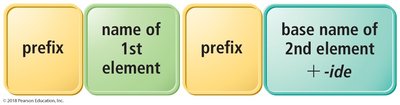
Molecular compounds are named using prefixes to indicate the number of atoms. The element with the smallest group number is named first, followed by the second element with the suffix -ide.
mono = 1
di = 2
tri = 3
tetra = 4
penta = 5
hexa = 6
hepta = 7
octa = 8
nona = 9
deca = 10
Molar Mass and Chemical Composition
Molar Mass Calculation
The molar mass of a compound is the sum of the atomic masses of all atoms in the formula. It is used to convert between grams and moles.
Formula:
Example: Molar mass of H2O = 2(1.01) + 16.00 = 18.02 g/mol

Percent Composition
The percent composition of an element in a compound is calculated by dividing the mass of the element by the total mass of the compound and multiplying by 100%.
Formula:
Empirical and Molecular Formulas from Experimental Data
Determining Empirical Formula
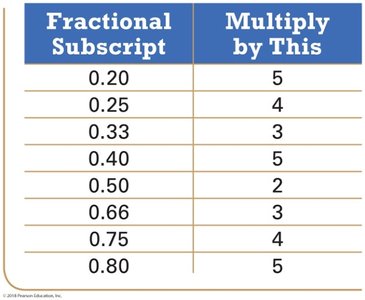
The empirical formula is determined from percent composition, decomposition data, or combustion analysis. The process involves converting mass to moles, finding the simplest ratio, and adjusting for whole numbers.
Convert percentages to grams (assume 100 g sample).
Convert grams to moles using atomic masses.
Divide by the smallest number of moles to get ratios.
Multiply ratios to obtain whole numbers if necessary.
Combustion Analysis
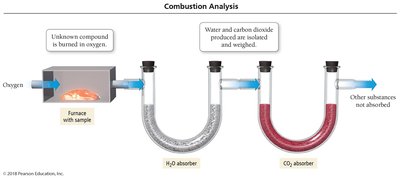
Combustion analysis is used to determine the empirical formula of compounds containing carbon and hydrogen. The sample is burned, and the masses of CO2 and H2O produced are measured to calculate the original amounts of C and H.
Summary
This chapter provides a comprehensive overview of molecules and compounds, including their formation, types of chemical bonds, methods for representing and naming compounds, and techniques for determining chemical composition. Mastery of these concepts is essential for understanding chemical reactions and the properties of substances.
