 Back
Chapter 5: Molecules and Compounds – Structured Study Notes
Study Guide - Smart Notes
 Tailored notes based on your materials, expanded with key definitions, examples, and context.
Molecules and Compounds
Properties of Compounds vs. Elements
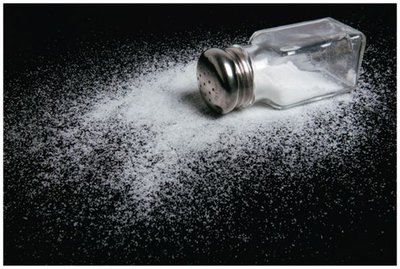
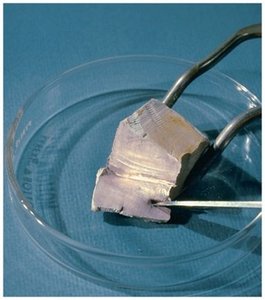
Compounds are substances formed from two or more elements chemically combined in fixed ratios. The properties of a compound are generally very different from the properties of the elements that compose it. For example, sodium chloride (table salt) is formed from sodium (a highly reactive metal) and chlorine (a poisonous yellow gas), yet the compound is safe for consumption.
Compound: A substance composed of two or more elements in fixed, definite proportions.
Element: A pure substance consisting of only one type of atom.
Example: Sodium chloride (NaCl) is table salt, distinct from sodium and chlorine.

Compounds vs. Mixtures
Most naturally occurring substances are compounds, not elements. Free atoms are rare in nature. Compounds differ from mixtures in that compounds have elements combined in fixed, definite proportions, while mixtures have variable proportions.
Compound: Elements combine in fixed ratios.
Mixture: Elements combine in variable ratios.


The Law of Constant Composition
The law of constant composition states that all samples of a given compound have the same proportions of their constituent elements. This means that the mass ratio of elements in a compound is always constant, regardless of the sample's origin.
Example (Water): Decomposing 18.0 g of water yields 16.0 g of oxygen and 2.0 g of hydrogen. The mass ratio is:
Example (Ammonia): Decomposing 17.0 g of ammonia yields 14.0 g of nitrogen and 3.0 g of hydrogen. The mass ratio is:
Chemical Formulas: Representation of Compounds
Chemical formulas indicate the elements present in a compound and the relative number of atoms of each. The formula uses element symbols and subscripts; a subscript of 1 is omitted by convention.
Example: Water is represented as H2O, meaning two hydrogen atoms and one oxygen atom.
Subscripts: Indicate the number of atoms; never change for a given compound.

Common Chemical Formulas
NaCl: Table salt (sodium chloride)
CO2: Carbon dioxide
C12H22O11: Sucrose (table sugar)
Changing Subscripts: Different Compounds
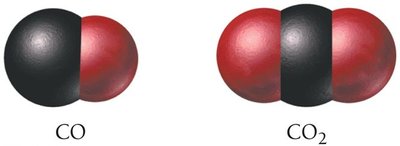
Changing the subscript in a chemical formula results in a different compound. For example, CO is carbon monoxide (toxic), while CO2 is carbon dioxide (relatively harmless).
Order of Elements in Chemical Formulas
Formulas list the most metallic element first. In compounds without metals, the more metal-like element (leftmost or lower in the periodic table) is listed first.
Example: NaCl, not ClNa.
Polyatomic Ions in Chemical Formulas
Some chemical formulas contain groups of atoms that act as a unit, called polyatomic ions. When several groups are present, parentheses and subscripts are used. To determine the total number of each atom, multiply the subscript outside the parentheses by the subscript inside.
Example: Mg(NO3)2 contains one magnesium atom and two nitrate groups.

Types of Chemical Formulas
Chemical formulas can be categorized as:
Empirical formula: Simplest whole-number ratio of atoms.
Molecular formula: Actual number of atoms in a molecule.
Structural formula: Shows how atoms are connected.
For hydrogen peroxide, the molecular formula is H2O2, and the empirical formula is HO.

Molecular View of Elements and Compounds
Pure substances can be elements or compounds. Elements may be atomic (single atoms) or molecular (diatomic molecules). Compounds may be molecular (nonmetals) or ionic (metal and nonmetal).
Atomic elements: Exist as single atoms (e.g., mercury).
Molecular elements: Exist as diatomic molecules (e.g., chlorine).


Elements That Occur as Diatomic Molecules
Name of Element | Formula of Basic Unit |
|---|---|
Hydrogen | H2 |
Nitrogen | N2 |
Oxygen | O2 |
Fluorine | F2 |
Chlorine | Cl2 |
Bromine | Br2 |
Iodine | I2 |
Compounds: Molecular vs. Ionic
Molecular compounds are formed from two or more nonmetals. Ionic compounds are formed from a metal and a nonmetal, involving electron transfer and resulting in positive (cation) and negative (anion) ions.
Molecular compound: Nonmetals only.
Ionic compound: Metal and nonmetal; contains cations and anions.


Writing Formulas for Ionic Compounds
Ionic compounds must be charge-neutral. The sum of the charges of cations and anions must equal zero. The formula is determined by the charges of the ions.
Steps:
Write the symbol and charge for each ion.
Make the magnitude of the charge on each ion the subscript for the other ion.
Reduce subscripts to smallest whole-number ratio.
Check for charge neutrality.
Example: Mg2+ and Cl- combine to form MgCl2.
Writing Formulas for Compounds with Polyatomic Ions
For compounds containing polyatomic ions, determine the charges, ensure charge neutrality, and use parentheses for multiple groups.
Example: Ca2+ and NO3- combine to form Ca(NO3)2.
Formula Mass: Mass of a Molecule or Formula Unit
The formula mass is the sum of the atomic masses of all atoms in a chemical formula. For example, the formula mass of MgCl2 is calculated by adding the atomic masses of one magnesium atom and two chlorine atoms.
