 Back
BackChapter 6: Chemical Composition – Counting Atoms, Molecules, and Determining Formulas
Study Guide - Smart Notes
 Tailored notes based on your materials, expanded with key definitions, examples, and context.
Chapter 6: Chemical Composition
Counting Atoms and Molecules
Atoms and molecules are extremely small, making it impractical to count them individually. Chemists use mass as a practical way to count these particles by relating mass to the number of particles through the concept of the mole.
The Mole: The mole is a counting unit in chemistry, defined as exactly 6.022 × 10²³ particles (atoms, molecules, ions, etc.). This number is known as Avogadro's number.
Definition: One mole is the number of atoms in exactly 12 grams of pure carbon-12.
Analogy: Just as a dozen means 12 items, a mole means 6.022 × 10²³ items.
Example: If you buy 2.60 pounds of nails and each dozen weighs 0.150 lb, you can use the mass to calculate the number of nails. Similarly, chemists use mass to count atoms.
Conversion Factors for Counting Atoms
Quantity-to-Quantity Conversion: The mole allows conversion between the number of particles and the amount of substance.
Quantity-to-Mass Conversion: The molar mass is the mass (in grams) of one mole of a substance.
Relationship: The molar mass in grams is numerically equal to the atomic mass in atomic mass units (amu).
Element | Atomic Mass (amu) | Molar Mass (g/mol) |
|---|---|---|
Carbon | 12.01 | 12.01 |
Copper | 63.55 | 63.55 |
Example: If you buy 0.58 g of krypton (Kr) and the molar mass is 83.80 g/mol, you can calculate the number of krypton atoms using the mole concept.
Counting Molecules by the Gram
The concept of molar mass extends to molecules and formula units. The molar mass of a compound is the sum of the molar masses of its constituent elements.
Chemical Formulas as Conversion Factors
Chemical formulas indicate the number of atoms of each element in a compound and can be used to convert between moles of a compound and moles of its elements.
Example: In H2O, 1 mole of water contains 2 moles of hydrogen atoms and 1 mole of oxygen atom.
Mass Percent
Mass percent expresses the proportion by mass of each element in a compound. It is useful for determining how much of a compound contains a specific element.
Definition: Mass percent of an element is the mass of the element in one mole of the compound divided by the total mass of one mole of the compound, multiplied by 100%.

Application: Mass percent can be used as a conversion factor in stoichiometric calculations.
Example: Using Mass Percent in Calculations
Suppose the mass percent of sodium (Na) in sodium chloride (NaCl) is 39%. If you are limited to consuming 2.4 g of Na, you can calculate the maximum grams of NaCl you can consume using the mass percent as a conversion factor.
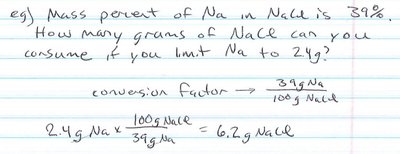
Calculation:
Conversion factor: 39 g Na / 100 g NaCl
Set up the calculation:
Calculating Mass Percent from a Chemical Formula
To find the mass percent of an element in a compound, use the chemical formula and the molar masses of the elements involved.
Formula:
Calculating Empirical Formulas
Empirical formulas represent the simplest whole-number ratio of elements in a compound. Laboratory analysis often provides mass percent composition, which can be used to determine the empirical formula.
Procedure:
Assume a 100 g sample (so percentages become grams).
Convert the mass of each element to moles using their molar masses.
Write a pseudoformula using the mole values as subscripts.
Divide all subscripts by the smallest number of moles to get the simplest ratio.
If any subscript is not a whole number, multiply all subscripts by an integer to obtain whole numbers.
Example: Aspirin analysis yields: C 60.00%, H 4.48%, O 35.53%. For a 100 g sample: 60.00 g C, 4.48 g H, 35.53 g O. Convert each to moles, divide by the smallest, and adjust to whole numbers as needed.
Fractional Subscript | Multiply by |
|---|---|
0.10 | 10 |
0.20 | 5 |
0.25 | 4 |
0.33 | 3 |
0.50 | 2 |
0.166 | 6 |
0.75 | 4 |
Calculating Molecular Formulas
The molecular formula gives the actual number of atoms of each element in a molecule and is a whole-number multiple of the empirical formula. To determine the molecular formula, you need the empirical formula and the molar mass of the compound.
Steps:
Calculate the empirical formula mass.
Divide the compound's molar mass by the empirical formula mass to find the multiple (n).
Multiply all subscripts in the empirical formula by n to get the molecular formula.
Formula:
Where:
