 Back
BackChapter 6: Chemical Composition – Study Notes
Study Guide - Smart Notes
 Tailored notes based on your materials, expanded with key definitions, examples, and context.
Chapter 6: Chemical Composition
Introduction to Chemical Composition
Chemical composition refers to the types and amounts of elements that make up a substance. Understanding chemical composition is essential for quantifying substances in chemistry, especially when relating the mass of compounds to the number of atoms or molecules they contain.
The Mole Concept
Definition and Importance of the Mole
The mole (mol) is the SI unit for amount of substance, allowing chemists to count atoms, ions, or molecules by weighing them. One mole contains Avogadro’s number of entities, which is a fundamental constant in chemistry.
Avogadro’s Number: entities per mole
Purpose: Enables conversion between atomic/molecular scale and macroscopic scale
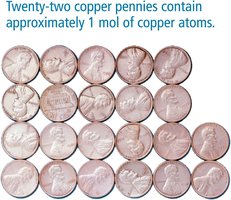
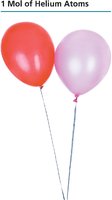
Example: Twenty-two copper pennies contain about 1 mol of copper atoms; two large helium balloons contain approximately 1 mol of helium atoms.
Definition of the Mole Based on Carbon-12
The mole is defined as the number of atoms in exactly 12 grams of pure carbon-12. This definition links the atomic scale to the gram scale, making it possible to count atoms by weighing.
Counting by Weighing: Analogy and Application
Counting Objects by Mass
Just as hardware stores sell nails by the pound rather than individually, chemists count atoms by weighing them. The process involves using conversion factors to relate mass to number of entities.
Example: If a dozen nails weigh 0.150 lb, and a customer buys 2.60 lb, the number of nails can be calculated using conversion factors.

Counting Atoms by Mass
Because atoms are extremely small and numerous, chemists use the mole as a counting unit, analogous to a dozen but much larger. The mole allows for practical counting of atoms and molecules by mass.
Conversions Involving Moles, Mass, and Number of Particles
Converting Moles to Number of Atoms
To convert moles of a substance to the number of atoms, multiply by Avogadro’s number.
Formula:

Converting Number of Atoms to Moles
To convert the number of atoms to moles, divide by Avogadro’s number.
Formula:
Molar Mass and Atomic Mass
The atomic mass unit (amu) is defined as one-twelfth the mass of a carbon-12 atom. The molar mass of an element is the mass of 1 mole of its atoms, numerically equal to its atomic mass in grams per mole.
Example: Copper has an atomic mass of 63.55 amu; 1 mole of copper atoms has a mass of 63.55 g.
Converting Between Grams and Moles
To convert between grams and moles, use the molar mass as a conversion factor.
Formula:
Formula:
Converting Between Grams and Number of Atoms
To find the number of atoms in a given mass, first convert grams to moles, then moles to atoms.
Step 1:
Step 2:

Molar Mass of Compounds
Definition and Calculation
The molar mass of a compound is the mass of 1 mole of its molecules or formula units. For ionic compounds, the smallest unit is called a formula unit. The molar mass is calculated by summing the atomic masses of all atoms in the chemical formula.
Formula:
Converting Between Grams and Moles of a Compound
To convert between grams and moles of a compound, use the compound’s molar mass as the conversion factor.

Converting Between Number of Molecules and Mass of a Compound
To find the mass corresponding to a certain number of molecules, convert molecules to moles (using Avogadro’s number), then moles to grams (using molar mass).
Step 1:
Step 2:
Chemical Formulas as Conversion Factors
Using Chemical Formulas to Relate Elements and Compounds
Chemical formulas indicate the ratio of elements in a compound, allowing conversion between moles of compound and moles of constituent elements.
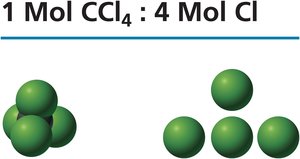
Example: 1 mol of CCl4 contains 4 mol of Cl atoms.
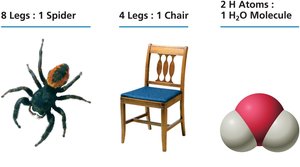
Other examples include 8 legs per spider, 4 legs per chair, and 2 H atoms per H2O molecule.
Converting Between Moles of a Compound and Moles of a Constituent Element
To find the number of moles of an element in a given number of moles of a compound, multiply by the ratio from the chemical formula.
Formula:
Converting Between Grams of a Compound and Grams of a Constituent Element
To find the mass of an element in a given mass of compound, convert grams of compound to moles, use the formula ratio to find moles of element, then convert to grams of element.
Empirical and Molecular Formulas
Definitions and Determination
The empirical formula gives the simplest whole-number ratio of elements in a compound. The molecular formula gives the actual number of each type of atom in a molecule. The empirical formula can be determined from the relative masses of elements; the molecular formula requires knowledge of the molar mass.
Summary Table: Key Conversion Relationships
Given | To Find | Conversion Steps |
|---|---|---|
Grams | Moles | Divide by molar mass |
Moles | Number of particles | Multiply by Avogadro’s number |
Number of particles | Moles | Divide by Avogadro’s number |
Grams of compound | Grams of element | Grams → Moles (compound) → Moles (element) → Grams (element) |
Learning Objectives
Convert between moles and number of atoms.
Convert between grams and moles.
Convert between grams and number of atoms or molecules.
Convert between grams and moles of a compound.
Convert between mass of a compound and number of molecules.
Convert between moles of a compound and moles of a constituent element.
Convert between grams of a compound and grams of a constituent element.
