 Back
Chapter 6: Chemical Composition – Study Notes for Introductory Chemistry
Study Guide - Smart Notes
 Tailored notes based on your materials, expanded with key definitions, examples, and context.
Chemical Composition
Introduction to Chemical Composition
Chemical composition refers to the types and amounts of elements that make up a compound. Understanding chemical composition is essential for quantifying substances, predicting reactions, and analyzing materials in chemistry. The information in a chemical formula, along with atomic and formula masses, allows chemists to calculate the amount of a constituent element in a compound.

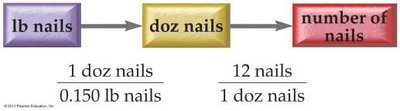
Counting by Weighing: Nails and Atoms
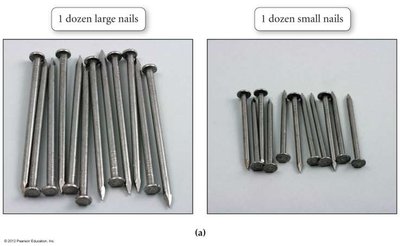
Counting objects by weighing is a practical method used in both everyday life and chemistry. For example, hardware stores sell nails by the pound rather than individually, and chemists count atoms by weighing samples.
Conversion Factors: Used to relate mass to number of items (e.g., nails or atoms).
Example: If a dozen nails weigh 0.150 lb, and there are 12 nails in a dozen, conversion factors can be used to determine the number of nails in a given mass.
Counting Atoms by the Gram: The Mole Concept
Atoms are too small and numerous to count individually. Chemists use the mole as a counting unit, analogous to a dozen, but much larger. One mole equals 6.022 × 10²³ units, known as Avogadro’s number.
Mole: The chemist’s counting unit for atoms, ions, or molecules.
Avogadro’s Number:
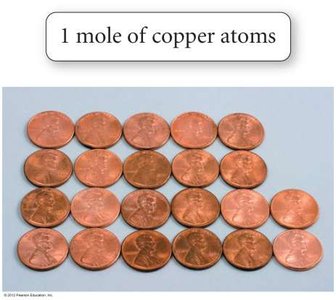
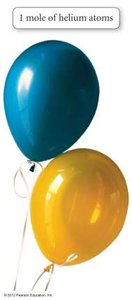
Examples: 1 mole of copper atoms is about 22 pennies; 1 mole of helium atoms fills two large balloons.
Converting Between Moles and Number of Atoms
To convert between moles and number of atoms, use Avogadro’s number as a conversion factor.
Formula:
Example: 3.5 mol He × atoms/mol = He atoms
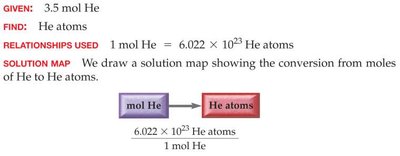

Converting Number of Atoms to Moles
To convert from number of atoms to moles, divide by Avogadro’s number.
Formula:
Example: Ag atoms × = mol Ag
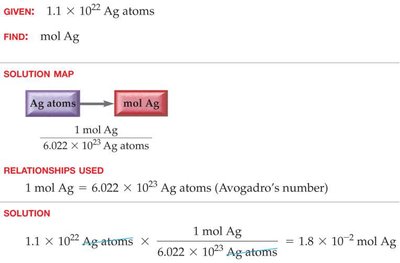
Molar Mass and Atomic Mass
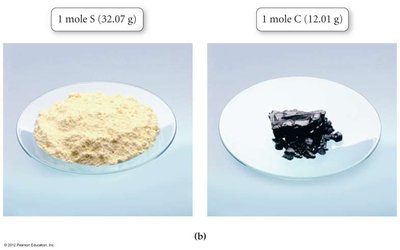
The molar mass of an element is the mass of 1 mole of atoms of that element, expressed in grams per mole (g/mol). It is numerically equal to the atomic mass in atomic mass units (amu).
Example: 1 copper atom = 63.55 amu; 1 mol copper atoms = 63.55 g
Comparison: The mass of 1 mole varies for different elements due to differences in atomic mass.
Converting Between Grams and Moles
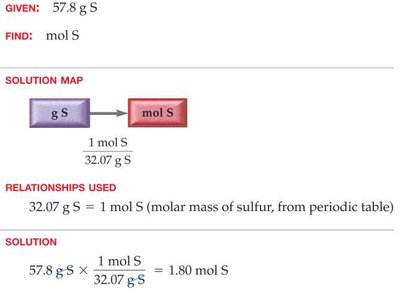
To convert between grams and moles, use the molar mass as a conversion factor.
Formula:
Example: 57.8 g S × = 1.80 mol S
Converting Between Moles and Grams
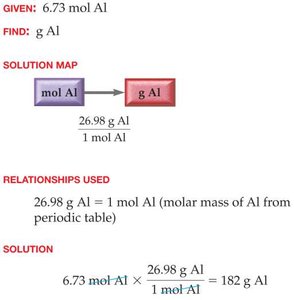
To convert from moles to grams, multiply by the molar mass.
Formula:
Example: 6.73 mol Al × 26.98 g/mol = 182 g Al
Converting Between Grams and Number of Atoms
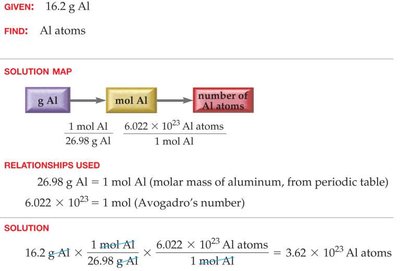
To find the number of atoms in a given mass, convert grams to moles, then moles to atoms using Avogadro’s number.
Formula:
Example: 16.2 g Al × × atoms/mol = Al atoms
Counting Molecules by the Gram: Compounds
For compounds, the molar mass is the mass of 1 mole of molecules or formula units. The formula mass is the sum of the atomic masses of all atoms in the chemical formula.
Formula Mass Example (CO2):
Molar Mass Example (CO2): 44.01 g/mol

Converting Between Grams and Moles of a Compound
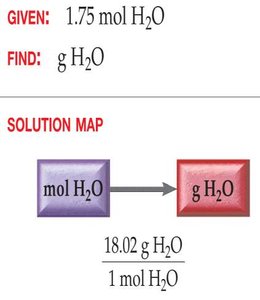
To convert between grams and moles of a compound, use the compound’s molar mass.
Formula:
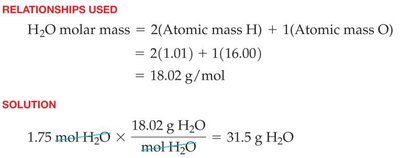
Example: 1.75 mol H2O × 18.02 g/mol = 31.5 g H2O
Converting Between Number of Molecules and Mass of a Compound
To find the mass of a given number of molecules, convert molecules to moles using Avogadro’s number, then moles to grams using molar mass.
Formula:
Chemical Formulas as Conversion Factors
Chemical formulas indicate the relative number of each kind of element in a compound. These relationships allow conversion between moles of a compound and moles of a constituent element.
Example: CO2 has 2 O atoms per molecule, so 2 mol O per 1 mol CO2.
Converting Between Grams of a Compound and Grams of a Constituent Element
To find the mass of a constituent element in a compound, convert grams of compound to moles, then moles of compound to moles of element, then moles of element to grams.
Example: Find the mass of sodium in 15 g NaCl.
Mass Percent Composition of Compounds
The mass percent composition of an element is the percentage of the total mass of the compound that is due to that element.
Formula:
Example: If sodium chloride is 39% sodium by mass, then 39 g sodium per 100 g NaCl.
Calculating Mass Percent Composition from a Chemical Formula
Mass percent composition can be calculated directly from the chemical formula by determining the mass of each element in one mole of the compound and dividing by the total molar mass.
Example: Calculate the mass percent of Cl in C2Cl4F2 (freon-114).
Empirical and Molecular Formulas
The empirical formula gives the smallest whole-number ratio of each type of atom in a compound. The molecular formula is a whole-number multiple of the empirical formula.
Example: Hydrogen peroxide: Molecular formula H2O2, Empirical formula HO
Steps to Calculate Empirical Formula:
Write down the masses of each element.
Convert masses to moles.
Write a pseudo-formula using mole values as subscripts.
Divide all subscripts by the smallest value.
If needed, multiply to get whole numbers.
Calculating Molecular Formulas
The molecular formula is determined by multiplying the empirical formula by an integer n, found by dividing the molar mass by the empirical formula molar mass.
Formula:
Example: For fructose, empirical formula CH2O, molar mass 180.2 g/mol.
Summary Table: Key Conversion Relationships
Conversion | Factor/Formula |
|---|---|
Grams to Moles | |
Moles to Grams | |
Moles to Atoms/Molecules | |
Atoms/Molecules to Moles | |
Mass Percent Composition | |
Empirical Formula | Smallest whole-number ratio of atoms |
Molecular Formula | Empirical formula × n |
Chapter Review: Chemical Skills
Converting between moles and number of atoms
Converting between grams and moles
Converting between grams and number of atoms or molecules
Converting between moles of a compound and moles of a constituent element
Converting between grams of a compound and grams of a constituent element
Using mass percent composition as a conversion factor
Determining mass percent composition from a chemical formula
Determining an empirical formula from experimental data
Calculating a molecular formula from an empirical formula and molar mass
