 Back
Chapter 6: Chemical Composition – The Mole, Molar Mass, and Chemical Formulas
Study Guide - Smart Notes
 Tailored notes based on your materials, expanded with key definitions, examples, and context.
Chemical Composition and Its Importance
Dietary Sodium and Chemical Compounds
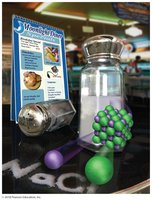
Sodium is an essential mineral in the human diet, commonly consumed as sodium chloride (table salt). Understanding the chemical composition of compounds like sodium chloride is crucial for determining how much of an element (e.g., sodium) is present in a given mass of a compound. This knowledge is important for health guidelines, such as the FDA's recommendation to limit sodium intake.
Counting by Weighing: The Analogy of Nails and Atoms
Counting Large Quantities by Mass
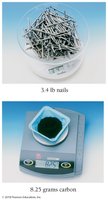
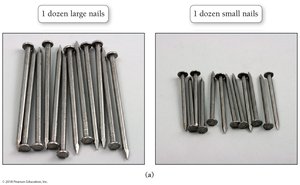
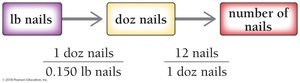
In practical scenarios, such as purchasing nails by the pound, counting is done by weighing rather than individually tallying each item. This analogy extends to chemistry, where atoms are counted by weighing due to their extremely small size and large numbers.
Conversion Factors in Counting
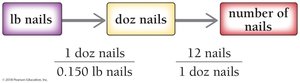
To determine the number of items (e.g., nails) from a given mass, conversion factors such as the weight per dozen and the number of items per dozen are used. This method is analogous to converting between mass and number of atoms in chemistry.
The Mole: Chemist's Counting Unit
Definition and Avogadro's Number
The mole (mol) is the SI unit for amount of substance, defined as exactly 6.022 × 10²³ entities (Avogadro's number). This large number allows chemists to count atoms, molecules, or ions by weighing macroscopic amounts of material.
1 mol = 6.022 × 10²³ particles
Examples: 1 mol of marbles = 6.022 × 10²³ marbles
Reasonable Quantities in the Real World
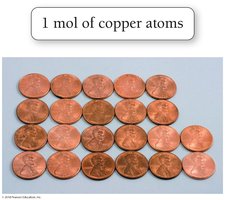
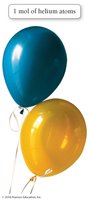
One mole of atoms or molecules corresponds to quantities that are tangible in everyday life. For example, 22 copper pennies contain about 1 mol of copper atoms, and two large helium balloons contain about 1 mol of helium atoms.
Relationship Between Mass and Number of Particles
The mole is defined such that the number of atoms in exactly 12 g of carbon-12 is Avogadro's number. This definition links the mass of a substance to the number of particles it contains, enabling counting by weighing.
Conversions Involving Moles, Mass, and Number of Particles
Converting Moles to Number of Atoms
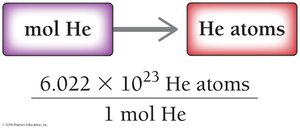
To convert moles of a substance to the number of atoms, multiply by Avogadro's number:
1 mol He = 6.022 × 10²³ He atoms
Converting Number of Atoms to Moles
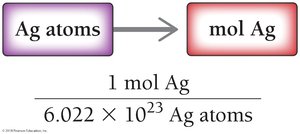
To convert the number of atoms to moles, divide by Avogadro's number:
1 mol Ag = 6.022 × 10²³ Ag atoms

Mass and Moles: The Molar Mass Concept
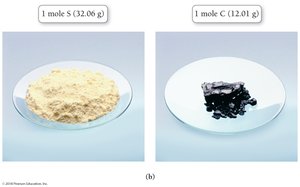
The molar mass of an element is the mass of 1 mol of its atoms, numerically equal to its atomic mass in grams per mole (g/mol). For example, copper has a molar mass of 63.55 g/mol.
Converting Between Grams and Moles
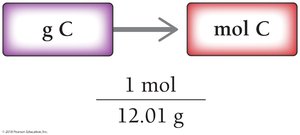
To convert grams to moles, divide by the molar mass. To convert moles to grams, multiply by the molar mass.
Example: Calculate moles of carbon in 0.58 g diamond.

Converting Grams to Moles to Atoms
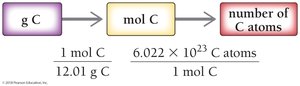
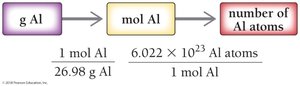
To find the number of atoms in a given mass, first convert grams to moles, then moles to atoms using Avogadro's number.
Example: Aluminum Atoms in a Can
To determine the number of aluminum atoms in a 16.2 g can, convert grams to moles (using the molar mass of Al), then moles to atoms.

Molar Mass of Compounds
Definition and Calculation
The molar mass of a compound is the mass of 1 mol of its molecules or formula units, calculated as the sum of the atomic masses of all atoms in the chemical formula.
Example: Water
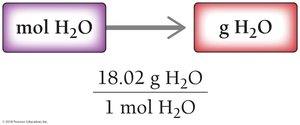
Calculate the mass in grams of 1.75 mol of water (H2O):
Molar mass H2O = 2(1.01) + 16.00 = 18.02 g/mol

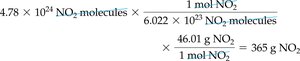
Example: Nitrogen Dioxide
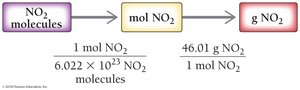
Calculate the mass of 4.78 × 1024 NO2 molecules:
Molar mass NO2 = 14.01 + 2(16.00) = 46.01 g/mol
Chemical Formulas as Conversion Factors
Using Chemical Formulas for Stoichiometry
Chemical formulas provide ratios of elements in compounds, which can be used as conversion factors. For example, CO2 contains two oxygen atoms per molecule, so the ratio is 2 O : 1 CO2.

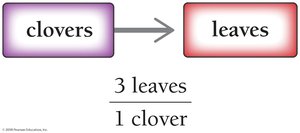
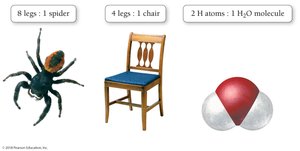
Example: Moles of Oxygen in Calcium Carbonate
To find the number of moles of oxygen in 1.7 mol CaCO3, use the ratio from the formula (3 mol O : 1 mol CaCO3).
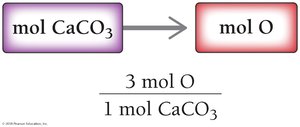
Example: Mass of Sodium in Sodium Chloride
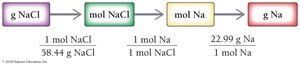
To find the mass of sodium in 15 g of NaCl, convert grams of NaCl to moles, then to moles of Na, and finally to grams of Na.

Mass Percent Composition
Definition and Calculation
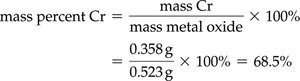
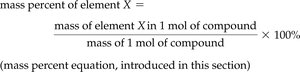
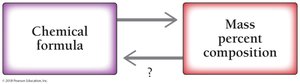
The mass percent composition of an element in a compound is the percentage of the compound's total mass contributed by that element. It is calculated as:

Example: Chromium in Metal Oxide
Given a 0.358-g sample of chromium forming 0.523 g of metal oxide, the mass percent of chromium is:
Using Mass Percent as a Conversion Factor
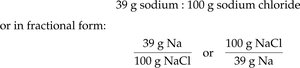
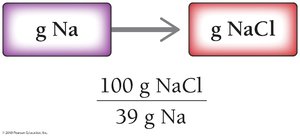
Mass percent can be used to convert between grams of an element and grams of a compound. For example, sodium chloride is 39% sodium by mass, so:
39 g Na : 100 g NaCl
Example: Sodium Intake from Sodium Chloride
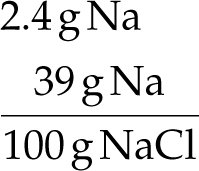
To stay within the FDA guideline of 2.4 g sodium per day, calculate the maximum grams of NaCl that can be consumed (NaCl is 39% sodium by mass):

Mass Percent from Chemical Formulas
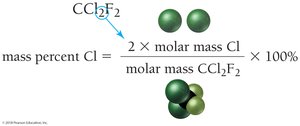
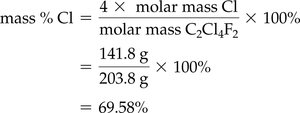
Mass percent can also be calculated directly from a chemical formula using atomic masses. For example, the mass percent of Cl in CCl2F2 is:
Example: Mass Percent of Cl in Freon-114
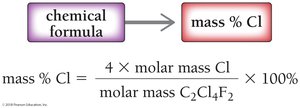
Calculate the mass percent of Cl in C2Cl4F2:
Empirical and Molecular Formulas
Empirical Formula
The empirical formula gives the simplest whole-number ratio of atoms in a compound. The molecular formula is a whole-number multiple of the empirical formula.
Example: Hydrogen peroxide (H2O2) has the empirical formula HO.
Calculating Empirical Formulas from Experimental Data
To determine an empirical formula from mass data:
Write down the masses of each element.
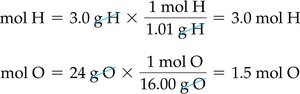
Convert masses to moles using molar masses.
Write a pseudo-formula using the mole values as subscripts.
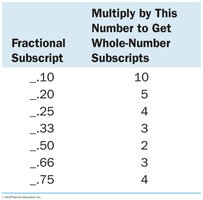
Divide all subscripts by the smallest subscript to get whole numbers.
If necessary, multiply by a small integer to obtain whole-number subscripts.
Calculating Molecular Formulas
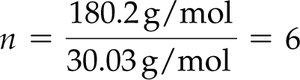
The molecular formula is determined by multiplying the empirical formula by an integer n, found by dividing the compound's molar mass by the empirical formula molar mass:

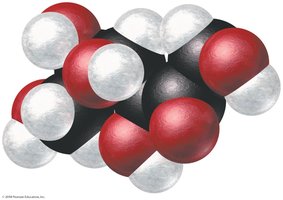
Example: Fructose
Given the empirical formula CH2O and a molar mass of 180.2 g/mol, the molecular formula for fructose is C6H12O6.
Summary of Key Concepts
The mole allows chemists to count atoms and molecules by weighing.
Molar mass links the mass of a substance to the number of particles it contains.
Chemical formulas provide conversion factors for stoichiometric calculations.
Mass percent composition is useful for converting between mass of elements and compounds.
Empirical and molecular formulas can be determined from experimental data and molar mass.
