 Back
Chapter 7: Chemical Reactions – Structured Study Notes for Introductory Chemistry
Study Guide - Smart Notes
 Tailored notes based on your materials, expanded with key definitions, examples, and context.
Chemical Reactions
Evidence of a Chemical Reaction
Chemical reactions are processes in which substances change into different substances. Identifying a chemical reaction often relies on observable evidence, though definitive proof requires chemical analysis. The following signs commonly indicate a chemical reaction:
Color change
Formation of a solid (precipitate) in a previously clear solution
Formation of a gas when a substance is added to a solution
Emission of light
Emission or absorption of heat
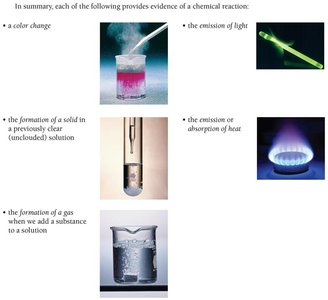
However, not all observable changes are evidence of a chemical reaction. For example, boiling water produces bubbles and steam, but no new substances are formed; water molecules remain unchanged.
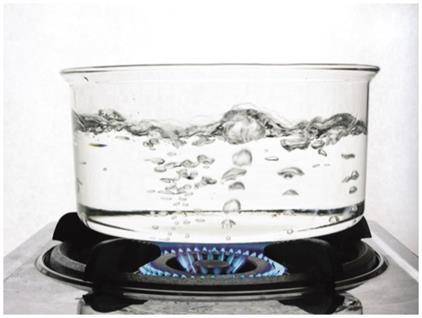
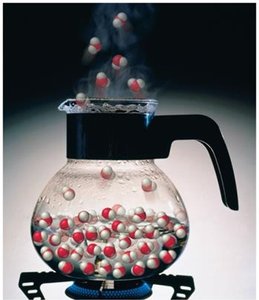
Additional info: Only chemical analysis that shows the initial substances have changed into other substances conclusively proves a chemical reaction has occurred.
Types of Chemical Reactions
Chemical reactions can be classified based on the changes occurring at the atomic and molecular level. The main types include:
Precipitation reactions: Formation of a solid from two aqueous solutions.
Acid–base reactions: Formation of water and a salt from an acid and a base.
Gas evolution reactions: Formation of a gas from reactants in solution.
Oxidation–reduction (redox) reactions: Transfer of electrons between substances.
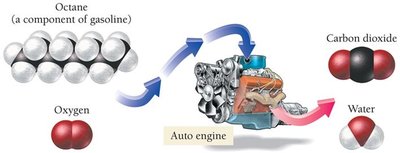
Combustion reactions: Reaction with oxygen, often producing heat, carbon dioxide, and water.
The Chemical Equation
Representing Chemical Reactions
Chemical reactions are represented by chemical equations. The substances on the left are reactants, and those on the right are products. The physical state of each substance is indicated in parentheses:
(g): gas
(l): liquid
(s): solid
(aq): aqueous (dissolved in water)
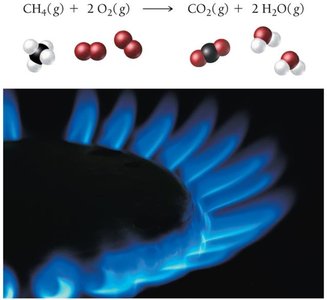
Example: Combustion of methane
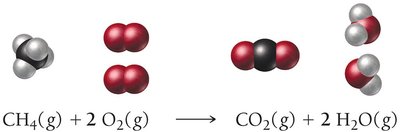
To balance a chemical equation, adjust the coefficients (numbers in front of formulas) so the number of each type of atom is equal on both sides. Never change subscripts.
Steps for Writing Balanced Chemical Equations
Write a skeletal equation with correct formulas for reactants and products.
Balance elements that occur in only one compound on each side first (metals before nonmetals).
Balance free elements last by adjusting their coefficients.
If fractions appear, multiply the entire equation to obtain whole numbers.
Check that the equation is balanced by summing the number of each atom on both sides.
Example: Reaction of aluminum with sulfuric acid:
Aqueous Solutions and Solubility
Solubility and Electrolytes
A compound is soluble if it dissolves in a liquid, and insoluble if it does not. An aqueous solution is a homogeneous mixture of a substance with water. Ionic compounds that dissolve in water usually dissociate into their component ions.
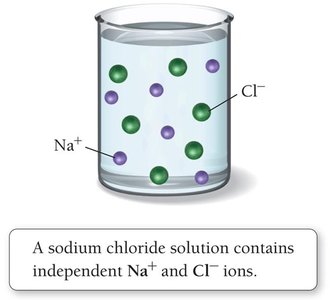
Substances that completely dissociate into ions are called strong electrolytes. Pure water does not conduct electricity, but strong electrolyte solutions do.
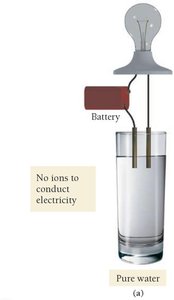
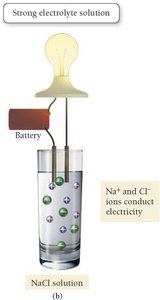
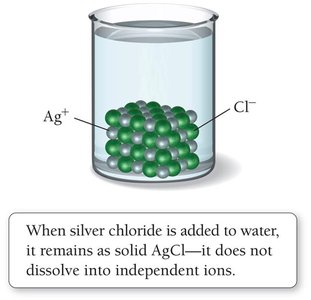
Not all ionic compounds are soluble. For example, AgCl does not dissolve in water and remains as a solid.
Solubility Rules
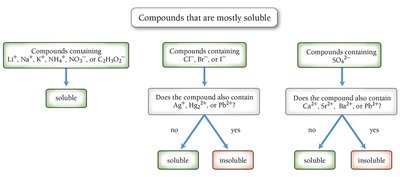
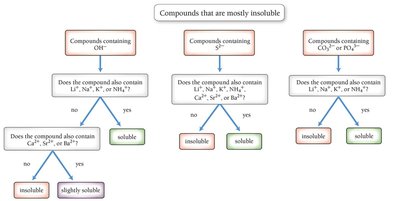
Empirical rules help predict solubility of ionic compounds. For example, compounds containing Li+, Na+, K+, NH4+, NO3-, or C2H3O2- are generally soluble. Compounds containing CO32- or PO43- are generally insoluble unless paired with Li+, Na+, K+, or NH4+.
Ion | Mostly Soluble | Exceptions |
|---|---|---|
Li+, Na+, K+, NH4+ | Soluble | None |
NO3-, C2H3O2- | Soluble | None |
Cl-, Br-, I- | Soluble | Ag+, Hg22+, Pb2+ |
SO42- | Soluble | Ca2+, Sr2+, Ba2+, Pb2+ |
OH-, S2- | Insoluble | Li+, Na+, K+, NH4+ |
CO32-, PO43- | Insoluble | Li+, Na+, K+, NH4+ |
Precipitation Reactions
Formation of a Solid in Solution
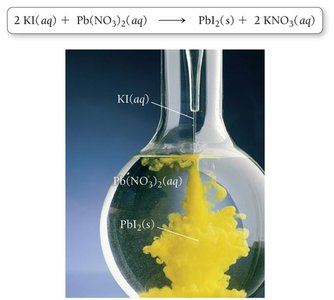
Precipitation reactions occur when two aqueous solutions combine to form an insoluble solid, called a precipitate. For example, mixing potassium iodide (KI) and lead(II) nitrate [Pb(NO3)2] forms a yellow precipitate of lead(II) iodide (PbI2).
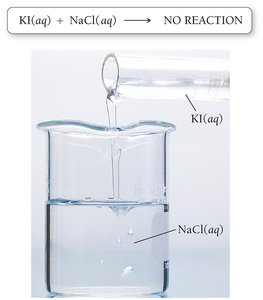
Not all combinations of aqueous solutions result in precipitation. For example, mixing KI and NaCl produces no reaction.
Predicting Precipitation Reactions
To predict precipitation reactions:
Write the formulas for the reactants.
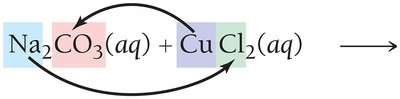
Combine the cation from one reactant with the anion from the other.
Use solubility rules to determine if any products are insoluble.
If an insoluble product forms, write it as a solid (s); otherwise, write "No Reaction".
Balance the equation.
Writing Chemical Equations for Reactions in Solution
Molecular, Complete Ionic, and Net Ionic Equations
Three types of equations are used to represent reactions in solution:
Molecular equation: Shows complete, neutral formulas for all compounds.
Complete ionic equation: Shows all ions as they are present in solution.
Net ionic equation: Shows only the ions and molecules that participate in the reaction, omitting spectator ions.

Acid–Base Reactions
Formation of Water and Salt
Acid–base reactions (neutralization reactions) occur when an acid reacts with a base to form water and an ionic compound (salt). The net ionic equation for many acid–base reactions is:

Acid | Formula | Base | Formula |
|---|---|---|---|
Hydrochloric acid | HCl | Sodium hydroxide | NaOH |
Hydrobromic acid | HBr | Lithium hydroxide | LiOH |
Nitric acid | HNO3 | Potassium hydroxide | KOH |
Sulfuric acid | H2SO4 | Calcium hydroxide | Ca(OH)2 |
Perchloric acid | HClO4 | Barium hydroxide | Ba(OH)2 |
Acetic acid | HC2H3O2 |
Gas Evolution Reactions
Formation of Gases in Solution
Gas evolution reactions produce a gas as a product. Common types include:
Reactant Type | Intermediate Product | Gas Evolved |
|---|---|---|
Sulfides | None | H2S |
Carbonates and bicarbonates | H2CO3 | CO2 |
Sulfites and bisulfites | H2SO3 | SO2 |
Ammonium | NH4OH | NH3 |
Example: Reaction of hydrochloric acid with potassium carbonate:
Oxidation–Reduction (Redox) Reactions
Electron Transfer Reactions
Redox reactions involve the transfer of electrons between substances. Oxidation is the loss of electrons, and reduction is the gain of electrons. These reactions are responsible for processes such as rusting, bleaching, and battery operation.
OIL RIG: Oxidation Is Loss; Reduction Is Gain
LEO GER: Lose Electrons Oxidation; Gain Electrons Reduction
Redox reactions occur when:
A substance reacts with elemental oxygen
A metal reacts with a nonmetal
One substance transfers electrons to another
Combustion Reactions
Combustion reactions are a type of redox reaction characterized by the reaction of a substance with oxygen to form oxygen-containing compounds, often including water. Combustion reactions are exothermic (emit heat).
Classifying Chemical Reactions
Types of Reactions by Atomic Changes
Chemical reactions can be classified by the changes in atomic arrangements:
Synthesis (Combination): Two simpler substances combine to form a more complex substance. Generic equation:
Decomposition: A complex substance breaks down into simpler substances. Generic equation:
Single-displacement: One element displaces another in a compound. Generic equation:
Double-displacement: Two elements or groups exchange places in two compounds. Generic equation:
Precipitation, acid–base, and gas evolution reactions are often double-displacement reactions.
Chemistry in the Environment: Ozone Depletion
Reactions Involved in Ozone Depletion
Chlorine atoms from chlorofluorocarbons (CFCs) catalyze the destruction of ozone in the atmosphere. Through a cycle of reactions, a single CFC molecule can deplete thousands of ozone molecules.
Additional info: This topic connects chemical reactions to environmental chemistry, illustrating the impact of reaction mechanisms on atmospheric chemistry.
Review and Learning Objectives
Identify a chemical reaction
Write balanced chemical equations
Determine if a compound is soluble
Predict and write equations for precipitation reactions
Write molecular, complete ionic, and net ionic equations
Identify and write equations for acid–base reactions
Identify and write equations for gas evolution reactions
Identify redox reactions
Identify and write equations for combustion reactions
Classify chemical reactions
