 Back
BackChapter 8: Quantities in Chemical Reactions – Stoichiometry, Limiting Reactants, and Yield
Study Guide - Smart Notes
 Tailored notes based on your materials, expanded with key definitions, examples, and context.
Quantities in Chemical Reactions
Introduction to Stoichiometry
Stoichiometry is the study of the quantitative relationships between the amounts of reactants and products in a chemical reaction. It allows chemists to predict the amount of products formed from given reactants and to determine the necessary quantities of reactants for a desired amount of product.
Global Warming and Greenhouse Gases
The Greenhouse Effect
The greenhouse effect describes how certain gases in Earth's atmosphere trap heat, much like glass in a greenhouse. Sunlight passes through the atmosphere and warms Earth's surface, but greenhouse gases prevent some of the heat from escaping back into space, leading to a rise in global temperatures as their concentrations increase.
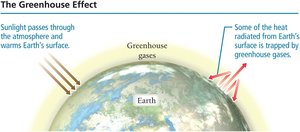
Greenhouse gases include carbon dioxide (CO2), methane (CH4), and water vapor (H2O).
Since 1880, atmospheric CO2 levels have risen significantly, correlating with an increase in Earth's average temperature.
Combustion of Fossil Fuels and CO2 Production
Combustion of fossil fuels such as octane (a component of gasoline) produces water and carbon dioxide. The balanced chemical equation for octane combustion allows us to calculate the amount of CO2 produced from a given amount of fuel burned, linking human activity to increased atmospheric CO2 levels.
Stoichiometry: Relationships Between Ingredients
Understanding Reaction Stoichiometry
Reaction stoichiometry refers to the numerical relationships between chemical quantities in a balanced chemical equation. These relationships allow us to:
Predict the amount of product formed from a given amount of reactant.
Determine the amount of one reactant needed to completely react with another.
Analogous to a recipe, stoichiometry provides the "ingredients list" for chemical reactions.
Example: Pancake Recipe Analogy
A recipe might state that 2 eggs make 5 pancakes. If you have 8 eggs, you can make 20 pancakes, assuming all other ingredients are sufficient. This ratio-based reasoning is directly analogous to stoichiometric calculations in chemistry.
Stoichiometry: Mole-to-Mole Conversions
Balanced Chemical Equations as Recipes
A balanced chemical equation shows the ratio in which reactants combine to form products. For example, the synthesis of ammonia from nitrogen and hydrogen is represented as:
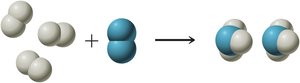
1 molecule of N2 reacts with 3 molecules of H2 to form 2 molecules of NH3.
These ratios apply to moles as well: 1 mol N2 : 3 mol H2 : 2 mol NH3.
Example: Mole-to-Mole Conversion
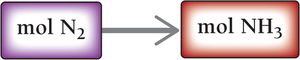
If you have 3 mol of N2 and excess H2, the amount of NH3 produced can be calculated using the mole ratio from the balanced equation.
Stoichiometry: Mass-to-Mass Conversions
General Approach
Often, reactant and product quantities are measured in grams. To relate masses, follow these steps:
Convert mass of reactant to moles using molar mass.
Use the balanced equation to convert moles of reactant to moles of product.
Convert moles of product to mass using molar mass.
Limiting Reactant, Theoretical Yield, and Percent Yield
Key Definitions
Limiting reactant (or limiting reagent): The reactant that is completely consumed first, thus limiting the amount of product formed.
Theoretical yield: The maximum amount of product that can be formed from the limiting reactant, calculated from stoichiometry.
Actual yield: The amount of product actually obtained from a reaction (usually less than the theoretical yield).
Percent yield: The ratio of actual yield to theoretical yield, expressed as a percentage.
Example: Pancake Analogy for Limiting Reactant
If you have enough flour for 15 pancakes, enough eggs for 25, and enough baking powder for 40, flour is the limiting ingredient, and 15 pancakes is the theoretical yield. If only 11 pancakes are actually made (due to burning or dropping), the percent yield is:
Limiting Reactant Problems: Moles
Finding the Limiting Reactant and Theoretical Yield
Given the initial moles of two reactants, use the balanced equation to determine which reactant produces the least amount of product. That reactant is the limiting reactant, and the corresponding amount of product is the theoretical yield.
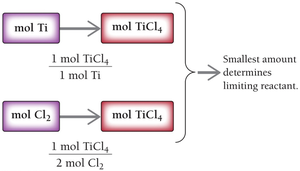
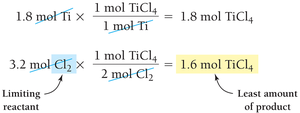
Example: If you start with 1.8 mol Ti and 3.2 mol Cl2:
1.8 mol Ti produces 1.8 mol TiCl4
3.2 mol Cl2 produces 1.6 mol TiCl4
Cl2 is the limiting reactant; theoretical yield is 1.6 mol TiCl4
Limiting Reactant Problems: Mass
Steps for Mass-Based Calculations
Convert masses of reactants to moles.
Use stoichiometry to determine which reactant produces less product (the limiting reactant).
The smallest calculated product amount is the theoretical yield.
Limiting Reactant Problems: Percent Yield
Calculating Percent Yield
Given the actual yield (from experiment) and the theoretical yield (from calculation), percent yield is calculated as:
Review and Learning Objectives
Recognize numerical relationships in balanced chemical equations.
Carry out mole-to-mole and mass-to-mass conversions.
Calculate limiting reactant, theoretical yield, and percent yield.
Summary Table: Key Stoichiometry Terms
Term | Definition |
|---|---|
Limiting Reactant | The reactant that is completely consumed first, limiting the amount of product formed. |
Theoretical Yield | The maximum amount of product that can be formed from the limiting reactant. |
Actual Yield | The amount of product actually obtained from a reaction. |
Percent Yield | The ratio of actual yield to theoretical yield, expressed as a percentage. |
