 Back
BackCHEM 103 Final Exam Comprehensive Study Guide
Study Guide - Smart Notes
 Tailored notes based on your materials, expanded with key definitions, examples, and context.
Introduction to Chemistry
Key Concepts and Reference Data
This guide provides essential reference information and formulas for introductory college chemistry, including atomic structure, chemical reactions, the periodic table, and important constants and equations.
The Metric System and Unit Conversions
Common Conversions and Constants
Avogadro’s Number: atoms, molecules, or formula units per mole.
Molar Volume of Gas at STP: 1 mol gas = 22.4 L (at 0°C and 1 atm).
Molar Mass: 1 mol = molar mass (g/mol).
Temperature Conversions:
Celsius to Kelvin:
Fahrenheit to Celsius:
Celsius to Fahrenheit:
Matter and Energy
Density and Percent Composition
Density:
Percent Composition:
Models of the Atom
Electron Configuration
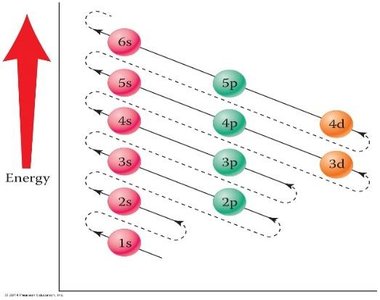
Electron configuration describes the arrangement of electrons in an atom’s orbitals. The order of filling is based on increasing energy levels.
Order: 1s, 2s, 2p, 3s, 3p, 4s, 3d, 4p, 5s, 4d, 5p, 6s, 4f, 5d, 6p
The Periodic Table
Element Classification and Trends
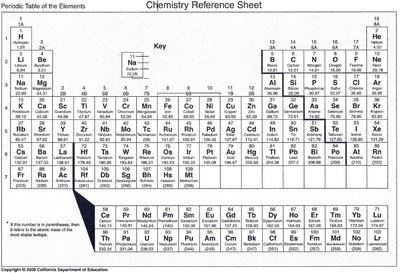
The periodic table organizes elements by increasing atomic number and groups elements with similar chemical properties.
Groups: Vertical columns (e.g., Group 1A: Alkali metals, Group 2A: Alkaline earth metals).
Periods: Horizontal rows.
Metals, Nonmetals, Metalloids: Metals are on the left, nonmetals on the right, and metalloids border the staircase line.
Electronegativity Trends
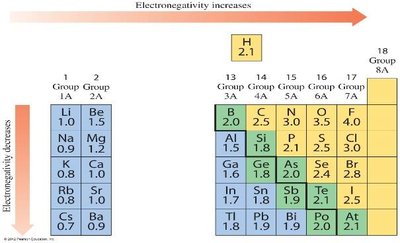
Electronegativity increases across a period (left to right) and decreases down a group (top to bottom).
Language of Chemistry
Common Polyatomic Ions
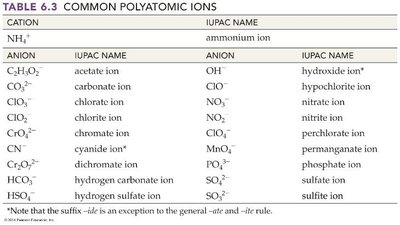
Polyatomic ions are ions composed of two or more atoms covalently bonded, carrying a net charge. Memorizing common polyatomic ions is essential for naming and writing chemical formulas.
Cation | IUPAC Name |
|---|---|
NH4+ | ammonium ion |
Anion | IUPAC Name |
|---|---|
C2H3O2- | acetate ion |
CO32- | carbonate ion |
ClO3- | chlorate ion |
ClO2- | chlorite ion |
CrO42- | chromate ion |
CN- | cyanide ion |
Cr2O72- | dichromate ion |
HCO3- | hydrogen carbonate ion |
HSO4- | hydrogen sulfate ion |
OH- | hydroxide ion |
NO3- | nitrate ion |
NO2- | nitrite ion |
ClO4- | perchlorate ion |
MnO4- | permanganate ion |
PO43- | phosphate ion |
SO42- | sulfate ion |
SO32- | sulfite ion |
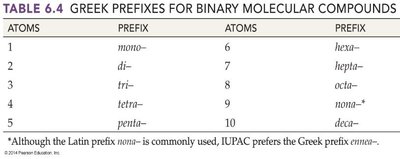
Greek Prefixes for Binary Molecular Compounds
Greek prefixes are used to indicate the number of atoms of each element in binary molecular compounds.
Atoms | Prefix | Atoms | Prefix |
|---|---|---|---|
1 | mono- | 6 | hexa- |
2 | di- | 7 | hepta- |
3 | tri- | 8 | octa- |
4 | tetra- | 9 | nona-* |
5 | penta- | 10 | deca- |
Chemical Reactions
Activity Series for Metals
The activity series ranks metals by their reactivity in single-replacement reactions. A metal can replace any metal below it in the series from a compound.
Order (most to least reactive): Li > K > Ba > Sr > Ca > Na > Mg > Al > Mn > Zn > Fe > Cd > Co > Ni > Sn > Pb > (H) > Cu > Ag > Hg > Au
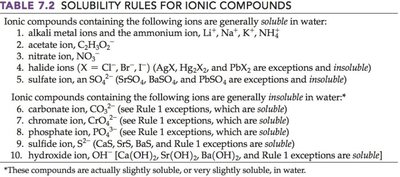
Solubility Rules for Ionic Compounds
Solubility rules help predict whether an ionic compound will dissolve in water.
Ionic compounds containing alkali metal ions or ammonium ion are soluble.
Acetate, nitrate, and most halide and sulfate salts are soluble (with exceptions).
Carbonates, chromates, phosphates, sulfides, and hydroxides are generally insoluble (with exceptions).
The Mole Concept
Stoichiometry and Percent Yield
Percent Yield:
Chemical Equation Calculations
Unit Analysis Map
Unit analysis (dimensional analysis) is used to convert between units using conversion factors.
Set up a chain of conversion factors to cancel units and solve for the desired quantity.
Gases
Gas Laws and Pressure Units
Boyle’s Law: (at constant T and n)
Charles’s Law: (at constant P and n)
Gay-Lussac’s Law: (at constant V and n)
Combined Gas Law:
Ideal Gas Law:
Gas Constant (R): 0.0821 L·atm/mol·K or 62.4 L·mmHg/mol·K
Dalton’s Law of Partial Pressures:
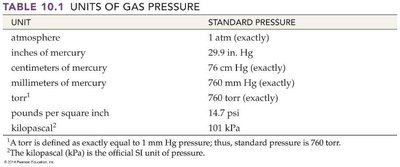
Units of Gas Pressure
Unit | Standard Pressure |
|---|---|
atmosphere | 1 atm (exactly) |
inches of mercury | 29.9 in. Hg |
centimeters of mercury | 76 cm Hg (exactly) |
millimeters of mercury | 760 mm Hg (exactly) |
torr | 760 torr (exactly) |
pounds per square inch | 14.7 psi |
kilopascal | 101 kPa |
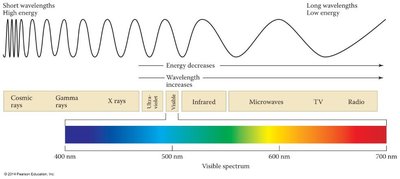
Models of the Atom and Electromagnetic Spectrum
Energy Levels and Electron Transitions
Electrons occupy specific energy levels. Transitions between these levels involve absorption or emission of energy as electromagnetic radiation.
Order of Orbital Filling
The order in which electrons fill atomic orbitals is determined by the Aufbau principle, which fills lower energy orbitals first.
Additional Reference Tables
Periodic Table with Common Ions
This table highlights the most common ionic charges for main group elements and transition metals.
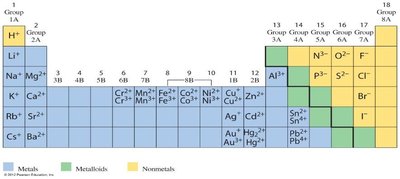 *Additional info: This guide covers all major topics relevant to an introductory chemistry course, including atomic structure, periodic trends, chemical nomenclature, stoichiometry, gas laws, and solution chemistry. The included tables and diagrams are essential for quick reference and exam preparation.*
