 Back
BackCHEM 170 Exam 1 Study Guide: Foundations of Chemistry
Study Guide - Smart Notes
 Tailored notes based on your materials, expanded with key definitions, examples, and context.
The Chemical World
Chemicals in Everyday Life
Chemicals are the substances that make up everything we encounter in our world, from the air we breathe to the food we eat. Understanding their properties and interactions is fundamental to chemistry.
Chemicals are defined as substances with a definite composition.
Examples: Water (H2O), table salt (NaCl), and carbon dioxide (CO2).
The Scientific Method
The scientific method is a systematic approach used to investigate natural phenomena and develop new knowledge.
Observation: Gathering information through the senses.
Hypothesis: A tentative explanation for an observation.
Experimentation: Testing hypotheses through controlled experiments.
Laws: Statements that summarize experimental results.
Theories: Explanations that unify laws and observations.
Interpreting Data and Graphs
Identifying patterns in data and interpreting graphs is essential for understanding chemical phenomena.
Graphs visually represent relationships between variables.
Patterns help predict outcomes and understand trends.
Measurement and Problem Solving
Scientific Notation
Scientific notation is used to express very large or very small numbers in a concise form.
Example: (Avogadro's number).
Format: where is a number between 1 and 10, and is an integer.
Significant Figures
Significant figures reflect the precision of a measured quantity.
All nonzero digits are significant.
Zeros between nonzero digits are significant.
Trailing zeros in a decimal number are significant.
Rounding and Calculations
Numbers are rounded to the correct number of significant figures after calculations.
Multiplication/Division: Round to the least number of significant figures.
Addition/Subtraction: Round to the least number of decimal places.
Metric (SI) Units and Prefixes
The metric system uses standard units and prefixes to measure quantities.
Length: meter (m)
Mass: kilogram (kg)
Time: second (s)
Prefixes: kilo- (), centi- (), milli- ()
Dimensional Analysis and Unit Conversions
Dimensional analysis uses conversion factors to change units between metric and English systems.
Example:
Conversion factors are ratios used to multiply and cancel units.
Density Calculations
Density is a physical property defined as mass per unit volume.
Formula:
Units: g/cm3 or kg/m3
Used as a conversion factor between mass and volume.
Matter and Energy
Definitions: Matter, Atoms, Molecules
Matter is anything that has mass and occupies space. Atoms are the basic units of matter, and molecules are combinations of atoms.
Matter: Anything with mass and volume.
Atom: Smallest unit of an element.
Molecule: Two or more atoms bonded together.
States of Matter
Matter exists in three primary states: solid, liquid, and gas.
Solid: Definite shape and volume.
Liquid: Definite volume, indefinite shape.
Gas: Indefinite shape and volume.
Classification of Matter
Matter can be classified as elements, compounds, or mixtures.
Element: Pure substance made of one type of atom.
Compound: Substance made of two or more elements chemically bonded.
Mixture: Combination of two or more substances not chemically bonded.
Homogeneous mixture: Uniform composition.
Heterogeneous mixture: Non-uniform composition.
Physical vs. Chemical Properties
Physical properties can be observed without changing the substance, while chemical properties describe how a substance reacts.
Physical properties: Color, density, melting point.
Chemical properties: Reactivity, flammability.
Physical vs. Chemical Changes
Physical changes alter the form but not the identity of a substance; chemical changes produce new substances.
Physical change: Melting, boiling, dissolving.
Chemical change: Burning, rusting.
Temperature and Scales
Temperature measures the average kinetic energy of particles. Three scales are used: Celsius, Fahrenheit, and Kelvin.
Celsius (°C): Water freezes at 0°C, boils at 100°C.
Fahrenheit (°F): Water freezes at 32°F, boils at 212°F.
Kelvin (K): Absolute zero is 0 K.
Atoms and Elements
Atomic Theory
All matter is composed of atoms. Atomic theory explains the structure and behavior of atoms.
Atoms are indivisible particles.
Atoms of the same element are identical.
Atoms combine to form compounds.
Nuclear Theory of the Atom
The nuclear theory describes the atom as having a dense nucleus containing protons and neutrons, surrounded by electrons.
Nucleus: Contains protons and neutrons.
Electrons: Orbit the nucleus.
Subatomic Particles
Atoms are made of protons, neutrons, and electrons, each with distinct properties.
Proton: Positive charge, located in nucleus.
Neutron: No charge, located in nucleus.
Electron: Negative charge, orbits nucleus.
Atomic Symbols and Numbers
Each element has a unique atomic symbol and number, which can be found on the periodic table.
Atomic number (Z): Number of protons.
Atomic mass: Weighted average mass of isotopes.
Periodic Table Classification
The periodic table organizes elements by increasing atomic number and groups them by similar properties.
Groups: Columns with similar properties.
Metals: Conductive, malleable.
Nonmetals: Insulating, brittle.
Metalloids: Properties intermediate between metals and nonmetals.
Isotopes and Mass Notation
Isotopes are atoms of the same element with different numbers of neutrons. Mass notation is used to represent isotopes.
Isotope: Same atomic number, different mass number.
Mass number (A): Sum of protons and neutrons.
Isotope notation: Element-A or AElement
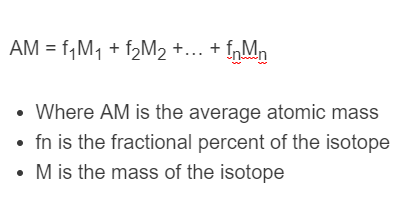
Average Atomic Mass Calculation
The average atomic mass is calculated using the fractional abundance and mass of each isotope.
Formula:
AM: Average atomic mass
fn: Fractional percent of the isotope
M: Mass of the isotope
Chemical Composition
The Mole Concept
The mole is a counting unit used to relate the mass of a substance to the number of particles.
1 mole: particles (Avogadro's number)
Used to convert between grams, moles, and number of atoms/molecules.
Dimensional Analysis for Chemical Quantities
Dimensional analysis is used to convert between mass, moles, and number of particles using conversion factors.
Example:
Conversion factors: Molar mass, Avogadro's number.
Electrons in Atoms and the Periodic Table
Electromagnetic Radiation and Energy
Electromagnetic radiation (light) has different types and energies, which affect atomic behavior.
Types: Gamma rays, X-rays, UV, visible, IR, microwaves, radio waves.
Energy increases with frequency.
Bohr Model of the Atom
The Bohr model describes electrons in fixed orbits around the nucleus, each with specific energy levels.
Electrons move between orbits by absorbing or emitting energy.
Quantum-Mechanical Model
The quantum-mechanical model describes electrons as occupying orbitals, regions of space with a high probability of finding an electron.
Orbitals: s, p, d, f
Electron configuration shows how electrons are distributed among orbitals.
Electron Configurations and Orbital Diagrams
Electron configurations and orbital diagrams represent the arrangement of electrons in an atom.
Example:
Abbreviated configurations use noble gas notation.
Valence Electrons
Valence electrons are the outermost electrons and determine chemical properties.
Elements in the same group have the same number of valence electrons.
Chemical Properties and Valence Electrons
The chemical properties of elements are largely determined by their valence electrons.
Elements with similar valence electron counts behave similarly.
Periodic Trends
Periodic trends describe how properties change across the periodic table.
Atomic size: Increases down a group, decreases across a period.
Ionization energy: Decreases down a group, increases across a period.
Metallic character: Increases down a group, decreases across a period.
Reference Information
Useful Conversion Factors
1 mile = 1.609 kilometer
2.2 pounds = 1 kilogram
Volume of a cube: (where is the length of a side)
Volume of a sphere: (where is the radius)
Sample Electron Configuration
Example:
Additional info: Academic context and explanations have been expanded for clarity and completeness based on the study guide topics.
