 Back
BackChem 31 Exam 1 Study Guide: Measurement, Matter, and Atomic Structure
Study Guide - Smart Notes
 Tailored notes based on your materials, expanded with key definitions, examples, and context.
Chapter 2: Measurement and Problem Solving
Key Vocabulary and Concepts
This chapter introduces fundamental concepts of measurement in chemistry, including precision, accuracy, significant figures, and unit conversions. Understanding these concepts is essential for reliable scientific calculations and data interpretation.
Exact Number: A value known with complete certainty, often from counting or defined relationships (e.g., 1 dozen = 12).
Measurement: A quantitative observation that includes a number and a unit.
Precision: The consistency of repeated measurements.
Accuracy: How close a measurement is to the true value.
Significant Figure: Digits in a measurement that are known with certainty plus one estimated digit.
SI Units: The International System of Units used in scientific measurement (e.g., meter, kilogram, second).
Mass: The amount of matter in an object; SI unit is kilogram (kg).
Volume: The space occupied by an object; SI unit is liter (L).
Density: Mass per unit volume; formula:
Unit Analysis: Using units to guide calculations (dimensional analysis).
Conversion Factor: A ratio used to convert between units.
Uncertainty: The estimated amount by which a measurement may differ from the true value.
Applying Accuracy and Precision
Accuracy and precision are critical for evaluating the reliability of experimental data. Accurate measurements are close to the accepted value, while precise measurements are consistent with each other.
Example: If a balance consistently reads 5.00 g for a 5.00 g standard, it is both accurate and precise.
Scientific Notation and Significant Figures
Scientific notation is used to express very large or small numbers. Significant figures reflect the precision of a measurement.
Scientific Notation: where is a number between 1 and 10, and is an integer.
Rules for Significant Figures:
Nonzero digits are always significant.
Zeros between nonzero digits are significant.
Leading zeros are not significant.
Trailing zeros are significant only if there is a decimal point.
Rounding: Round calculated values to the correct number of significant figures based on the operation performed.
Unit Conversions
Unit conversions are essential for comparing and calculating measurements in chemistry. Conversion factors are used to change units within the metric system or between metric and English units.
Metric Prefixes: Common prefixes include kilo (k, ), centi (c, ), milli (m, ).
Area/Volume Conversions: Derived units such as cm3 for volume.
Density as a Conversion Factor: Density can be used to convert between mass and volume.
Common Unit Equivalents
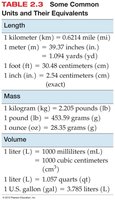
Refer to the following table for common unit conversions in length, mass, and volume.
Length | Equivalent |
|---|---|
1 kilometer (km) | 0.6214 miles (mi) |
1 meter (m) | 39.37 inches (in) |
1 foot (ft) | 30.48 centimeters (cm) |
1 inch (in) | 2.54 centimeters (cm) (exact) |
Mass | Equivalent |
1 kilogram (kg) | 2.205 pounds (lb) |
1 pound (lb) | 453.59 grams (g) |
1 ounce (oz) | 28.35 grams (g) |
Volume | Equivalent |
1 liter (L) | 1000 milliliters (mL) |
1 liter (L) | 1000 cubic centimeters (cm3) |
1 liter (L) | 1.057 quarts (qt) |
1 U.S. gallon (gal) | 3.785 liters (L) |
Density of Common Substances
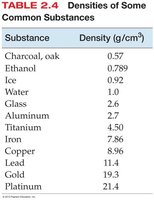
Density is a physical property used to identify substances and solve conversion problems. The following table lists densities of common substances.
Substance | Density (g/cm3) |
|---|---|
Charcoal, oak | 0.57 |
Ethanol | 0.789 |
Ice | 0.92 |
Water | 1.0 |
Glass | 2.6 |
Aluminum | 2.7 |
Titanium | 4.50 |
Iron | 7.86 |
Copper | 8.96 |
Lead | 11.4 |
Gold | 19.3 |
Platinum | 21.4 |
Chapter 3: Matter and Energy
Classification of Matter
Matter is anything that has mass and occupies space. It can be classified as pure substances or mixtures, and further as elements, compounds, homogeneous mixtures, or heterogeneous mixtures.
Pure Substance: Matter with a fixed composition (element or compound).
Mixture: Combination of two or more substances; can be homogeneous (solution) or heterogeneous.
Element: Substance consisting of one type of atom.
Compound: Substance composed of two or more elements chemically combined.
Homogeneous Mixture: Uniform composition throughout (e.g., salt water).
Heterogeneous Mixture: Non-uniform composition (e.g., salad).
Physical and Chemical Properties
Physical properties can be observed without changing the substance's identity, while chemical properties involve a change in composition.
Physical Change: Change in state or appearance (e.g., melting, boiling).
Chemical Change: Change that produces new substances (e.g., rusting).
Law of Conservation of Mass: Mass is neither created nor destroyed in a chemical reaction.
Energy and Its Forms
Energy is the capacity to do work. It exists in various forms, including potential, kinetic, electrical, thermal, and chemical energy.
Potential Energy: Stored energy due to position.
Kinetic Energy: Energy of motion.
Electrical Energy: Energy from moving charges.
Thermal Energy: Energy due to temperature.
Chemical Energy: Energy stored in chemical bonds.
Energy Conversion Factors
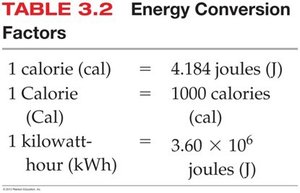
Energy can be measured in different units. The following table provides conversion factors between calories, joules, and kilowatt-hours.
Unit | Equivalent |
|---|---|
1 calorie (cal) | 4.184 joules (J) |
1 Calorie (Cal) | 1000 calories (cal) |
1 kilowatt-hour (kWh) | joules (J) |
Temperature and Heat
Temperature measures the average kinetic energy of particles. Heat is energy transferred due to temperature difference. Three temperature scales are used: Celsius, Fahrenheit, and Kelvin.
Interconversion:
Celsius to Kelvin:
Celsius to Fahrenheit:
Specific Heat Capacity: The amount of heat required to raise the temperature of 1 gram of a substance by 1°C. Formula:
Specific Heat Capacities of Common Substances
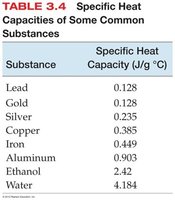
The following table lists specific heat capacities for several substances.
Substance | Specific Heat Capacity (J/g °C) |
|---|---|
Lead | 0.128 |
Gold | 0.128 |
Silver | 0.235 |
Copper | 0.385 |
Iron | 0.449 |
Aluminum | 0.903 |
Ethanol | 2.42 |
Water | 4.184 |
Chapter 4: Atoms and Elements
Atomic Structure and Periodic Table
This chapter covers the structure of atoms, including subatomic particles, isotopes, ions, and the organization of elements in the periodic table.
Electron: Negatively charged particle in an atom.
Proton: Positively charged particle in the nucleus.
Neutron: Neutral particle in the nucleus.
Nucleus: Central part of the atom containing protons and neutrons.
Atomic Number: Number of protons in an atom.
Mass Number: Sum of protons and neutrons.
Atomic Mass: Weighted average mass of an atom based on isotopic abundance.
Isotopes: Atoms of the same element with different numbers of neutrons.
Ions: Atoms or molecules with a net charge due to loss or gain of electrons.
Cation: Positively charged ion.
Anion: Negatively charged ion.
Classification of Elements
Representative (Main Group) Elements: Groups 1, 2, and 13-18.
Transition Elements: Groups 3-12.
Alkali Metals: Group 1.
Alkaline Earth Metals: Group 2.
Chalcogens: Group 16.
Halogens: Group 17.
Noble Gases: Group 18.
Metals: Elements that are typically shiny, conductive, and malleable.
Nonmetals: Elements that are not conductive and are often gases or brittle solids.
Metalloids: Elements with properties intermediate between metals and nonmetals.
Calculating Atomic Mass
Atomic mass can be calculated from the percent natural abundances and isotopic masses using the formula:
Law of Conservation of Mass in Chemical Reactions
In any chemical reaction, the total mass of reactants equals the total mass of products.
Example: If 10 g of reactants produce 10 g of products, mass is conserved.
Periodic Table Memorization
Memorize element names and symbols for elements #1-56 and 72-86.
Know metric prefixes, symbols, and exponents as outlined in Chapter 2.
Additional info: The notes emphasize the importance of memorizing element names, symbols, and metric prefixes for exam success.
