 Back
BackCHEM-C 101 Elementary Chemistry I: Syllabus and Study Guide
Study Guide - Smart Notes
 Tailored notes based on your materials, expanded with key definitions, examples, and context.
Course Overview
Introduction to CHEM-C 101
This course, Elementary Chemistry I (CHEM-C 101), is designed for students with no prior background in chemistry and those not pursuing science careers. It covers the essential principles of chemistry, including atomic and molecular structure, bonding, properties and reactions of elements and compounds, stoichiometry, solutions, acids and bases, and more. The course emphasizes both conceptual understanding and practical problem-solving skills.
Course Structure and Materials
Required Materials
Dedicated folder for class materials
Pencil and paper
Scientific calculator (non-programmable)
Textbooks: Introductory Chemistry: Atoms First (Russo & Silver, 5th Ed.) and Introductory Chemistry (Tro, 7th Ed.)
Prerequisites
High school Algebra I
Learning Objectives
Core Chemistry Skills and Concepts
Apply the scientific method to chemical problems
Use fundamental mathematics and chemical language
Classify, measure, and describe changes in matter
Understand atoms, molecules, and compounds
Explain modern atomic theory and atomic trends
Describe chemical bonding (ionic, covalent, etc.) and its effect on properties
Apply chemical nomenclature and calculate mass relationships
Understand stoichiometry and the gas laws
Describe solids, liquids, and gases at both macroscopic and microscopic levels
Use the VSEPR model to predict molecular geometry
Identify polar and nonpolar molecules
Draw Lewis structures and predict bond strengths/lengths
Define and predict intermolecular forces (IMF): dipole-dipole, hydrogen bonding, dispersion
Relate IMFs to properties like boiling point and viscosity
Define solutions, predict solubility, and explain molecular interactions in solution
Describe chemical equilibrium and reaction rates
Define acids and bases, distinguish strengths, and understand the pH scale
Explain oxidation, reduction, and nuclear chemistry
Course Goals and Outcomes
Terminology and Problem Solving
Recognize and use major chemistry terminology
Identify and name chemical compounds
Write and balance chemical equations
Solve stoichiometric problems using dimensional analysis
Apply chemistry concepts to real-world situations
General Education and Chemistry Learning Outcomes
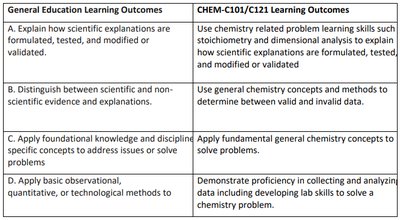
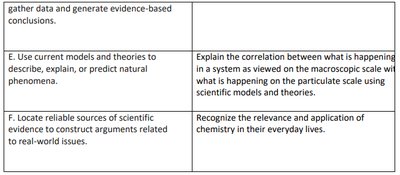
Comparison Table: General Education vs. CHEM-C101/C121 Outcomes
General Education Learning Outcomes | CHEM-C101/C121 Learning Outcomes |
|---|---|
Explain how scientific explanations are formulated, tested, and modified or validated. | Use chemistry-related problem learning skills such as stoichiometry and dimensional analysis to explain how scientific explanations are formulated, tested, and modified or validated. |
Distinguish between scientific and non-scientific evidence and explanations. | Use general chemistry concepts and methods to determine between valid and invalid data. |
Apply foundational knowledge and discipline-specific concepts to address issues or solve problems. | Apply fundamental general chemistry concepts to solve problems. |
Apply basic observational, quantitative, or technological methods to gather data and generate evidence-based conclusions. | Demonstrate proficiency in collecting and analyzing data including developing lab skills to solve a chemistry problem. |
Use current models and theories to describe, explain, or predict natural phenomena. | Explain the correlation between what is happening in a system as viewed on the macroscopic scale with what is happening on the particulate scale using scientific models and theories. |
Locate reliable sources of scientific evidence to construct arguments related to real-world issues. | Recognize the relevance and application of chemistry in their everyday lives. |
Course Schedule
Semester Outline and Major Topics
Chapter 1: What is Chemistry?
Chapter 2: The Numerical Side of Chemistry (Measurement, Units, Problem Solving)
Chapter 3: Evolution of the Atom (Atomic Theory, Structure)
Chapter 4: The Modern Model of the Atom (Electron Configuration, Periodic Trends)
Chapter 5: Chemical Bonding and Nomenclature (Ionic, Covalent Bonds, Naming)
Chapter 6: The Shape of Molecules (VSEPR, Molecular Geometry)
Chapter 7: Intermolecular Forces and Phases of Matter
Chapter 8: Chemical Reactions (Types, Balancing, Energy)
Chapter 9: Stoichiometry and the Mole (Mole Concept, Calculations)
Chapter 10: Electron Transfer and Chemical Reactions (Redox)
Chapter 11: The Ideal Gas Law and Gas Properties
Chapter 12: Solutions (Concentration, Solubility)
Chapter 13: Chemical Kinetics (Reaction Rates)
Chapter 14: Chemical Equilibrium (Le Chatelier's Principle)
Chapter 15: Electrolytes, Acids, and Bases (pH, Strengths)
Chapter 16: Nuclear Chemistry (Radioactivity, Applications)
Assessment and Grading
Indiana University Grading Scale
A+: 98-100%
A: 93-97.9%
A-: 90-92.9%
B+: 87-89.9%
B: 83-86.9%
B-: 80-82.9%
C+: 77-79.9%
C: 73-76.9%
C-: 70-72.9%
D+: 67-69.9%
D: 63-66.9%
D-: 60-62.9%
High School Grading Scale
A: 90-100%
B: 80-89.9%
C: 70-79.9%
D: 60-69.9%
F: 59.9% & below
Assessment Breakdown
Exams (3): 30%
Quizzes (8): 12%
Discussion Worksheets: 32%
Practice Activities: 6%
Final Cumulative Exam: 20%
Classroom Policies and Expectations
Professional Conduct and Safety
Follow all safety protocols and laboratory rules
Respect classmates, instructor, and school property
Be responsible for your own learning and assignments
Arrive prepared and participate actively
Adhere to electronic device and academic integrity policies
Laboratory Safety
Follow all written and verbal instructions
Wear appropriate safety equipment
Report all accidents or unsafe conditions immediately
No eating or drinking in the lab
Keep work areas clean and organized
Academic Integrity
IU Plagiarism and Academic Misconduct Policy
Cheating, plagiarism, and other forms of academic dishonesty are strictly prohibited
Violations may result in failing grades and disciplinary action
Always give proper credit for others' work and ideas
Support and Accessibility
Student Disabilities
Accommodations are available for qualified students
Contact your school’s special education teacher or guidance counselor for support
Mission Statement and Classroom Culture
Instructor’s Mission
The instructor aims to empower students to become lifelong learners, develop critical thinking and life skills, and reach their highest potential in science learning.
Classroom Expectations
Respect for all individuals
Responsibility for assignments and behavior
Readiness to learn and participate
Visual Aids


Additional info: The images included are the official Indiana University logo and the school mascot, which are relevant for institutional identification and school spirit, but do not directly reinforce chemistry concepts.
