 Back
BackChemical Composition: The Mole, Molar Mass, and Chemical Formulas
Study Guide - Smart Notes
 Tailored notes based on your materials, expanded with key definitions, examples, and context.
Chapter 6: Chemical Composition
Introduction to Chemical Composition
Chemical composition refers to the types and amounts of elements that make up a substance. Understanding chemical composition is essential for quantifying substances, predicting reactions, and analyzing compounds in chemistry.
The Mole Concept
Counting Atoms and Molecules by Mass
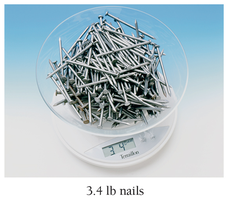
Atoms and molecules are extremely small and numerous, making direct counting impractical. Chemists use mass as a way to count these particles, similar to how hardware stores sell nails by the pound rather than individually.
Key Point: Counting by weighing is a practical method for large quantities of small items, such as nails or atoms.
Example: If a dozen nails weigh 0.150 lb, and a customer buys 2.60 lb, the number of nails can be calculated using conversion factors.

The Mole and Avogadro's Number
The mole (mol) is the chemist’s counting unit, analogous to a dozen but much larger. One mole contains units (Avogadro’s number), whether those units are atoms, molecules, or ions.
Key Point: The mole allows chemists to relate mass to number of particles.
Example: Twenty-two copper pennies contain about 1 mole of copper atoms.
Equation: particles
Defining the Mole
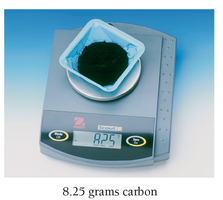
The mole is defined as the number of atoms in exactly 12 grams of pure carbon-12. This definition links mass and number of atoms, enabling chemists to count atoms by weighing them.
Key Point: The mole is a bridge between the atomic scale and the macroscopic scale.
Molar Mass and Atomic Mass
Atomic Mass Unit and Molar Mass
The atomic mass unit (amu) is defined as one-twelfth the mass of a carbon-12 atom. The molar mass of an element is the mass of 1 mole of its atoms, numerically equal to its atomic mass in amu but expressed in grams per mole.
Key Point: The molar mass of copper is 63.55 g/mol, meaning 1 mole of copper atoms weighs 63.55 grams.
Equation:
Converting Between Grams, Moles, and Number of Atoms
Conversions between mass, moles, and number of atoms are fundamental in chemistry. The relationships are:
Grams to Moles:
Moles to Number of Atoms:
Chemical Formulas and Composition
Information in Chemical Formulas
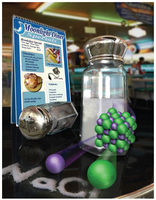
Chemical formulas indicate the relative number of each kind of element in a compound. For example, NaCl contains one sodium ion for every chloride ion. The masses of sodium and chlorine differ, so the mass of sodium in sodium chloride must be calculated using atomic masses and the formula.
Calculating Amounts of Elements in Compounds
To determine the amount of a constituent element in a compound, use the chemical formula and atomic masses. For example, to find the mass of sodium in a given mass of sodium chloride, use the mass percent composition or molar mass relationships.
Mass Percent Composition
Definition and Calculation
Mass percent composition is the percentage by mass of each element in a compound. It is calculated as:
Equation:
Example: Sodium chloride is 39% sodium by mass.
Using Mass Percent as a Conversion Factor
Mass percent composition can be used to convert between grams of an element and grams of a compound. For example, if sodium chloride is 39% sodium by mass, then:
Conversion factor:
Empirical and Molecular Formulas
Empirical Formula from Mass Percent Composition
The empirical formula gives the smallest whole-number ratio of atoms in a compound. It can be determined from mass percent composition or experimental data.
Steps:
Convert mass percent to grams (assume 100 g sample).
Convert grams to moles using molar mass.
Write a pseudo-formula using mole values as subscripts.
Divide by the smallest subscript to get whole numbers.
Example: Decomposition of water yields 3.0 g H and 24 g O. Convert to moles and determine the empirical formula.
Molecular Formula from Empirical Formula and Molar Mass
The molecular formula is a whole-number multiple of the empirical formula. To find the molecular formula:
Equation:
Multiply the subscripts in the empirical formula by n.
Example: Fructose has an empirical formula CH2O and a molar mass of 180.2 g/mol. Calculate n and the molecular formula.
Review and Learning Objectives
Summary of Key Concepts
The mole is a counting unit that relates mass to number of particles.
Molar mass allows conversion between grams and moles.
Chemical formulas provide the relative number of each element in a compound.
Mass percent composition is used to relate the mass of elements to the mass of compounds.
Empirical and molecular formulas can be determined from experimental data and molar mass.
Chemical Skills Learning Objectives
Convert between moles and number of atoms.
Convert between grams and moles.
Convert between grams and number of atoms or molecules.
Convert between moles of a compound and moles of a constituent element.
Convert between grams of a compound and grams of a constituent element.
Use mass percent composition as a conversion factor.
Determine mass percent composition from a chemical formula.
Determine an empirical formula from experimental data.
Calculate a molecular formula from an empirical formula and molar mass.
Applications and Examples
Real-World Examples
Dietary Sodium: Calculating how much sodium chloride can be consumed to stay within FDA sodium guidelines.
Iron Ore: Determining the amount of iron in a given mass of ore.
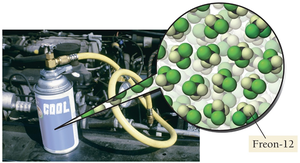
Chlorofluorocarbons: Calculating chlorine content in compounds like Freon-12.

Additional info: These notes expand on the brief points in the source material, providing definitions, equations, and examples for clarity and completeness.
