 Back
BackChemical Equations, Moles, and Solution Concentration: Core Concepts in Chemical Accounting
Study Guide - Smart Notes
 Tailored notes based on your materials, expanded with key definitions, examples, and context.
Chemical Equations and the Law of Conservation of Mass
Law of Conservation of Mass
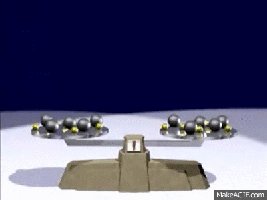
The Law of Conservation of Mass states that matter is neither created nor destroyed in a chemical reaction. This principle, established by Antoine Lavoisier, is foundational to all chemical equations and calculations.
Reactants are substances present before the reaction; products are substances formed as a result.
The total mass and number of atoms for each element must be the same on both sides of the equation.
Chemical Equations: Structure and Balancing
Chemical equations are concise representations of chemical reactions, showing the identities and quantities of reactants and products.
Subscripts indicate the number of atoms of each element in a molecule.
Coefficients indicate the number of molecules or moles involved.
States of matter are denoted as (s) for solid, (l) for liquid, (g) for gas, and (aq) for aqueous.
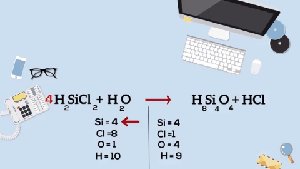
To balance an equation, adjust only the coefficients, never the subscripts.
Balancing Chemical Equations: Stepwise Approach
Balancing ensures the same number of each type of atom on both sides of the equation. The process involves:
Writing correct formulas for all reactants and products.
Counting the number of atoms of each element on both sides.
Balancing one element at a time using coefficients.
Checking that all elements are balanced.
Example: Balancing Sodium Azide Decomposition
Consider the decomposition of sodium azide, used in airbags:
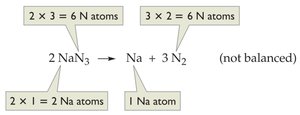
Balancing requires ensuring equal numbers of sodium and nitrogen atoms on both sides.
Volume Relationships and Avogadro's Hypothesis
Law of Combining Volumes
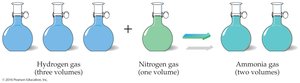
When gases react at constant temperature and pressure, their volumes are in simple whole-number ratios.
Avogadro's Hypothesis
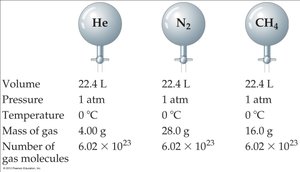
Equal volumes of gases, at the same temperature and pressure, contain equal numbers of molecules. This leads to the concept of molar volume:
At standard temperature and pressure (STP: 0°C, 1 atm), 1 mole of any gas occupies 22.4 L.
The Mole and Avogadro's Number
Definition of the Mole
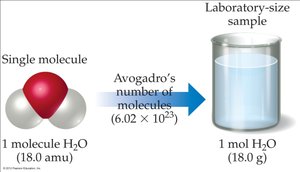
A mole (mol) is the amount of substance containing as many particles (atoms, molecules, ions) as there are in exactly 12 g of carbon-12. This number is Avogadro's number:
Avogadro's number: particles/mol
Using Avogadro's Number
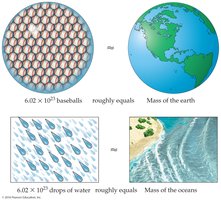
Avogadro's number allows conversion between moles and number of particles:
1 mole = particles
Molar Mass and Formula Mass
Molar Mass
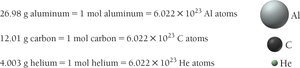
The molar mass of a substance is the mass of one mole of its entities (atoms, molecules, or formula units), expressed in grams per mole (g/mol). For elements, this is the atomic mass from the periodic table.
For compounds, add the atomic masses of all atoms in the formula.
Formula Mass and Molecular Mass
Formula mass is used for ionic compounds; molecular mass for covalent molecules. Both are calculated by summing atomic masses.
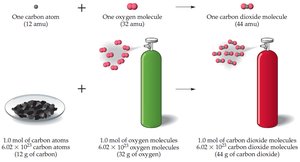
Stoichiometry: Quantitative Chemical Relationships
Stoichiometric Calculations
Stoichiometry uses balanced equations to relate amounts of reactants and products. The coefficients provide the mole ratios needed for conversions.
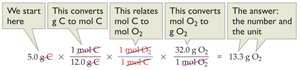
General plan: mass A → moles A → moles B → mass B

Example: Mass Relationships in Reactions
To find the mass of oxygen needed to react with a given mass of carbon:
Convert grams of C to moles of C
Use the mole ratio from the balanced equation
Convert moles of O2 to grams



Solutions and Concentration
Solutions: Definitions
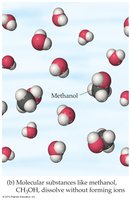
A solution is a homogeneous mixture of two or more substances. The solute is dissolved in the solvent, which is present in greater amount.
Concentration of Solutions
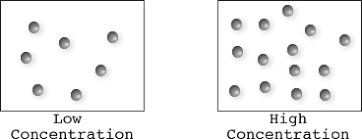
Concentration expresses the amount of solute in a given amount of solution. Common units include:
Percent by mass:
Percent by volume:
Molarity (M):
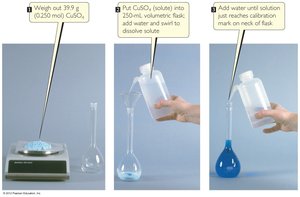
Preparing Solutions of Known Molarity
To prepare a solution of known molarity:
Weigh the required mass of solute.
Dissolve in a volumetric flask.
Add solvent to the calibration mark.
Calculating Molarity and Related Quantities
Example: To find the molarity of a solution, convert grams of solute to moles, then divide by the volume in liters.

To find the mass of solute needed for a given volume and molarity, multiply volume (L) by molarity (mol/L), then by molar mass (g/mol).


To find the volume of solution needed for a given amount of solute and molarity, divide moles by molarity.

Percent Concentration Calculations
Percent by mass and percent by volume are alternative ways to express concentration, useful for practical laboratory and industrial applications.
