 Back
BackChemical Equilibrium: Principles, Expressions, and Applications
Study Guide - Smart Notes
 Tailored notes based on your materials, expanded with key definitions, examples, and context.
Chemical Equilibrium
Dynamic Equilibrium
Dynamic equilibrium occurs when two opposing processes happen at the same rate, resulting in no net change in the system. In chemistry, this refers to reversible reactions where the forward and reverse reactions proceed at equal rates.
Definition: Dynamic equilibrium is the state in which the rate of the forward reaction equals the rate of the reverse reaction.
Example:
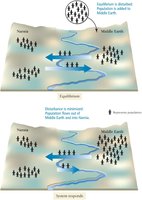
Analogy: Like traffic moving in opposite directions at the same rate, or populations moving between two kingdoms until the rates are equal.
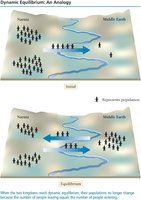
Equilibrium: Sameness and Constancy
At equilibrium, certain properties of a system become constant and unchanging. For example, a cup of hot water cools until its temperature matches its surroundings, then remains constant.
Sameness: The property (e.g., temperature, concentration) is equal to that of the surroundings.
Constancy: The property no longer changes over time.
The Rate of a Chemical Reaction
Reaction Rate
The rate of a chemical reaction measures how quickly reactants are converted to products. It is influenced by several factors, including concentration and temperature.
Definition: Reaction rate is the amount of reactant converted to product per unit time.
Fast Rate: Products form quickly.
Slow Rate: Products form slowly.
Collision Theory
Chemical reactions occur when molecules or atoms collide with sufficient energy to overcome the activation energy barrier.
Activation Energy: The minimum energy required for a reaction to occur.
High-Energy Collisions: Lead to product formation.
Low-Energy Collisions: Do not result in reaction.
Factors Affecting Reaction Rate
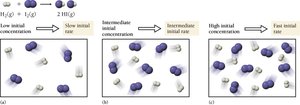
Concentration
Increasing the concentration of reactants generally increases the reaction rate, as more collisions occur per unit time.
Higher concentration: More frequent collisions, faster reaction.
Lower concentration: Fewer collisions, slower reaction.
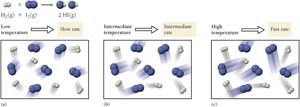
Temperature
Raising the temperature increases the speed of molecules, resulting in more frequent and higher-energy collisions, thus increasing the reaction rate.
Higher temperature: Faster, more energetic collisions, faster reaction.
Lower temperature: Slower, less energetic collisions, slower reaction.
Dynamic Chemical Equilibrium
Reversible Reactions and Equilibrium
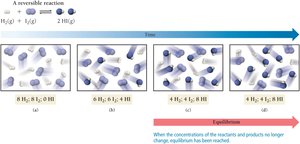
Reversible reactions can proceed in both forward and reverse directions. Dynamic equilibrium is reached when the rates of both directions are equal, and concentrations of reactants and products remain constant.
Condition: Rate of forward reaction = rate of reverse reaction.
Concentration: No net change in reactant or product concentrations.
The Equilibrium Constant (Keq)
Definition and Expression
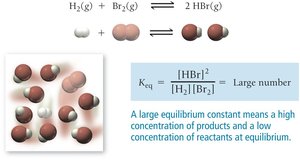
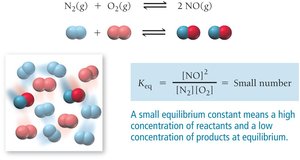
The equilibrium constant quantifies the relative concentrations of reactants and products at equilibrium for a given reaction.
Expression: For a generic reaction , the equilibrium constant is:

Significance of Keq
Large Keq: High concentration of products, low concentration of reactants at equilibrium.
Small Keq: High concentration of reactants, low concentration of products at equilibrium.
Writing Equilibrium Expressions
Coefficients in the balanced chemical equation become exponents in the equilibrium expression.
Example: For ,
Heterogeneous Equilibria
For reactions involving solids or liquids, their concentrations are omitted from the equilibrium expression because they are constant.
Only gaseous and aqueous species: Included in equilibrium expressions.
Le Châtelier’s Principle
Principle and Application
When a system at equilibrium is disturbed, it shifts in a direction that minimizes the disturbance.
Disturbances: Changes in concentration, temperature, or volume.
System response: Shifts to restore equilibrium.
Effect of Concentration Change
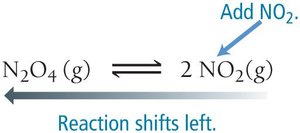
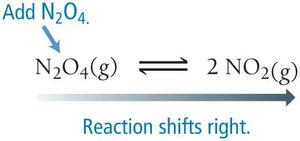
Adding or removing reactants or products causes the reaction to shift to consume the added substance or replace the removed one.
Add product: Reaction shifts left (toward reactants).
Add reactant: Reaction shifts right (toward products).
Effect of Volume Change (for Gases)
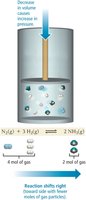
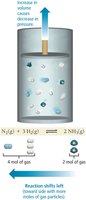
Changing the volume of a gas mixture affects the pressure and causes the equilibrium to shift.
Decrease volume: Increases pressure; reaction shifts to side with fewer moles of gas.
Increase volume: Decreases pressure; reaction shifts to side with more moles of gas.
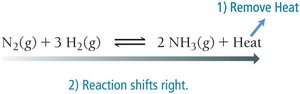
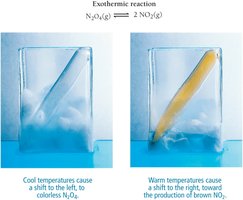
Effect of Temperature Change
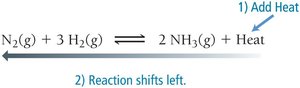
The effect of temperature depends on whether the reaction is exothermic or endothermic.
Exothermic reaction: Heat is a product. Increasing temperature shifts equilibrium left (toward reactants).
Endothermic reaction: Heat is a reactant. Increasing temperature shifts equilibrium right (toward products).
The Solubility-Product Constant (Ksp)
Definition and Expression
The solubility-product constant describes the equilibrium between a solid ionic compound and its dissolved ions in solution.
Expression: For ,
Solids: Omitted from the equilibrium expression.

Reaction Rate and Activation Energy
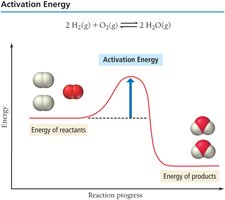
Activation Energy
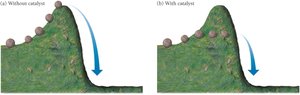
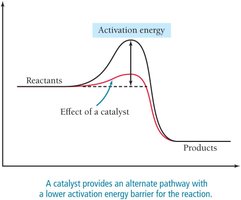
Activation energy is the energy barrier that must be overcome for reactants to be converted into products. It determines how fast a reaction proceeds.
High activation energy: Slow reaction rate.
Low activation energy: Fast reaction rate.
Catalysts
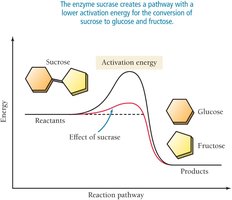
A catalyst increases the rate of a reaction by providing an alternate pathway with a lower activation energy. It is not consumed in the reaction and does not affect the equilibrium position.
Effect: More reactant molecules can overcome the activation barrier.
Example: Enzymes are biological catalysts that speed up biochemical reactions.
Summary Table: Effects on Equilibrium
Disturbance | System Response |
|---|---|
Add reactant | Shifts right (toward products) |
Add product | Shifts left (toward reactants) |
Decrease volume (gas) | Shifts to side with fewer moles of gas |
Increase volume (gas) | Shifts to side with more moles of gas |
Increase temperature (exothermic) | Shifts left (toward reactants) |
Increase temperature (endothermic) | Shifts right (toward products) |
Additional info: This guide covers the essential concepts and applications of chemical equilibrium, including equilibrium expressions, Le Châtelier’s principle, solubility-product constants, reaction rates, activation energy, and catalysts, as relevant to introductory college chemistry.
