 Back
Chemical Reactions and Their Classification: Evidence, Equations, and Types
Study Guide - Smart Notes
 Tailored notes based on your materials, expanded with key definitions, examples, and context.
Evidence of a Chemical Reaction
Macroscopic and Molecular Indicators
Chemical reactions are fundamental processes in chemistry where substances change into new substances. Identifying a chemical reaction involves observing both macroscopic changes and molecular transformations.
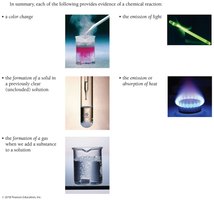
Color Change: A visible alteration in color often signals a chemical reaction.
Formation of a Solid: The appearance of a solid (precipitate) in a previously clear solution is evidence of a reaction.
Formation of a Gas: Bubbling or gas evolution upon mixing substances indicates a reaction.
Emission of Light: Some reactions release light energy.
Emission or Absorption of Heat: Temperature changes may accompany reactions.
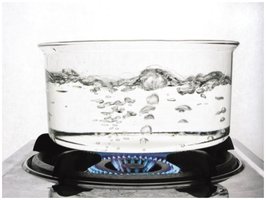
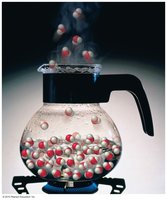
It is important to note that not all observable changes are evidence of a chemical reaction. For example, boiling water produces bubbles, but this is a physical change, not a chemical one.
Representing Chemical Reactions: Chemical Equations
Structure and Balancing
Chemical equations are used to represent reactions. Reactants are written on the left, products on the right, and the physical state of each substance is indicated in parentheses: (s) for solid, (l) for liquid, (g) for gas, and (aq) for aqueous (dissolved in water).
Balancing Equations: The number of atoms of each element must be equal on both sides of the equation, reflecting the law of conservation of mass.
Coefficients: Only coefficients (numbers in front of formulas) are adjusted to balance equations; subscripts (numbers within formulas) are never changed.
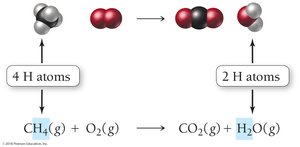
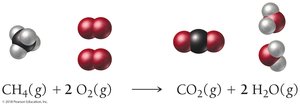
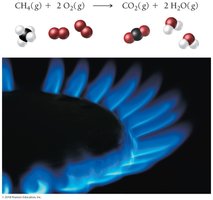
Example: Combustion of methane
Skeletal equation:
Balancing oxygen atoms:
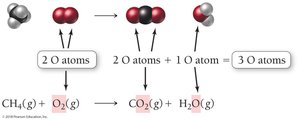
Balancing hydrogen atoms:
Balanced equation:
Aqueous Solutions and Solubility
Terminology and Properties
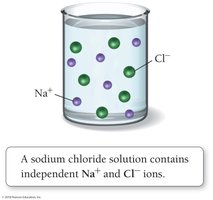
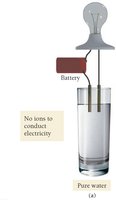
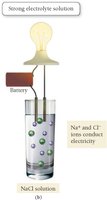
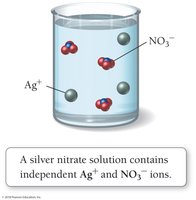
An aqueous solution is a homogeneous mixture of a substance with water. The solubility of a compound refers to its ability to dissolve in water. Ionic compounds that dissolve and dissociate into ions are called strong electrolytes.
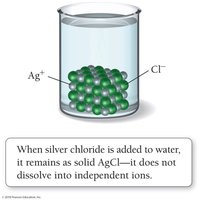
Soluble: Dissolves in water.
Insoluble: Does not dissolve in water.
Strong Electrolyte: Completely dissociates into ions in solution.
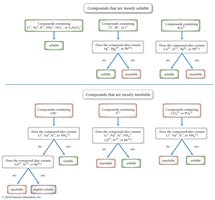
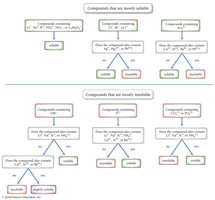
Solubility Rules
Empirical solubility rules help predict whether an ionic compound will dissolve in water. These rules are based on the ions present in the compound.
Precipitation Reactions
Formation of a Solid in Solution
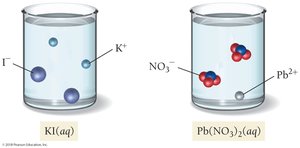
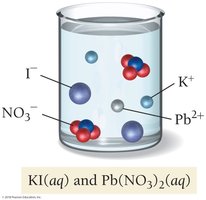
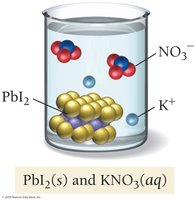
Precipitation reactions occur when two aqueous solutions are mixed and an insoluble compound forms as a solid (precipitate).
Example:
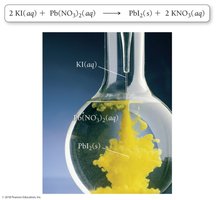
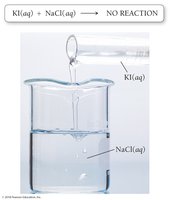
If no insoluble product forms, no reaction occurs.
Predicting Precipitation Reactions
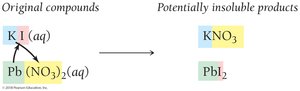
To predict precipitation reactions, combine the cation from one reactant with the anion from the other and use solubility rules to determine if a precipitate will form.
Writing Chemical Equations for Reactions in Solution
Molecular, Complete Ionic, and Net Ionic Equations
Chemical equations for reactions in solution can be written in three forms:
Molecular Equation: Shows complete, neutral formulas for all compounds.
Complete Ionic Equation: Shows all ions as they exist in solution.
Net Ionic Equation: Shows only the ions and molecules directly involved in the reaction, omitting spectator ions.

Acid–Base Reactions
Formation of Water and Salt
Acid–base reactions (neutralization reactions) occur when an acid reacts with a base to form water and an ionic compound (salt).
Example:

Gas Evolution Reactions
Formation of Gaseous Products
Gas evolution reactions produce a gas as a product when two solutions are mixed. These reactions often involve compounds such as carbonates, sulfides, or ammonium.
Oxidation–Reduction (Redox) Reactions
Electron Transfer Processes
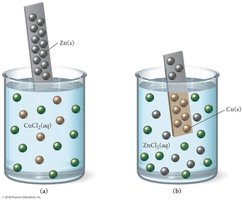
Redox reactions involve the transfer of electrons between substances. Oxidation is the loss of electrons, and reduction is the gain of electrons. These reactions are essential in processes such as rusting, combustion, and battery operation.
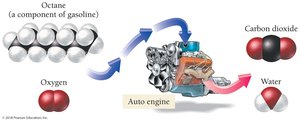
Combustion reactions are a type of redox reaction characterized by the reaction of a substance with oxygen to form oxygen-containing compounds and the release of heat.
Classifying Chemical Reactions
Types of Reactions Based on Atom Rearrangement
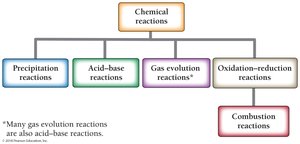
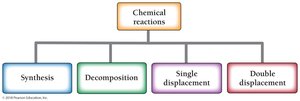
Chemical reactions can be classified based on the rearrangement of atoms:
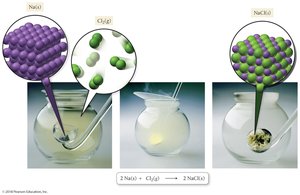
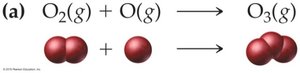
Synthesis Reaction: Two simpler substances combine to form a more complex substance.
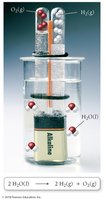
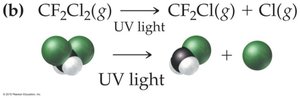
Decomposition Reaction: A complex substance breaks down into simpler substances.
Single-Displacement Reaction: One element displaces another in a compound.
Double-Displacement Reaction: Elements or groups in two compounds exchange places.
Chemistry in the Environment: Ozone Depletion
Reactions Involving Chlorofluorocarbons
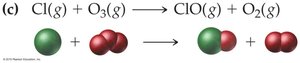
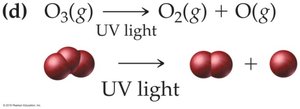
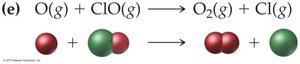
Chlorine atoms from chlorofluorocarbons (CFCs) participate in a cycle of reactions that deplete the ozone layer. These reactions regenerate atomic chlorine, allowing a single CFC molecule to destroy thousands of ozone molecules.
Review and Learning Objectives
Identify evidence of a chemical reaction.
Write balanced chemical equations.
Determine solubility of compounds.
Predict and write equations for precipitation reactions.
Write molecular, complete ionic, and net ionic equations.
Identify and write equations for acid–base, gas evolution, redox, and combustion reactions.
Classify chemical reactions.
