 Back
BackChemical Reactions: Evidence, Equations, and Classifications
Study Guide - Smart Notes
 Tailored notes based on your materials, expanded with key definitions, examples, and context.
Chapter 7: Chemical Reactions and Equations
Evidence of a Chemical Reaction
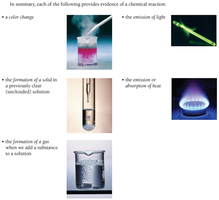
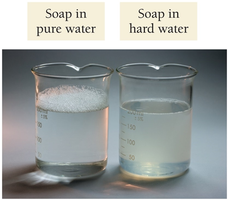
Chemical reactions are processes in which substances change into new substances. Recognizing a chemical reaction often involves observing macroscopic changes, but the only conclusive evidence is chemical analysis showing the transformation of substances at the atomic or molecular level.
Color Change: A visible shift in color can indicate a chemical reaction.
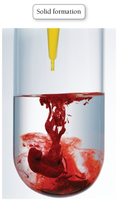
Formation of a Solid (Precipitate): A solid forms in a previously clear solution.
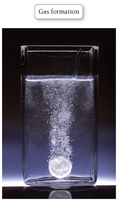
Formation of a Gas: Bubbles or gas evolution upon mixing substances.
Emission of Light: Light is produced during the reaction.
Emission or Absorption of Heat: Temperature changes occur as heat is released or absorbed.
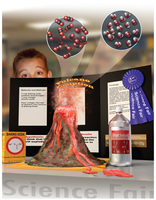
Example: The classic grade school volcano uses baking soda (sodium bicarbonate) and vinegar (acetic acid) to produce carbon dioxide gas, water, and sodium acetate. The eruption is caused by gas evolution.
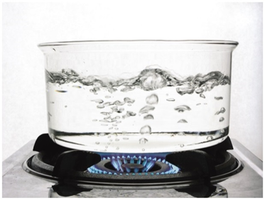
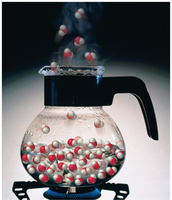
Note: Not all physical changes are chemical reactions. For example, boiling water forms steam, but both are composed of water molecules—no chemical change occurs.
Chemical Equations
Chemical reactions are represented by chemical equations, which show the reactants (starting substances) and products (new substances formed). The state of each substance is indicated in parentheses: (s) for solid, (l) for liquid, (g) for gas, and (aq) for aqueous (dissolved in water).
Reactants: Substances on the left side of the equation.
Products: Substances on the right side of the equation.
States: Indicated by abbreviations (s), (l), (g), (aq).
Balancing Chemical Equations
Balancing chemical equations ensures the conservation of atoms. The number of each type of atom must be the same on both sides of the equation. Coefficients are used to balance equations, not subscripts.
Write correct chemical formulas for all reactants and products.
Balance elements that appear in only one compound on each side first.
Balance free elements last.
Adjust coefficients to achieve balance; never change subscripts.
Example: Combustion of Methane
Unbalanced equation:
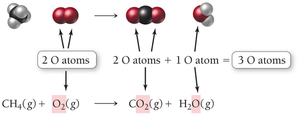
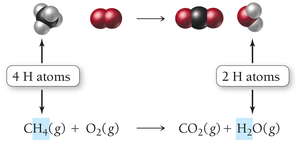
Balanced equation:
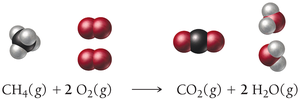
Checking Balance: Multiply subscripts by coefficients to count atoms. If no coefficient or subscript is present, a 1 is implied.
Types of Chemical Reactions
Chemical reactions can be classified by the changes that occur and the products formed.
Precipitation Reactions: Formation of a solid (precipitate) when two aqueous solutions are mixed.
Acid–Base Reactions: Formation of water and a salt when an acid and a base are mixed.
Gas Evolution Reactions: Formation of a gas during the reaction.
Oxidation–Reduction (Redox) Reactions: Transfer of electrons between substances; includes combustion.
Solubility and Precipitation
Solubility describes whether a compound dissolves in water. Soluble compounds form aqueous solutions; insoluble compounds form precipitates. Empirical solubility rules help predict outcomes of mixing ionic compounds.
Strong Electrolytes: Ionic compounds that dissociate completely in water, conducting electricity.
Precipitation Reaction Example: Mixing potassium iodide and lead(II) nitrate forms a yellow precipitate of lead(II) iodide.
Writing Chemical Equations for Reactions in Solution
Equations can be written in three forms:
Molecular Equation: Shows complete, neutral formulas for all compounds.
Complete Ionic Equation: Shows all ions present in solution.
Net Ionic Equation: Shows only the species that participate in the reaction (spectator ions omitted).
Acid–Base and Gas Evolution Reactions
Acid–base reactions (neutralization) form water and a salt. Gas evolution reactions produce a gaseous product, often through decomposition of an intermediate.
Oxidation–Reduction (Redox) and Combustion Reactions
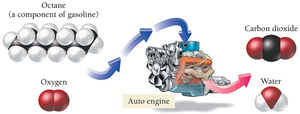
Redox reactions involve electron transfer. Oxidation is loss of electrons; reduction is gain of electrons. Combustion is a type of redox reaction where a substance reacts with oxygen, producing heat and often carbon dioxide and water.
Classifying Chemical Reactions by Atom Rearrangement
Synthesis Reaction: Two or more simple substances combine to form a more complex substance.
Decomposition Reaction: A complex substance breaks down into simpler substances.
Single-Displacement Reaction: One element replaces another in a compound.
Double-Displacement Reaction: Elements or groups in two compounds exchange places.
Summary Table: Types of Chemical Reactions
Type | Description | Example |
|---|---|---|
Synthesis | Simple substances combine | |
Decomposition | Complex substance breaks down | |
Single-Displacement | Element replaces another | |
Double-Displacement | Exchange of elements/groups | |
Combustion | Reaction with oxygen, heat produced |
Key Learning Objectives
Identify evidence of chemical reactions.
Write and balance chemical equations.
Determine solubility and predict precipitation reactions.
Write molecular, complete ionic, and net ionic equations.
Classify chemical reactions by type.
Additional info: Some images and tables referenced in the original material are not included here due to relevance or clarity requirements. The summary table above is inferred from standard chemistry classifications.
