 Back
Chemistry: Matter and Energy – Guided Practice
Study Guide - Smart Notes
 Tailored notes based on your materials, expanded with key definitions, examples, and context.
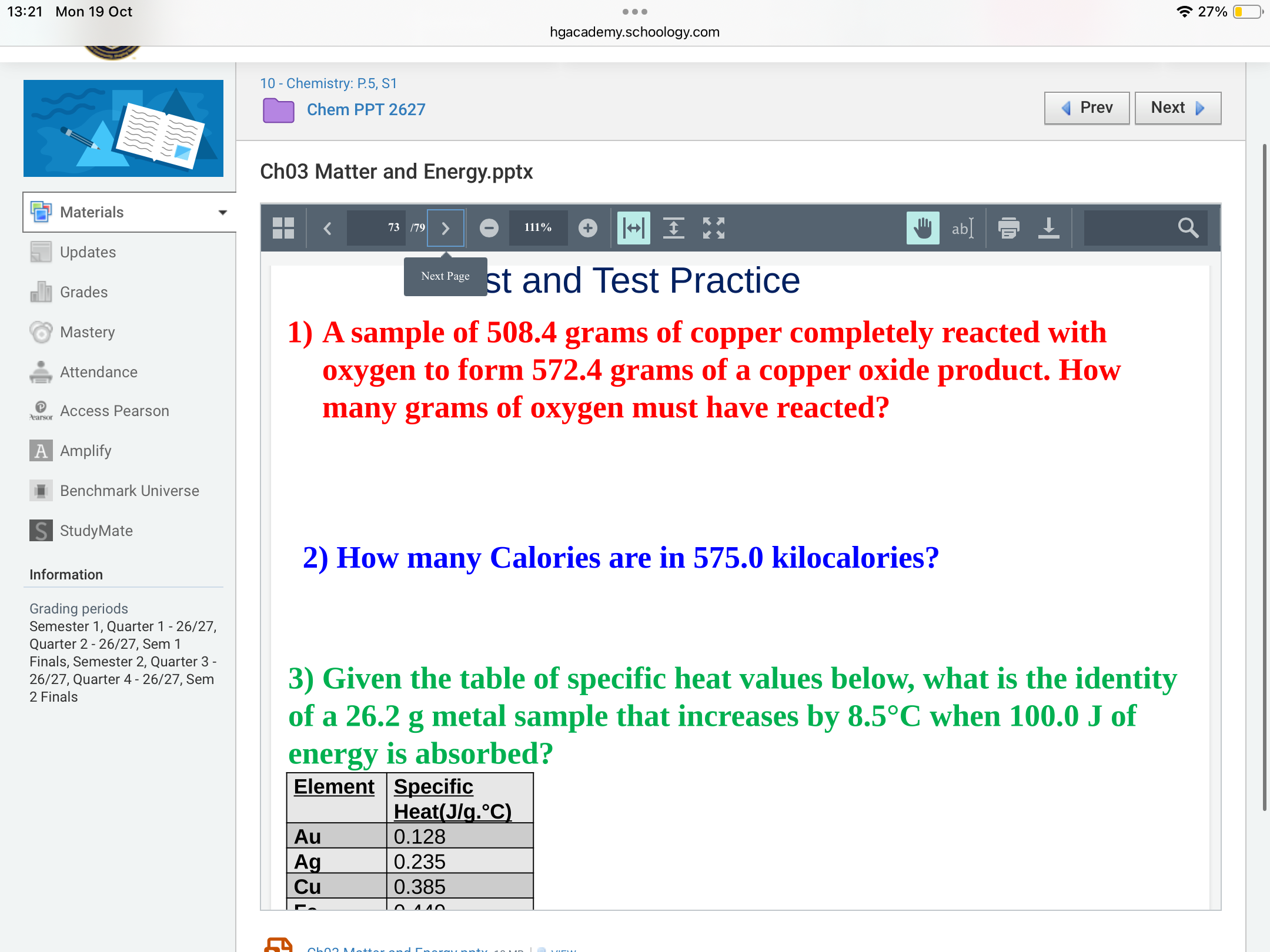
Q1. A sample of 508.4 grams of copper completely reacted with oxygen to form 572.4 grams of a copper oxide product. How many grams of oxygen must have reacted?
Background
Topic: Conservation of Mass / Stoichiometry
This question tests your understanding of the law of conservation of mass and how to determine the mass of a reactant in a chemical reaction.
Key Terms and Formulas:
Law of Conservation of Mass: The total mass of reactants equals the total mass of products.
Reactants: Copper (Cu) and Oxygen (O2)
Product: Copper oxide (CuO or Cu2O, depending on reaction)
Step-by-Step Guidance
Write the equation for the conservation of mass:
Identify the known values: ,
Set up the equation to solve for the mass of oxygen:
Plug in the values, but do not calculate the final answer yet.
Try solving on your own before revealing the answer!
Final Answer: 64.0 grams of oxygen
The mass of oxygen that reacted is 64.0 grams, based on the conservation of mass.
Q2. How many Calories are in 575.0 kilocalories?
Background
Topic: Energy Units and Conversions
This question tests your ability to convert between kilocalories and Calories, which are commonly used units of energy in chemistry and nutrition.
Key Terms and Formulas:
Calorie (with capital C): Also known as a kilocalorie (kcal), used in food energy.
Conversion:
Step-by-Step Guidance
Recall the conversion factor:
Set up the conversion:
Prepare to multiply, but do not calculate the final answer yet.
Try solving on your own before revealing the answer!
Final Answer: 575.0 Calories
Since 1 kilocalorie equals 1 Calorie, the value remains the same.
Q3. Given the table of specific heat values below, what is the identity of a 26.2 g metal sample that increases by 8.5°C when 100.0 J of energy is absorbed?
Background
Topic: Specific Heat and Calorimetry
This question tests your ability to use the specific heat formula to identify a metal based on its heat capacity and the energy absorbed.
Key Terms and Formulas:
Specific Heat (): The amount of energy required to raise the temperature of 1 gram of a substance by 1°C.
Formula:
Where:
= heat absorbed (Joules)
= mass (grams)
= specific heat (J/g·°C)
= change in temperature (°C)
Step-by-Step Guidance
Identify the known values: , ,
Rearrange the formula to solve for specific heat:
Plug in the values for , , and to set up the calculation for .
Compare the calculated value to the table of specific heat values for Au, Ag, and Cu, but do not identify the metal yet.
Prepare to match your calculated value to the closest value in the table.
Try solving on your own before revealing the answer!
Final Answer: Silver (Ag)
However, the closest value in the table is for Silver (Ag), which has a specific heat of 0.235 J/g·°C. Double-check your calculation and compare to the table to confirm the identity.
