 Back
BackChemistry of the Atmosphere: Air Composition, Nitrogen and Oxygen Cycles, and Air Pollution
Study Guide - Smart Notes
 Tailored notes based on your materials, expanded with key definitions, examples, and context.
Chemistry of the Atmosphere
Air Composition
The Earth's atmosphere is a mixture of gases, primarily nitrogen, oxygen, argon, and carbon dioxide. Understanding the composition of air is fundamental to chemistry and environmental science.
Nitrogen (N2): Makes up about 78% of the atmosphere by volume.
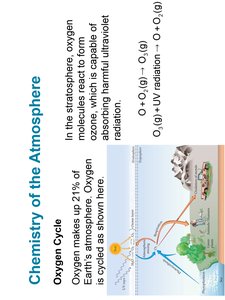
Oxygen (O2): Constitutes about 21% of the atmosphere.
Argon (Ar): Accounts for approximately 0.9%.
Carbon Dioxide (CO2): Less than 0.04%.
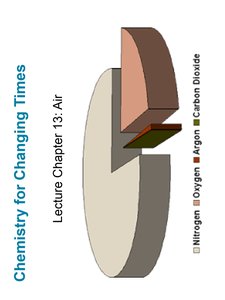
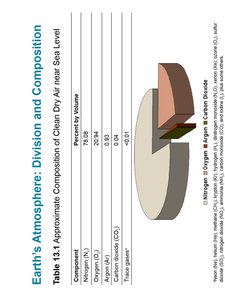
Table: Approximate Composition of Clean Dry Air near Sea Level
Component | Percent by Volume |
|---|---|
Nitrogen (N2) | 78.08 |
Oxygen (O2) | 20.95 |
Argon (Ar) | 0.93 |
Carbon Dioxide (CO2) | 0.04 |
Atmospheric Layers
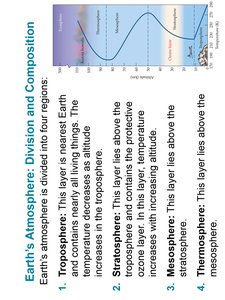
The atmosphere is divided into four main regions, each with distinct characteristics and roles in Earth's climate and chemistry.
Troposphere: Closest to Earth's surface; contains most living things and weather phenomena. Temperature decreases with altitude.
Stratosphere: Above the troposphere; contains the ozone layer. Temperature increases with altitude.
Mesosphere: Above the stratosphere; temperature decreases with altitude.
Thermosphere: Outermost layer; temperature increases with altitude.
Nitrogen Cycle and Fixation
Nitrogen in the Atmosphere
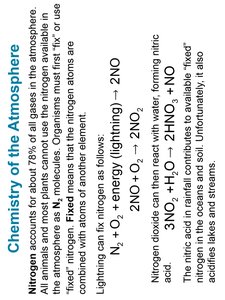
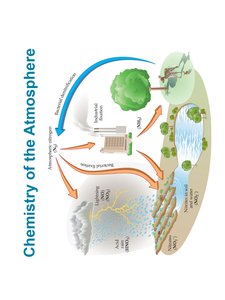
Nitrogen is essential for life but must be 'fixed' (converted to usable forms) for biological processes. Most organisms cannot use atmospheric N2 directly.
Nitrogen Fixation: Conversion of N2 to compounds like ammonia (NH3) or nitrate (NO3-).
Lightning can fix nitrogen by providing energy for the reaction:
Nitrogen oxides can further react to form nitric acid:
Industrial Nitrogen Fixation
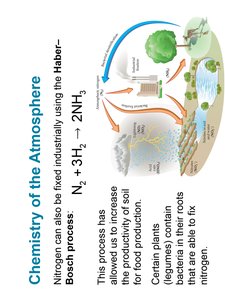
The Haber-Bosch process is an industrial method to fix nitrogen, producing ammonia for fertilizers.
Impact on Population
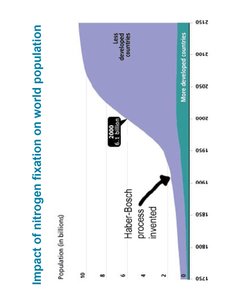
The invention of the Haber-Bosch process greatly increased food production and world population.
Oxygen Cycle and Ozone Formation
Oxygen in the Atmosphere
Oxygen is vital for respiration and forms ozone in the stratosphere, which protects life by absorbing ultraviolet radiation.
Ozone Formation: O2 molecules react to form O3 (ozone).
Temperature Inversion and Air Pollution
Temperature Inversion
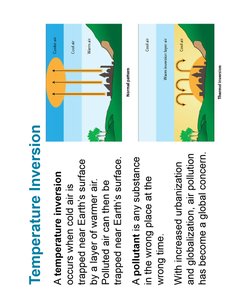
A temperature inversion occurs when cold air is trapped near Earth's surface by a layer of warmer air, preventing pollutants from dispersing and increasing air pollution.
Pollutant: Any substance in the wrong place at the wrong time.
Pollution Through the Ages
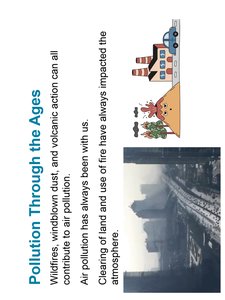
Air pollution has been present throughout history, caused by natural events (wildfires, dust, volcanoes) and human activities (land clearing, fire use).
Industrial Smog and Its Chemistry
Definition and Sources
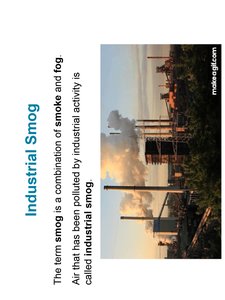
Smog is a combination of smoke and fog, often resulting from industrial activity.
Chemistry of Industrial Smog
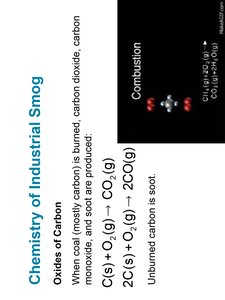
Oxides of Carbon
Burning coal produces carbon monoxide, carbon dioxide, and soot.
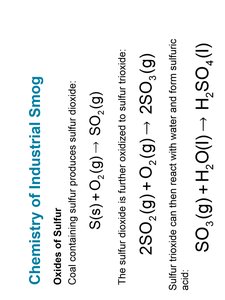
Oxides of Sulfur
Coal containing sulfur produces sulfur dioxide, which can further oxidize and form sulfuric acid.
Particulate Matter (PM)
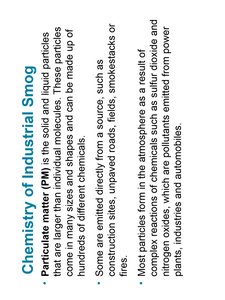
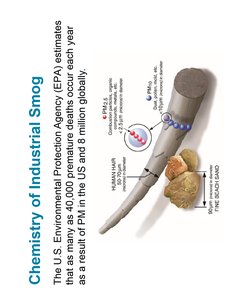
PM consists of solid and liquid particles larger than individual molecules, emitted from various sources and chemical reactions.
Sources include construction sites, unpaved roads, fields, smokestacks, and fires.
PM can result from reactions of chemicals such as sulfur dioxide and nitrogen oxides.
Types of Smog
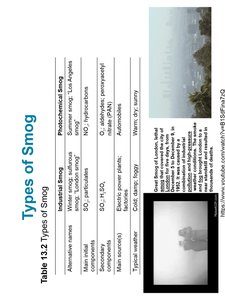
Smog can be classified as photochemical or industrial, each with distinct sources and chemical characteristics.
Type | Main Sources | Main Pollutants | Weather |
|---|---|---|---|
Photochemical Smog | Vehicles, Los Angeles | NO, hydrocarbons, O3, aldehydes | Warm or sunny |
Industrial Smog | Industry, London | SO2, particulates | Cold or damp |
Health and Environmental Effects of Industrial Smog
Health Effects
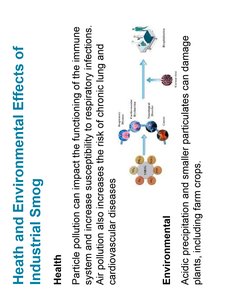
Particle pollution can impair the immune system, increase susceptibility to infections, and raise the risk of chronic lung and cardiovascular diseases.
Environmental Effects
Acidic precipitation and smaller particulates can damage plants, including farm crops.
Controlling Industrial Smog
Electrostatic Precipitators
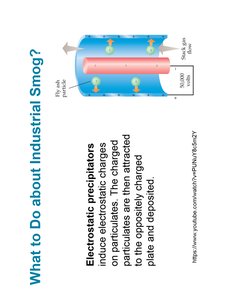
Electrostatic precipitators remove particulates from emissions by inducing electrostatic charges, causing particles to deposit on plates.
Bag Filtration and Cyclone Separators
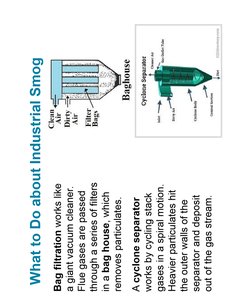
Bag filtration uses filters to remove particulates, while cyclone separators use centrifugal force to separate heavier particles.
Wet Scrubbers and Sulfur Dioxide Removal
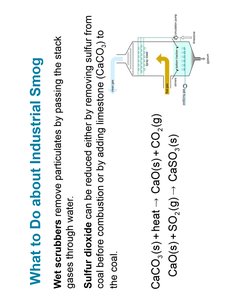
Wet scrubbers remove particulates by passing gases through water. Sulfur dioxide can be reduced by removing sulfur from coal or adding limestone.
Automobile Emissions
Gasoline and Octane Combustion
Gasoline is a mixture of hydrocarbons; octane (C8H18) is a typical representative. Complete combustion produces carbon dioxide and water.
Carbon Monoxide
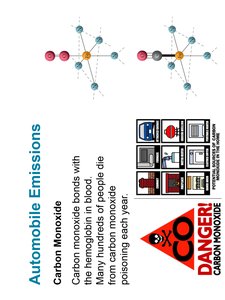
Incomplete combustion produces carbon monoxide (CO), a toxic, colorless, odorless gas that binds with hemoglobin, preventing oxygen transport.
Emission Trends
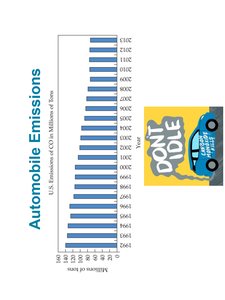
U.S. emissions of CO have varied over time, with efforts to reduce idling and improve air quality.
Nitrogen Oxides
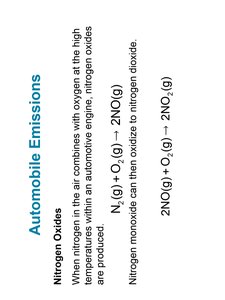
High temperatures in engines produce nitrogen oxides (NO and NO2), which contribute to smog and acid rain.
Volatile Organic Compounds (VOCs)
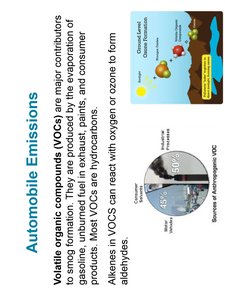
VOCs are major contributors to smog, produced by fuel exhaust, paints, and consumer products. Alkenes in VOCs can react with oxygen or ozone to form aldehydes.
Peroxyacetyl Nitrate (PAN)
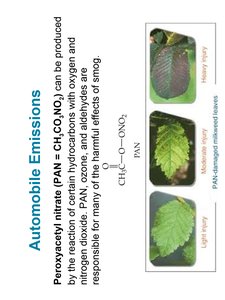
PAN is produced by the reaction of hydrocarbons with oxygen and nitrogen oxides, responsible for many harmful effects of smog.
Photochemical Smog
Formation and Components
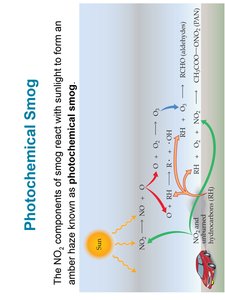
NO2 components of smog react with sunlight to form an amber haze known as photochemical smog.
Summary Table: Types of Smog
Type | Main Pollutants | Weather |
|---|---|---|
Photochemical Smog | NO, hydrocarbons, O3, aldehydes | Warm or sunny |
Industrial Smog | SO2, particulates | Cold or damp |
Additional info: These notes expand on the original slides by providing definitions, chemical equations, and context for atmospheric chemistry, air pollution, and emission control methods. All images included are directly relevant to the adjacent content and reinforce key concepts for introductory chemistry students.
