 Back
BackComprehensive Study Guidance for Honors Chemistry Final Review
Study Guide - Smart Notes
 Tailored notes based on your materials, expanded with key definitions, examples, and context.
Q1. Draw calcium’s orbital notation.
Background
Topic: Atomic Structure and Electron Configuration
This question tests your understanding of how electrons are arranged in orbitals for calcium, and how to represent this arrangement using orbital notation.
Key Terms and Formulas:
Orbital notation: A visual representation of electron configuration showing individual orbitals and electron spins.
Electron configuration for Ca:
Aufbau Principle: Electrons fill the lowest energy orbitals first.
Pauli Exclusion Principle: Each orbital can hold two electrons with opposite spins.
Hund’s Rule: Electrons fill degenerate orbitals singly before pairing up.
Step-by-Step Guidance
Write out the electron configuration for calcium: .
Draw boxes or lines for each orbital (s, p) and fill them with arrows to represent electrons. Each box/line represents an orbital, and each arrow represents an electron (up for one spin, down for the opposite).
Start with the 1s orbital and fill in two electrons (one up, one down), then move to 2s, 2p, 3s, 3p, and finally 4s, following the order of filling.
Make sure to pair electrons in each orbital according to the Pauli Exclusion Principle and Hund’s Rule.

Try solving on your own before revealing the answer!
Final Answer:
The orbital notation for calcium shows all orbitals filled up to 4s with paired electrons, matching the electron configuration .
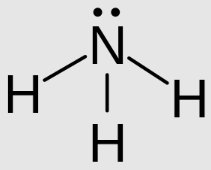
Q2. Draw the Lewis structure for ammonia (NH3).
Background
Topic: Chemical Bonding and Lewis Structures
This question tests your ability to represent the arrangement of atoms and valence electrons in a molecule using Lewis structures.
Key Terms and Formulas:
Lewis structure: A diagram showing the bonding between atoms and the lone pairs of electrons in a molecule.
Valence electrons: Electrons in the outermost shell involved in bonding.
Octet rule: Atoms tend to form bonds to achieve eight electrons in their valence shell.
Step-by-Step Guidance
Count the total number of valence electrons for NH3: N (5) + 3 × H (1) = 8 electrons.
Place nitrogen in the center and arrange three hydrogens around it.
Draw single bonds between N and each H, using up 6 electrons (2 per bond).
Place the remaining 2 electrons as a lone pair on the nitrogen atom.
Try solving on your own before revealing the answer!
Final Answer:
The Lewis structure for ammonia shows nitrogen with three single bonds to hydrogen and one lone pair of electrons.
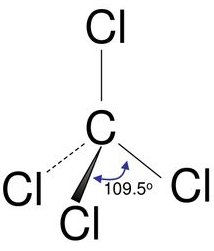
Q3. Draw the Lewis structure for carbon tetrachloride (CCl4).
Background
Topic: Chemical Bonding and Lewis Structures
This question tests your ability to represent the arrangement of atoms and valence electrons in a molecule using Lewis structures, and to recognize molecular geometry.
Key Terms and Formulas:
Lewis structure: Diagram showing bonds and lone pairs.
Tetrahedral geometry: Four bonds around a central atom, bond angles of 109.5°.
Valence electrons: C (4) + 4 × Cl (7) = 32 electrons.
Step-by-Step Guidance
Count the total valence electrons: C (4) + 4 × Cl (7) = 32 electrons.
Place carbon in the center and four chlorines around it.
Draw single bonds between C and each Cl, using 8 electrons.
Distribute the remaining electrons as lone pairs on the chlorine atoms to complete their octets.
Try solving on your own before revealing the answer!
Final Answer:
The Lewis structure for CCl4 shows carbon with four single bonds to chlorine, each chlorine with three lone pairs, and a tetrahedral geometry.
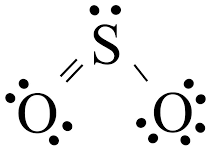
Q4. Draw the Lewis structure for sulfur dioxide (SO2).
Background
Topic: Chemical Bonding and Lewis Structures
This question tests your ability to represent the arrangement of atoms, bonds, and lone pairs in a molecule, including resonance structures.
Key Terms and Formulas:
Lewis structure: Diagram showing bonds and lone pairs.
Resonance: Some molecules have multiple valid Lewis structures.
Valence electrons: S (6) + 2 × O (6) = 18 electrons.
Step-by-Step Guidance
Count the total valence electrons: S (6) + 2 × O (6) = 18 electrons.
Place sulfur in the center and two oxygens on either side.
Draw bonds between S and each O, and distribute remaining electrons as lone pairs to complete octets.
Consider resonance structures with double bonds and lone pairs.
Try solving on your own before revealing the answer!
Final Answer:
The Lewis structure for SO2 shows sulfur with one double bond and one single bond to oxygen, lone pairs on each atom, and resonance possibilities.
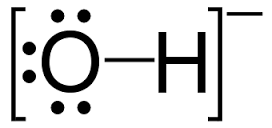
Q5. Draw the Lewis structure for hydroxide ion (OH-).
Background
Topic: Chemical Bonding and Lewis Structures
This question tests your ability to represent ions in Lewis structures, including the placement of extra electrons and charge.
Key Terms and Formulas:
Lewis structure: Diagram showing bonds and lone pairs.
Ion: OH- has one extra electron compared to neutral OH.
Valence electrons: O (6) + H (1) + 1 (for charge) = 8 electrons.
Step-by-Step Guidance
Count the total valence electrons: O (6) + H (1) + 1 (for negative charge) = 8 electrons.
Draw a single bond between O and H.
Place the remaining electrons as lone pairs on the oxygen atom.
Enclose the structure in brackets and indicate the negative charge.
Try solving on your own before revealing the answer!
Final Answer:
The Lewis structure for OH- shows oxygen with three lone pairs, a single bond to hydrogen, and the structure enclosed in brackets with a negative charge.
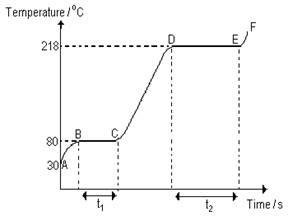
Q6. Use the heating curve to answer the following questions:
Background
Topic: Phase Changes and Heating Curves
This question tests your understanding of how temperature changes during phase transitions, and how to interpret a heating curve graph.
Key Terms and Formulas:
Heating curve: A graph showing temperature vs. time as a substance is heated.
Melting point: Temperature at which a substance changes from solid to liquid.
Boiling point: Temperature at which a substance changes from liquid to gas.
Plateau: Flat regions on the curve indicate phase changes.
Step-by-Step Guidance
Identify the flat regions (plateaus) on the heating curve, which correspond to phase changes.
Read the temperature at the start of the plateau for melting (solid to liquid) and boiling (liquid to gas).
Compare the lengths of the plateaus to determine which phase change requires more energy.
Analyze whether the melting and boiling points match those of water to determine the substance.
Try solving on your own before revealing the answer!
Final Answer:
The heating curve shows melting at 80°C and boiling at 218°C, with the boiling plateau requiring more energy. The substance is not water, as the melting and boiling points do not match water's values.
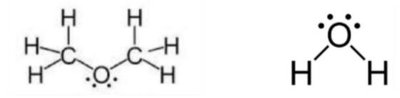
Q7. Here are the Lewis structures for dimethyl ether (left) and water (right): What types of intermolecular forces occur for each?
Background
Topic: Intermolecular Forces
This question tests your ability to identify the types of intermolecular forces present in different molecules based on their structure and polarity.
Key Terms and Formulas:
Intermolecular forces (IMFs): Forces between molecules, including London dispersion, dipole-dipole, and hydrogen bonding.
Hydrogen bonding: Occurs when H is bonded to N, O, or F.
Dipole-dipole: Occurs in polar molecules without hydrogen bonding.
London dispersion: Present in all molecules, but dominant in nonpolar molecules.
Step-by-Step Guidance
Examine the Lewis structures for dimethyl ether and water to determine if they are polar and if they have hydrogen bonding.
For dimethyl ether, check if there is an O-H or N-H bond for hydrogen bonding (there is not).
For water, note the O-H bonds, which allow for hydrogen bonding.
Identify the strongest intermolecular force present in each molecule.
Try solving on your own before revealing the answer!
Final Answer:
Dimethyl ether exhibits dipole-dipole forces, while water exhibits hydrogen bonding, which is stronger and leads to a higher boiling point for water.
