 Back
BackDevelopment of Atomic Theory: Historical Models of the Atom
Study Guide - Smart Notes
 Tailored notes based on your materials, expanded with key definitions, examples, and context.
Atoms and Elements
Historical Development of Atomic Theory
The concept of the atom has evolved over centuries as scientists have developed new models to explain the structure and behavior of matter. Each model reflects the scientific understanding of its time and has contributed to the modern view of atomic structure.
Democritus: The First Atomic Hypothesis
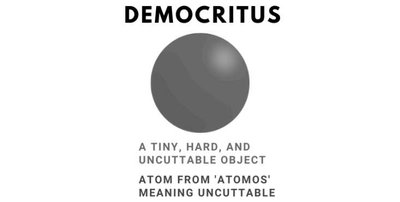
Key Point 1: Democritus (c. 460–370 BCE) proposed that all matter is composed of tiny, indivisible, and indestructible particles called atomos, meaning "uncuttable."
Key Point 2: He described atoms as solid, hard spheres that differ in size, shape, and mass, but not in internal structure.
Example: Democritus' ideas were philosophical and not based on experimental evidence, but they laid the groundwork for later scientific theories of matter.
Dalton: The Solid Sphere Model
Key Point 1: John Dalton (1766–1844) revived the atomic theory in the early 19th century, proposing that atoms are solid, indivisible spheres.
Key Point 2: Dalton's atomic theory stated that atoms cannot be created or destroyed and that each element consists of identical atoms unique to that element.
Example: Dalton's model explained the law of conservation of mass and the law of definite proportions.

Thomson: The Plum Pudding Model
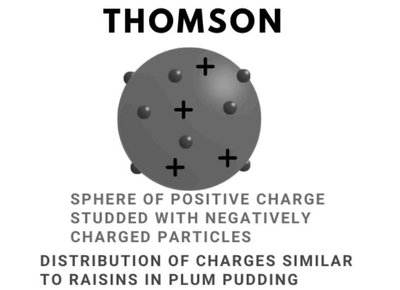
Key Point 1: J.J. Thomson (1856–1940) discovered the electron in 1897, showing that atoms are divisible and contain negatively charged particles.
Key Point 2: Thomson proposed that the atom is a sphere of positive charge with negatively charged electrons embedded within it, like raisins in a plum pudding.
Example: This model explained the overall electrical neutrality of atoms but did not account for the arrangement of charges.
Rutherford: The Nuclear Model
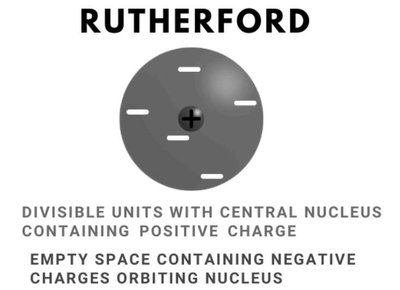
Key Point 1: Ernest Rutherford (1871–1937) conducted the gold foil experiment in 1911, revealing that atoms have a small, dense, positively charged nucleus.
Key Point 2: Most of the atom is empty space, with electrons orbiting the nucleus at a distance.
Example: Rutherford's model explained the deflection of alpha particles and introduced the concept of the atomic nucleus.
Bohr: The Planetary Model
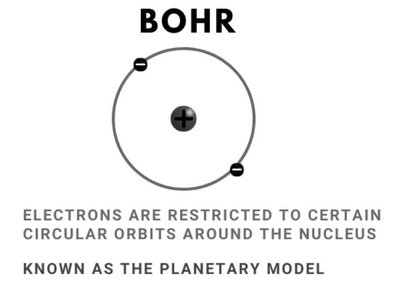
Key Point 1: Niels Bohr (1885–1962) refined Rutherford's model by proposing that electrons move in fixed, circular orbits (energy levels) around the nucleus.
Key Point 2: Electrons can jump between energy levels by absorbing or emitting specific amounts of energy (quanta).
Example: Bohr's model explained the line spectra of hydrogen and introduced the concept of quantized energy levels.
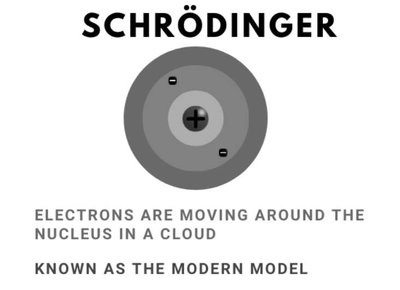
Schrödinger: The Quantum Mechanical Model
Key Point 1: Erwin Schrödinger (1887–1961) developed the quantum mechanical model, describing electrons as existing in probability clouds (orbitals) rather than fixed orbits.
Key Point 2: The exact location of an electron cannot be determined; instead, there is a probability of finding it in a certain region around the nucleus.
Example: This model is the basis for modern atomic theory and explains chemical bonding and atomic behavior more accurately.
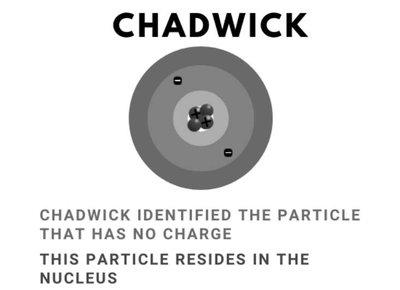
Chadwick: Discovery of the Neutron
Key Point 1: James Chadwick (1891–1974) discovered the neutron in 1932, a neutral particle residing in the nucleus alongside protons.
Key Point 2: Neutrons contribute to the mass of the atom and play a crucial role in nuclear stability.
Example: The discovery of the neutron explained the existence of isotopes and advanced the understanding of nuclear reactions.
Additional info: The progression of atomic models reflects advances in experimental techniques and theoretical understanding. Modern chemistry relies on the quantum mechanical model to explain atomic structure, chemical bonding, and the properties of elements.
