 Back
BackElectrons in Atoms and the Periodic Table: Chapter 9 Study Guide
Study Guide - Smart Notes
 Tailored notes based on your materials, expanded with key definitions, examples, and context.
Electrons in Atoms and the Periodic Table CH. 9
Introduction
This chapter explores the structure of atoms, focusing on how electrons are arranged and how this arrangement determines the chemical properties and periodic trends of elements. Understanding atomic models, electron configurations, and periodic table patterns is fundamental to predicting element behavior.
Atomic Models
The Bohr Model of the Atom
The Bohr model was developed to explain the emission spectra of elements, particularly hydrogen. In this model, electrons travel in fixed circular orbits around the nucleus at specific distances.
Key Point 1: Electrons occupy discrete energy levels (orbits) around the nucleus.
Key Point 2: The model successfully predicts the hydrogen emission spectrum but fails for elements with more than one electron.
Example: When an electron jumps between orbits, energy is absorbed or emitted as a photon of a specific wavelength.
The Quantum-Mechanical Model of the Atom
The quantum-mechanical model replaced the Bohr model, introducing orbitals as probability maps rather than fixed paths. This model explains the behavior of electrons in all elements.
Key Point 1: Orbitals represent regions where electrons are likely to be found, not exact paths.
Key Point 2: Electrons exhibit both wave-like and particle-like behavior.
Example: Probability maps show statistical patterns of electron locations, similar to tracking many baseball throws to see where they cross home plate.

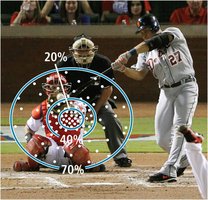
Quantum Mechanical Orbitals
Principal Quantum Numbers and Subshells
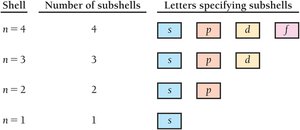
Orbitals are specified by a principal quantum number (n) and a letter (s, p, d, f) indicating the subshell and shape.
Key Point 1: The principal quantum number (n) determines the energy and size of the orbital.
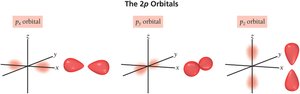
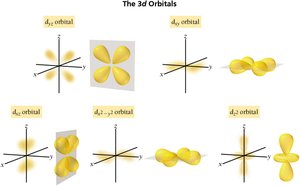
Key Point 2: The number of subshells in a shell equals n; subshells are labeled s (spherical), p (dumbbell), d, and f.
Shell | Number of Subshells | Letters Specifying Subshells |
|---|---|---|
n = 1 | 1 | s |
n = 2 | 2 | s, p |
n = 3 | 3 | s, p, d |
n = 4 | 4 | s, p, d, f |
Orbital Shapes and Probability
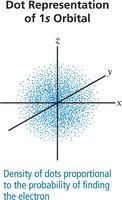
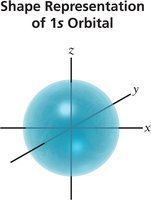
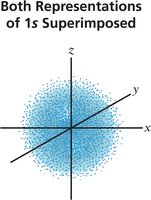
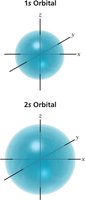
Orbitals have characteristic shapes and probability distributions. The s orbital is spherical, and dot density diagrams show where electrons are most likely to be found.
Key Point 1: The 1s orbital is spherical, with highest electron probability near the nucleus.
Key Point 2: The 2s orbital is larger but retains the spherical shape; p orbitals are dumbbell-shaped.
Example: Dot and shape representations help visualize electron probability.
Ground State and Excited State
The ground state is the lowest energy configuration of electrons. Absorption of energy can promote electrons to higher-energy orbitals, creating excited states.
Key Point 1: The ground state is the default, lowest-energy arrangement.
Key Point 2: Excited states occur when electrons absorb energy and move to higher orbitals.
Electron Configurations
Writing Electron Configurations
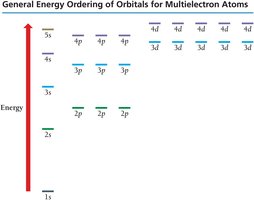
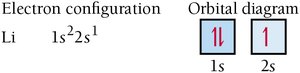
Electron configurations show how electrons occupy orbitals. The order of filling is determined by energy levels, and diagrams use arrows to indicate electron spin.
Key Point 1: Lower-energy orbitals fill before higher-energy orbitals.
Key Point 2: Orbitals hold a maximum of two electrons with opposite spins (Pauli exclusion principle).
Key Point 3: Orbitals of equal energy are filled singly first (Hund’s rule).

Noble Gas Core Notation
For elements beyond neon, electron configurations can be abbreviated using the previous noble gas in brackets, followed by the remaining configuration.
Valence and Core Electrons
Valence electrons are in the outermost shell and are involved in chemical bonding. Core electrons are all other electrons.
Key Point 1: The number of valence electrons determines chemical reactivity.
Key Point 2: Core electrons are not involved in bonding.
Periodic Table and Electron Configurations
Periodic Table Blocks and Patterns
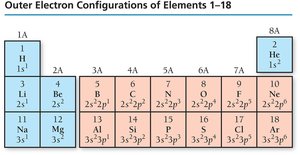
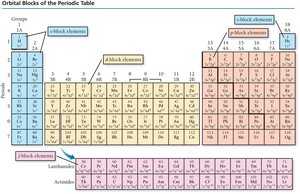
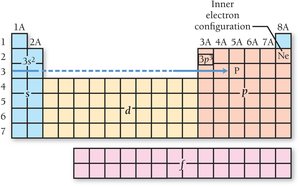
The periodic table is divided into blocks (s, p, d, f) based on which subshell is being filled. Elements in the same group have similar valence electron configurations and properties.
Writing Electron Configurations from the Periodic Table
The position of an element in the periodic table allows prediction of its electron configuration. The highest principal quantum number corresponds to the row number; for d block elements, the d orbital's n value is row number minus one.
Explanatory Power of the Quantum-Mechanical Model
Chemical Properties and Valence Electrons
The number of valence electrons largely determines an element’s chemical properties. Elements with the same number of valence electrons have similar properties.
Key Point 1: Noble gases have 8 valence electrons and are stable.
Key Point 2: Elements near noble gases are highly reactive, seeking to achieve noble gas configuration.
Example: Alkali metals form +1 cations; halogens form -1 anions.
Periodic Trends
Atomic Size
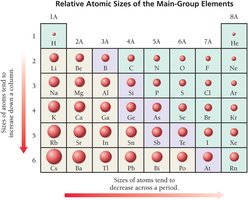
Atomic size decreases across a period (left to right) and increases down a group (top to bottom). This is due to increasing nuclear charge and principal quantum number.
Key Point 1: More protons pull electrons closer, reducing size across a period.
Key Point 2: Higher n values place electrons farther from the nucleus, increasing size down a group.
Ionization Energy
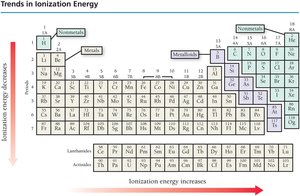
Ionization energy is the energy required to remove an electron. It increases across a period and decreases down a group.
Key Point 1: Atoms closer to noble gas configuration require more energy to remove electrons.
Key Point 2: Larger atoms (down a group) have electrons farther from the nucleus, making removal easier.
Metallic Character
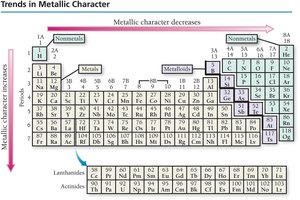
Metallic character refers to how easily an atom loses electrons. It decreases across a period and increases down a group.
Key Point 1: Metals are to the left of the periodic table and lose electrons easily.
Key Point 2: Nonmetals are to the right and gain electrons.
Summary Table: Key Periodic Trends
Trend | Across a Period (Left to Right) | Down a Group (Top to Bottom) |
|---|---|---|
Atomic Size | Decreases | Increases |
Ionization Energy | Increases | Decreases |
Metallic Character | Decreases | Increases |
