 Back
BackElectrons in Atoms and the Periodic Table: Study Guide and Key Concepts
Study Guide - Smart Notes
 Tailored notes based on your materials, expanded with key definitions, examples, and context.
Electrons in Atoms and the Periodic Table
Fundamental Constants and Equations
Understanding the behavior of electrons in atoms requires familiarity with several physical constants and equations that describe the energy and movement of light and electrons.
Planck's Constant (h):
Speed of Light (c):
Energy of a Photon:
Relationship between Wavelength, Frequency, and Speed of Light:
Change in Energy:
Prefixes: Know the meaning of nano- (10-9) and kilo- (103).
Electromagnetic Radiation (EMR)
Electromagnetic radiation encompasses a range of energy forms, from radio waves to gamma rays. Understanding their properties is essential for interpreting atomic spectra and electron transitions.
Types of EMR (in order of increasing energy): Radio < Microwave < Infrared < Visible < Ultraviolet < X-ray < Gamma ray
Energy and Frequency: Higher frequency means higher energy.
Wavelength: Higher energy corresponds to shorter wavelength.
Example: Infrared radiation has a shorter wavelength and higher energy than microwave radiation.
Photons and Atomic Spectra
A photon is a quantum of electromagnetic energy. The emission spectrum of hydrogen provided evidence that electrons occupy quantized energy levels.
Photon: A discrete packet of light energy.
Hydrogen Emission Spectrum: Shows that electrons can only occupy specific energy levels, not a continuum.
The Bohr Model of the Hydrogen Atom
The Bohr model describes electrons as orbiting the nucleus in fixed energy levels (shells). Transitions between these levels involve absorption or emission of photons.
Excitation: Electron moves to a higher energy level (e.g., n = 5 to n = 7).
Relaxation: Electron falls to a lower energy level, releasing energy as light.
Energy and Distance: Moving electrons away from the nucleus requires energy due to the potential energy of charged particles.
Energy Differences: Larger jumps between energy levels involve greater energy changes (e.g., n = 1 to n = 3 requires more energy than n = 1 to n = 2).
Light Emission: Greater drops (e.g., n = 10 to n = 1) release higher energy photons than smaller drops (e.g., n = 2 to n = 1).
Atomic Orbitals and Quantum Numbers
Electrons occupy regions of space called orbitals, which have characteristic shapes and energies.
s orbital: Spherical shape
p orbital: Two-lobed (dumbbell) shape
d orbital: Four-lobed (cloverleaf) shape
Degenerate Orbitals: Orbitals with the same energy (e.g., the three p orbitals in a given shell)
Shells, Subshells, and Orbitals
Atomic structure is organized hierarchically:
Shell: Principal energy level (n = 1, 2, 3, ...)
Subshell: Set of orbitals with the same type (s, p, d, f) within a shell
Orbital: Specific region within a subshell that can hold up to two electrons
Type | Max Electrons |
|---|---|
Any orbital | 2 |
s subshell | 2 |
p subshell | 6 |
d subshell | 10 |
First shell (n=1) | 2 |
Second shell (n=2) | 8 |
Electron Configuration Rules
Electron configurations describe the arrangement of electrons in an atom. Several principles govern this arrangement:
Aufbau Principle: Electrons fill the lowest energy orbitals first.
Pauli Exclusion Principle: No two electrons in an atom can have the same set of quantum numbers; each orbital holds a maximum of two electrons with opposite spins.
Hund’s Rule: Electrons occupy degenerate orbitals singly before pairing up.
Electron configurations can be written in full or using noble gas abbreviations. An asterisk (*) indicates an excited state, where an electron has moved to a higher energy orbital than in the ground state.
Valence and Core Electrons
Valence electrons are the outermost electrons involved in chemical bonding, while core electrons are those in inner shells. The number of each can be determined from the electron configuration.
Orbital Diagrams
Orbital diagrams visually represent the arrangement of electrons in orbitals, showing paired and unpaired electrons. These diagrams are useful for determining magnetic properties and predicting chemical behavior.
Formation of Ions
When forming cations, electrons are always removed from the orbital with the highest principal quantum number (n) first. Predictable ions include alkali metals (1+), alkaline earth metals (2+), and halides (1-).
Ionization Energy and Atomic Radius
Ionization energy is the energy required to remove an electron from an atom. It increases across a period and decreases down a group due to changes in effective nuclear charge and atomic size. The atomic radius increases down a group and decreases across a period.
Reason for Ionization Energy: Removing an electron requires energy due to the attraction between the negatively charged electron and the positively charged nucleus.
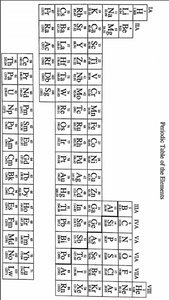
Periodic Table Reference
The periodic table is essential for determining electron configurations, valence electrons, and predicting chemical properties of elements.
Additional info: For exam preparation, practice writing electron configurations, drawing orbital diagrams, and predicting trends in atomic properties using the periodic table.
