 Back
BackElectrons in Atoms and the Periodic Table: Study Guide
Study Guide - Smart Notes
 Tailored notes based on your materials, expanded with key definitions, examples, and context.
Electrons in Atoms and the Periodic Table
Blimps and Balloons: The Role of Helium and Hydrogen
The choice of gas in airships highlights the chemical properties of elements. Hydrogen (H2) is highly reactive and flammable, which led to the Hindenburg disaster. Modern blimps use helium (He), an inert gas, due to its chemical stability. Helium's nucleus contains two protons, and its neutral atom has two electrons, resulting in a stable electron configuration.
Light: Electromagnetic Radiation
Light is a form of electromagnetic radiation that interacts with matter and has both wave-like and particle-like properties. It consists of photons and travels at a constant speed, known as the speed of light (c), which is m/s. The study of light's interaction with atoms has been crucial in developing atomic models.
Properties of Waves
Waves carry energy as they move through space. Two key properties of waves are:
Wavelength (\(\lambda\)): The distance between adjacent wave crests.
Frequency (\(\nu\)): The number of cycles or crests passing a stationary point per second.
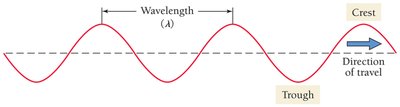

Wavelength and frequency are inversely related:
- Shorter wavelength means higher frequency. - Longer wavelength means lower frequency.
Visible Spectrum (VIBGYOR)
When white light passes through a prism, it splits into seven colors: Violet, Indigo, Blue, Green, Yellow, Orange, and Red (VIBGYOR). The order is important, as each color corresponds to a specific wavelength. Wavelength increases from violet (400 nm) to red (750 nm).
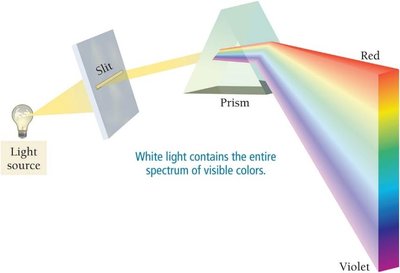
The Electromagnetic Spectrum
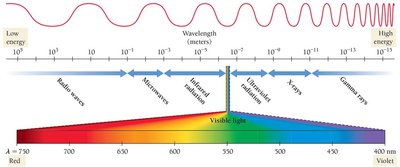
The electromagnetic spectrum includes all types of electromagnetic radiation, from radio waves to gamma rays. The visible spectrum is only a small part of this range. The order (from longest to shortest wavelength) is: radio waves, microwaves, infrared, visible, ultraviolet, X-rays, gamma rays.
Wavelength and frequency are inversely related:
Energy and frequency are directly related:
Key observations:
Radio waves: largest wavelength, lowest frequency, lowest energy
Gamma rays: shortest wavelength, highest frequency, highest energy
In visible light: red has the longest wavelength, violet the shortest
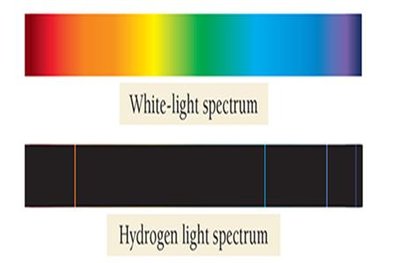
Emission Spectra of Elements vs. White Light
White light produces a continuous spectrum, while the emission spectra of elements consist of only specific wavelengths. This is because atoms emit light at characteristic energies when electrons transition between energy levels.
The Bohr Model of the Atom
Niels Bohr proposed a model where electrons travel in circular orbits around the nucleus, each with a quantized energy level (n = 1, 2, 3, ...). Electrons cannot exist between these orbits. Lower n means closer to the nucleus and lower energy; higher n means farther and higher energy.
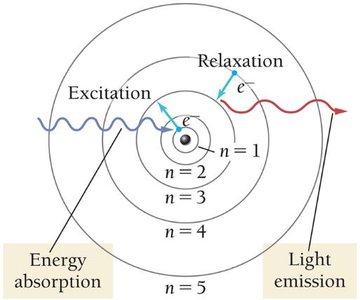
The Bohr Model: Hydrogen Emission Lines
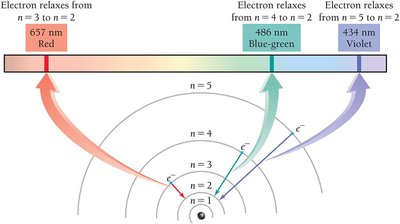
When a hydrogen atom absorbs energy, its electron is excited to a higher orbit. As the electron relaxes to a lower orbit, it emits a photon. The energy difference between orbits determines the wavelength of emitted light:
n = 3 to n = 2: smaller energy, lower frequency, higher wavelength (red light)
n = 5 to n = 2: larger energy, higher frequency, lower wavelength (violet light)
The Quantum-Mechanical Model: Atoms with Orbitals
The quantum-mechanical model replaces Bohr orbits with orbitals, which are probability maps showing where electrons are likely to be found. For example, the 1s orbital is spherical, and the dot density represents the probability of finding an electron.
Quantum Numbers and Orbitals
Orbitals are described by four quantum numbers:
Quantum Number | Symbol | Property | Values |
|---|---|---|---|
Principal | n | Orbital size and energy | 1, 2, 3, ... |
Angular | l | Orbital shape | 0, 1, ..., n-1 |
Magnetic | m | Orbital orientation | -l ... 0 ... +l |
Spin | s | Spin of electron | +1/2 or -1/2 |
Principal Quantum Number (n)
Higher n means higher energy and larger orbital. Example: 2s (n=2) is higher in energy than 1s (n=1).
Angular Quantum Number (l)
l determines the shape of the orbital and depends on n:
l = 0: s orbital
l = 1: p orbital
l = 2: d orbital
l = 3: f orbital
For each n, l ranges from 0 to n-1. For example, n=3 allows l=0,1,2 (3s, 3p, 3d).
Magnetic Quantum Number (m)
m determines the orientation of the orbital and ranges from -l to +l. For example:
l = 0 (s): m = 0 (one s orbital)
l = 1 (p): m = -1, 0, +1 (three p orbitals)
l = 2 (d): m = -2, -1, 0, +1, +2 (five d orbitals)
l = 3 (f): m = -3, -2, -1, 0, +1, +2, +3 (seven f orbitals)
Spin Quantum Number (s)
Each electron has a spin quantum number of +1/2 or -1/2.
Electronic Configuration
Electronic configuration shows how electrons occupy orbitals. Three rules must be followed:
Aufbau Principle: Electrons fill orbitals from lowest to highest energy.
Pauli Exclusion Principle: Each orbital holds a maximum of two electrons with opposite spins.
Hund's Rule: Electrons occupy degenerate orbitals singly before pairing up.
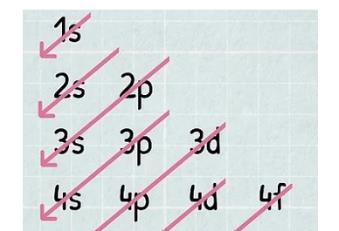
Be familiar with the electronic configurations of the first 20 elements and the use of noble gas shorthand.
s, p, d, and f Blocks in the Periodic Table
The periodic table is divided into blocks based on the type of orbital being filled:
s-block: Groups 1A and 2A
p-block: Groups 3A to 8A
d-block: Transition elements
f-block: Inner transition elements
Patterns in the Periodic Table
The number of valence electrons for main-group elements equals the group number (except helium). Elements with the same number of valence electrons have similar properties. For example:
Alkali metals (group 1A): 1 valence electron, highly reactive
Halogens (group 7A): 7 valence electrons, highly reactive
Noble gases (group 8A): filled outer shells (octet), inert
Examples:
O (group 6A): 6 valence electrons, gains 2 electrons to form O2-
Al (group 3A): 3 valence electrons, loses 3 electrons to form Al3+
H: unfilled 1s orbital, highly reactive
He: filled 1s orbital, inert
This explains the chemical behavior of elements and the stability of noble gases.
