 Back
Electrons in Atoms and the Periodic Table: Chapter 9 Study Guide
Study Guide - Smart Notes
 Tailored notes based on your materials, expanded with key definitions, examples, and context.
Electrons in Atoms and the Periodic Table
Introduction
This chapter explores the structure of atoms, the behavior of electrons, and how these concepts explain the chemical properties and periodic trends of elements. Understanding atomic models, electron configurations, and periodic table patterns is fundamental to predicting element reactivity and properties.
Light and Electromagnetic Radiation
Nature of Light
Light is a form of electromagnetic radiation, exhibiting both wave-like and particle-like behavior. It travels at a constant speed, known as the speed of light (c), and is characterized by wavelength and frequency.
Wavelength (λ): The distance between adjacent wave crests.
Frequency (ν): The number of cycles or crests passing a stationary point per second.
Relationship: Wavelength and frequency are inversely related:
Photon: A particle of light, carrying energy dependent on wavelength.
Energy of a photon: (where h is Planck's constant)
Visible light contains a spectrum of colors, each with a different wavelength. Red light has the longest wavelength (750 nm), and violet has the shortest (400 nm).
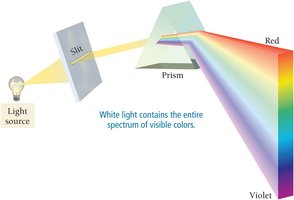
Color Perception
Objects appear colored based on the wavelengths of light they reflect. For example, a red shirt appears red because it reflects red light and absorbs other colors.

The Electromagnetic Spectrum
The electromagnetic spectrum includes various types of radiation, ordered by wavelength and energy:
Gamma rays: Shortest wavelength, highest energy; can damage biological molecules.
X-rays: Used in medical imaging; can damage biological molecules.
Ultraviolet (UV): Causes sunburn; can damage biological molecules.
Visible light: Enables vision; does not damage biological molecules.
Infrared: Felt as heat; emitted by warm objects.
Microwaves: Used in ovens; absorbed by water molecules.
Radio waves: Longest wavelength; used in communication.

Ionizing Radiation and Health
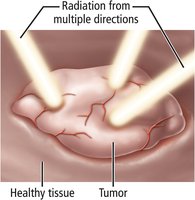
X-rays and gamma rays are called ionizing radiation because their high energy can ionize atoms and molecules, potentially damaging biological tissues. Radiation therapy uses this property to target cancer cells while minimizing harm to healthy tissue.
Atomic Models
The Bohr Model
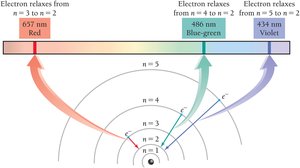
The Bohr model describes electrons traveling in fixed circular orbits around the nucleus, each with a specific energy level (quantum number n). Energy is quantized, meaning electrons can only occupy certain orbits.
Energy transitions: Electrons absorb energy to move to higher orbits (excited state) and emit energy as photons when returning to lower orbits (ground state).
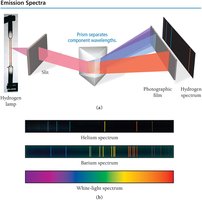
Emission spectrum: Each element emits light at specific wavelengths, corresponding to electron transitions between orbits.
Limitations of the Bohr Model
The Bohr model successfully explains the hydrogen emission spectrum but fails for elements with more than one electron. It was replaced by the quantum-mechanical model.
The Quantum-Mechanical Model
This model describes electrons as occupying orbitals, which are probability maps indicating where an electron is likely to be found. Electrons do not follow fixed paths but have statistical distributions.
Principal quantum number (n): Specifies the energy level (shell).
Subshells: Indicated by letters (s, p, d, f), specifying orbital shape.
Ground state: Lowest energy configuration.
Excited state: Higher energy configuration after absorbing energy.


Orbital Shapes and Probability
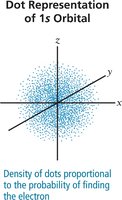
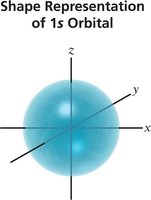
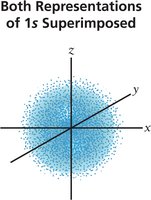
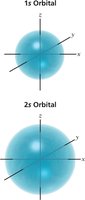
Orbitals are visualized by dot density (probability) and geometric shapes. The 1s orbital is spherical, with the highest probability near the nucleus.
Subshells and Principal Shells
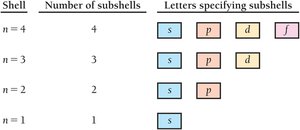
The number of subshells in a principal shell equals the value of n. Each subshell is specified by a letter and has a distinct shape.
Shell | Number of subshells | Letters specifying subshells |
|---|---|---|
n = 4 | 4 | s, p, d, f |
n = 3 | 3 | s, p, d |
n = 2 | 2 | s, p |
n = 1 | 1 | s |
Orbital Shapes: 2s, 2p, and 3d
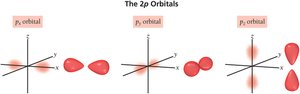
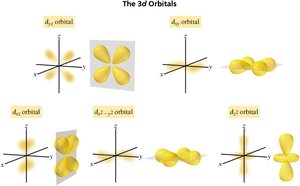
The 2s orbital is larger than the 1s but retains a spherical shape. The 2p orbitals have a dumbbell shape, and the 3d orbitals have more complex shapes.
Electron Configurations
How Electrons Occupy Orbitals
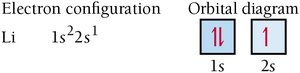
Electron configuration shows the arrangement of electrons in orbitals for an atom. Orbital diagrams use arrows to represent electrons and their spins.
Pauli exclusion principle: Orbitals hold no more than two electrons with opposite spins.
Hund’s rule: Orbitals of equal energy are filled singly first, with parallel spins.
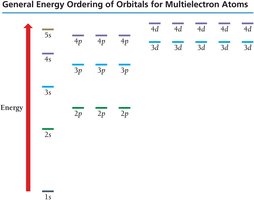
Order of filling: Lower-energy orbitals fill before higher-energy orbitals.

Noble Gas Core Notation
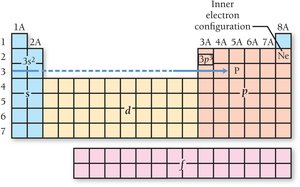
Electron configurations for elements beyond neon can be abbreviated using the noble gas core notation, representing the inner electron configuration with the noble gas symbol in brackets.
Valence and Core Electrons
Valence electrons are in the outermost principal shell and are involved in chemical bonding. Core electrons are all other electrons not in the outermost shell.
Periodic Table and Electron Configurations
Periodic Table Patterns
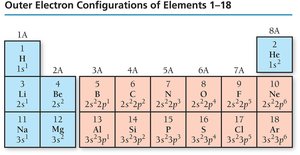
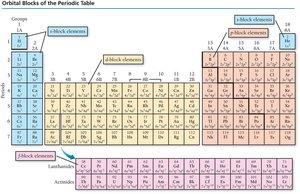
The periodic table is organized into blocks (s, p, d, f) based on the subshells being filled. Elements in the same group have the same number of valence electrons and similar properties.
Writing Electron Configurations from the Periodic Table
The position of an element in the periodic table determines its electron configuration. The highest principal quantum number corresponds to the row number, and the block (s, p, d, f) indicates which subshell is being filled.
Explanatory Power of the Quantum-Mechanical Model
Chemical Properties and Valence Electrons
The number of valence electrons determines an element’s chemical properties. Elements with the same number of valence electrons have similar reactivity. Noble gases are stable due to filled s and p orbitals, while elements near noble gases are highly reactive.
Periodic Trends
Atomic Size
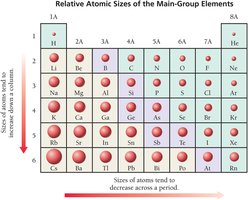
Atomic size decreases across a period (left to right) due to increased nuclear charge pulling electrons closer. Atomic size increases down a group as the principal quantum number increases, placing electrons farther from the nucleus.
Ionization Energy
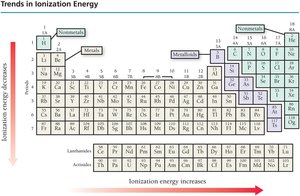
Ionization energy is the energy required to remove an electron from an atom. It increases across a period and decreases down a group.
Metallic Character
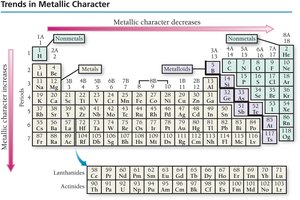
Metallic character refers to the tendency of an element to lose electrons. It decreases across a period and increases down a group.
Applications: Chemistry and Health
Pumping Ions in Biological Systems
Cells use ion pumps to move sodium (Na+) and potassium (K+) ions across membranes, creating gradients essential for nerve signal transmission.
Summary of Key Concepts
Light is electromagnetic radiation with wave and particle properties.
The Bohr model explains hydrogen’s emission spectrum; the quantum-mechanical model describes electron probability distributions.
Electron configurations and periodic table patterns predict element properties and reactivity.
Periodic trends include atomic size, ionization energy, and metallic character.
