 Back
BackEssential Math Skills for Introductory Chemistry
Study Guide - Smart Notes
 Tailored notes based on your materials, expanded with key definitions, examples, and context.
0. Math Skills
0.1 Place Values
Understanding place values is fundamental for interpreting and manipulating numbers in chemistry, where measurements can span from extremely large to very small values. Each digit in a number has a specific place value, which determines its contribution to the overall value of the number.
Place Value: The position of a digit relative to the decimal point (e.g., ones, tens, hundreds, tenths, hundredths).
Implied Decimal: Numbers without a decimal point are assumed to have one at the end (e.g., 5280 is 5280.).
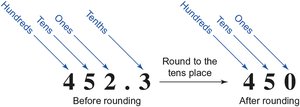
Rounding: Reducing the number of digits by following specific rules based on the value of the digit to be dropped.
Rounding Up: If the first digit to be dropped is 5 or greater, increase the preceding digit by one.
Rounding Down: If the first digit to be dropped is less than 5, leave the preceding digit unchanged.
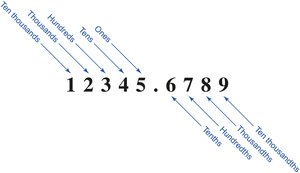
Example: In the number 3,284.659, the digit 2 is in the hundreds place, 8 is in the tens place, and so on.
Rounding Example: 4.7732 rounded to the hundredths place is 4.77; to the tenths place is 4.8.
Key Points:
Zeros are used as placeholders when rounding digits to the left of the decimal point.
Knowing place values is essential for accurate measurement and reporting in chemistry.
0.2 Negative Numbers
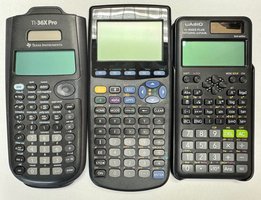
Negative numbers are frequently used in chemistry, such as in temperature, pH, and scientific notation. Proper calculator usage is essential for entering and calculating with negative values.
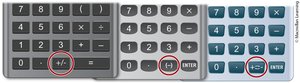
Change Sign Key: Most scientific calculators have a dedicated key to change the sign of a number (not the subtraction key).
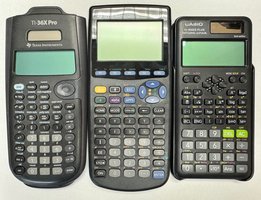
Calculator Entry: The sequence for entering negative numbers varies by calculator model.
Applications: Negative numbers are used in calculations involving temperature changes, energy, and more.
Example Calculations:
−6 + 2 = −4
17 − (−5) = 22
−24 × 3 = −72
−15 ÷ 4 = −3.75
Key Point: Always use the change sign key for negatives, not the subtraction key.
0.3 Exponents
Exponents, or powers, represent repeated multiplication and are common in scientific notation and chemical calculations.
Exponent: A superscript indicating how many times the base is multiplied by itself (e.g., ).
Base: The number being multiplied.
Exponent of 0: Any number to the power of 0 equals 1 ().
Negative Exponent: Indicates repeated division (reciprocal), e.g., .
Calculator Usage: Most calculators have dedicated keys for exponents and square roots.
Example: ;
0.4 Order of Operations
Order of operations ensures consistent results in multi-step calculations. The mnemonic PEMDAS helps remember the sequence:
Parentheses
Exponents
Multiplication and Division (left to right)
Addition and Subtraction (left to right)
Example:
7 − 15 ÷ 3 = 2 (division before subtraction)
8 + 3^2 = 17 (exponent before addition)
(2 + 6) × 7 = 56 (parentheses first, then multiplication)
Scientific calculators follow order of operations if expressions are entered correctly, including parentheses.
0.5 Rearranging Equations
Algebraic manipulation is often required to solve for a specific variable in chemistry equations. The goal is to isolate the variable of interest using algebraic operations.
Isolating Variables: Perform the same operation on both sides of the equation to maintain equality.
Variables in Denominator: Invert both sides to move the variable to the numerator, then isolate.
Square Roots: If a variable is squared, take the square root of both sides to solve for the variable.
Example: Solve for e in :
Divide both sides by cd:
Example: Isolate x in :
Divide both sides by y:
Take the square root:
0.6 Interpreting a Graph
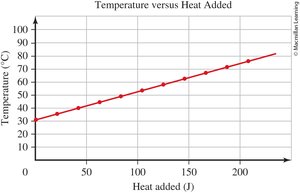
Graphs are essential for visualizing relationships between variables in chemistry. Understanding how to read and interpret graphs is a key skill.
Line Graph: Shows the relationship between two variables, with data points connected by a line.
Independent Variable: Plotted on the x-axis (horizontal); the variable you control or change.
Dependent Variable: Plotted on the y-axis (vertical); the variable that responds to changes in the independent variable.
Graph Title: Follows the format "[dependent variable] versus [independent variable]".
Data Points: Each point represents an (x, y) pair.
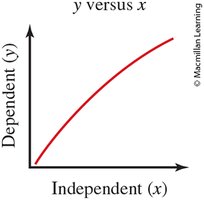
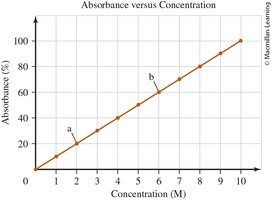
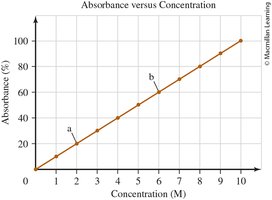
Example: In a graph of absorbance versus concentration, concentration is the independent variable (x-axis), and absorbance is the dependent variable (y-axis).
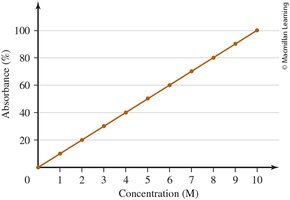
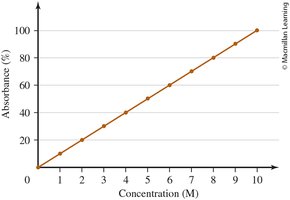
Reading Data Points: To find the (x, y) values of a point, extend lines from the point to the axes.
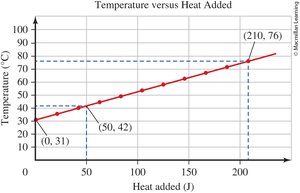
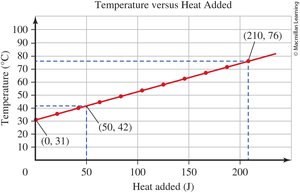
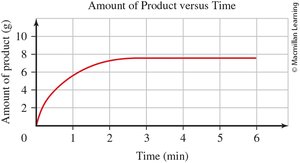
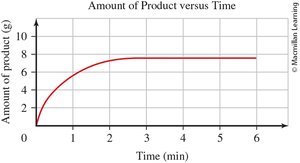
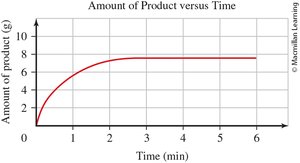
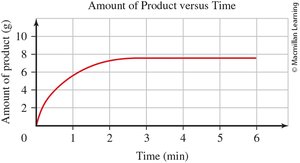
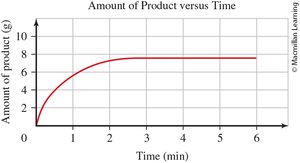
Example: In a graph of amount of product versus time, you can determine the initial amount, final amount, duration, and when the reaction is complete by reading the axes and the curve.
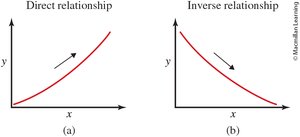
Direct vs. Inverse Relationships:
Direct Relationship: Both variables increase or decrease together (e.g., hours worked and money earned).
Inverse Relationship: One variable increases while the other decreases (e.g., speed and travel time).
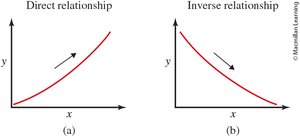
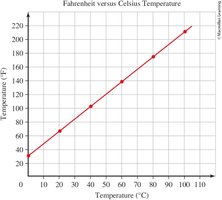
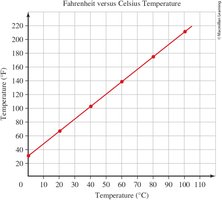
Example: Fahrenheit temperature is directly related to Celsius temperature; as one increases, so does the other.
Summary Table: Place Value Names
Place | Example Digit | Value |
|---|---|---|
Ten Thousands | 1 | 10,000 |
Thousands | 2 | 2,000 |
Hundreds | 3 | 300 |
Tens | 4 | 40 |
Ones | 5 | 5 |
Tenths | 6 | 0.6 |
Hundredths | 7 | 0.07 |
Thousandths | 8 | 0.008 |
Ten Thousandths | 9 | 0.0009 |
Key Takeaways
Mastery of basic math skills is essential for success in introductory chemistry.
Accurate calculations, proper use of calculators, and correct interpretation of graphs are foundational skills for laboratory and theoretical work.
