 Back
BackEssential Reference Sheet for Introductory Chemistry
Study Guide - Smart Notes
 Tailored notes based on your materials, expanded with key definitions, examples, and context.
List of Elements with Their Symbols and Atomic Masses
Overview
This section provides a comprehensive table of chemical elements, including their names, symbols, and atomic masses. Understanding these properties is fundamental for identifying elements, writing chemical formulas, and performing calculations in chemistry.
Element Name: The official name of the element.
Symbol: The one- or two-letter abbreviation used to represent the element in chemical equations.
Atomic Mass: The average mass of an atom of the element, measured in atomic mass units (amu).
Example: Hydrogen (H) has an atomic mass of approximately 1.008 amu, while Carbon (C) has an atomic mass of about 12.01 amu.
Element | Symbol | Atomic Mass (amu) |
|---|---|---|
Hydrogen | H | 1.008 |
Carbon | C | 12.01 |
Oxygen | O | 16.00 |
Nitrogen | N | 14.01 |
Sodium | Na | 22.99 |
Chlorine | Cl | 35.45 |
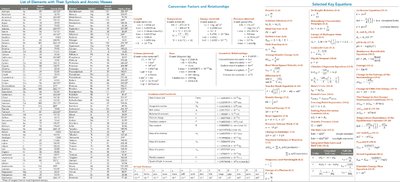
Common Conversion Factors and Relationships
Overview
Conversion factors are essential for solving chemistry problems involving units. This section summarizes key relationships used in measurements, stoichiometry, and calculations.
Length:
Mass:
Volume:
Avogadro's Number:
Energy:
Example: To convert 250 mL to liters:
Selected Key Equations
Overview
This section presents fundamental equations used throughout introductory chemistry, including those for stoichiometry, gas laws, and solution calculations.
Mole Calculations:
Ideal Gas Law:
Concentration:
Dilution:
Percent Composition:
Energy Change:
Example: To find the number of moles in 18 g of water ():
Mathematical Constants
Overview
Chemistry calculations often require mathematical constants such as pi (), Avogadro's number, and the gas constant (). These values are used in equations for energy, gas laws, and molecular calculations.
Pi ():
Avogadro's Number ():
Gas Constant ():
Example: The ideal gas law uses to relate pressure, volume, temperature, and moles of gas.
Summary Table: Key Chemistry Constants
Purpose
This table summarizes the most frequently used constants in introductory chemistry, aiding in calculations and problem solving.
Constant | Symbol | Value | Units |
|---|---|---|---|
Avogadro's Number | particles/mol | ||
Gas Constant | L·atm/(mol·K) | ||
Speed of Light | m/s | ||
Planck's Constant | J·s | ||
Faraday Constant | C/mol |
Application in Introductory Chemistry
Overview
The information provided in these tables and equations is directly relevant to the following chapters: Atoms and Elements, Molecules and Compounds, Chemical Composition, Chemical Reactions, Quantities in Chemical Reactions, Gases, Solutions, Acids and Bases, and Chemical Equilibrium. Mastery of these constants, conversion factors, and equations is essential for success in introductory chemistry courses.
