 Back
Exam #2 Study Guide: Atomic Structure, Periodic Table, Bonding, and Chemical Reactions
Study Guide - Smart Notes
 Tailored notes based on your materials, expanded with key definitions, examples, and context.
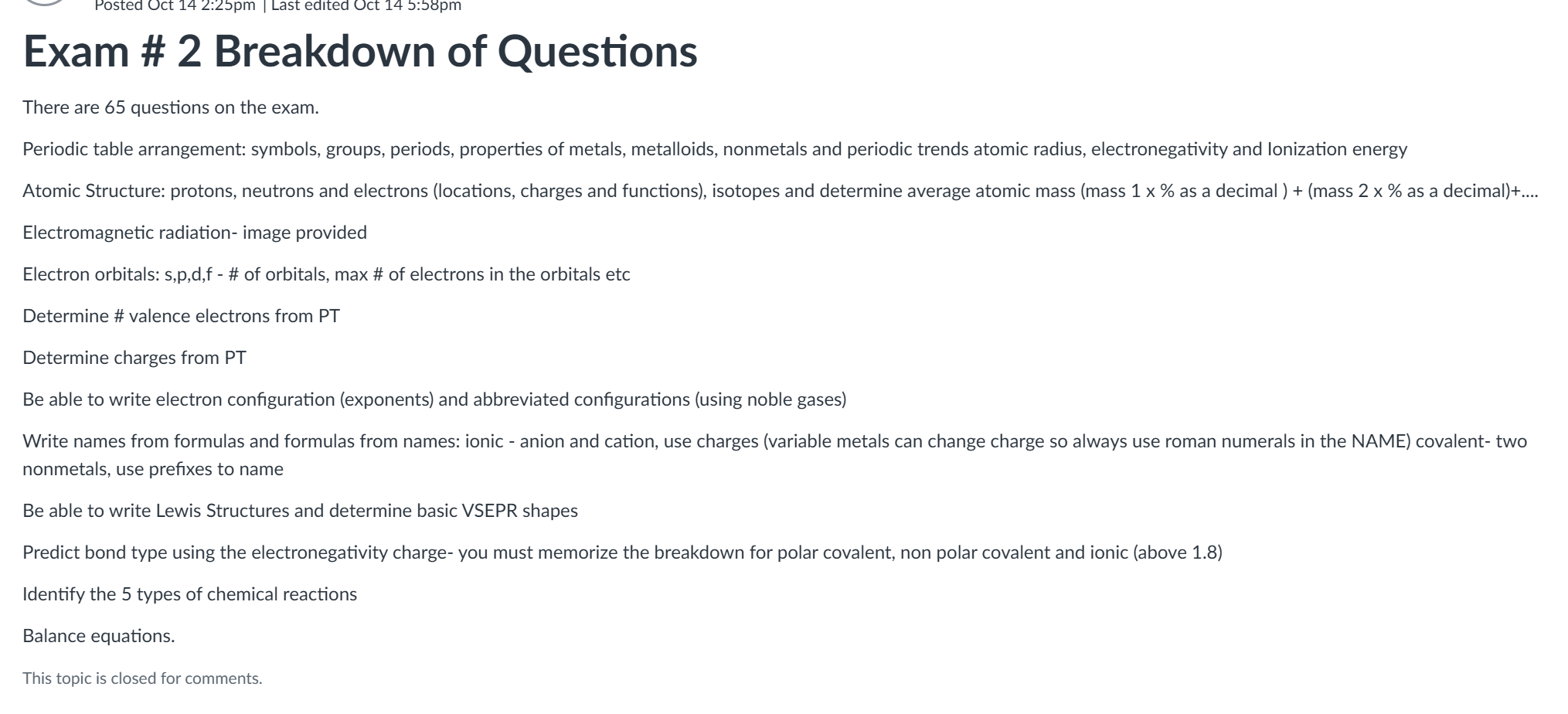
Periodic Table Arrangement
Symbols, Groups, Periods, and Properties
The periodic table organizes elements by increasing atomic number and groups them based on similar chemical properties. Understanding its structure is fundamental to predicting element behavior.
Element Symbols: One- or two-letter abbreviations for each element (e.g., H for hydrogen, Na for sodium).
Groups: Vertical columns; elements in the same group have similar properties (e.g., Group 1: Alkali metals).
Periods: Horizontal rows; properties change progressively across a period.
Metals: Located on the left and center; shiny, conductive, malleable.
Nonmetals: Located on the right; poor conductors, often gases or brittle solids.
Metalloids: Elements with properties intermediate between metals and nonmetals (e.g., Si, Ge).
Periodic Trends
Atomic Radius: Increases down a group, decreases across a period.
Electronegativity: Tendency to attract electrons; increases across a period, decreases down a group.
Ionization Energy: Energy required to remove an electron; increases across a period, decreases down a group.
Atomic Structure
Protons, Neutrons, and Electrons
Atoms consist of three main subatomic particles, each with distinct properties and functions.
Protons: Positive charge (+1), located in the nucleus, determine atomic number.
Neutrons: Neutral charge (0), located in the nucleus, contribute to atomic mass.
Electrons: Negative charge (-1), orbit the nucleus in electron shells, involved in chemical bonding.
Isotopes and Average Atomic Mass
Isotopes: Atoms of the same element with different numbers of neutrons.
Average Atomic Mass: Weighted average based on isotope abundance. Formula:
Example: If chlorine has two isotopes: Cl-35 (75%) and Cl-37 (25%), then
Electromagnetic Radiation
Nature and Properties
Electromagnetic radiation is energy transmitted through space as waves. It includes visible light, ultraviolet, infrared, and more.
Key Properties: Wavelength, frequency, and energy.
Relationship: where is energy, is Planck's constant, and is frequency.
Electron Orbitals
Types and Capacities
Electrons occupy orbitals, which are regions of space around the nucleus. Each orbital type has a specific shape and capacity.
s orbital: 1 orbital, max 2 electrons
p orbitals: 3 orbitals, max 6 electrons
d orbitals: 5 orbitals, max 10 electrons
f orbitals: 7 orbitals, max 14 electrons
Valence Electrons and Charges from the Periodic Table
Determining Valence Electrons
Valence electrons are the outermost electrons involved in bonding. Their number can be determined from the group number for main group elements.
Example: Group 1 elements have 1 valence electron; Group 17 have 7.
Determining Charges
Metals: Tend to lose electrons and form positive ions (cations).
Nonmetals: Tend to gain electrons and form negative ions (anions).
Example: Sodium (Na) forms Na+; Chlorine (Cl) forms Cl-.
Electron Configuration
Writing Electron Configurations
Electron configuration shows the distribution of electrons among orbitals. Abbreviated configurations use noble gases as reference points.
Full Configuration: List all orbitals (e.g., 1s2 2s2 2p6).
Abbreviated: Use noble gas core (e.g., [Ne] 3s2 3p1).
Naming and Writing Formulas
Ionic Compounds
Anion and Cation: Name cation first, then anion (e.g., NaCl: sodium chloride).
Variable Metals: Use Roman numerals for charge (e.g., FeCl2: iron(II) chloride).
Covalent Compounds
Two Nonmetals: Use prefixes (mono-, di-, tri-, etc.) to indicate number of atoms (e.g., CO2: carbon dioxide).
Lewis Structures and VSEPR Shapes
Drawing Lewis Structures
Lewis structures represent valence electrons and bonding in molecules. VSEPR theory predicts molecular shapes based on electron pair repulsion.
Steps: Count valence electrons, arrange atoms, assign bonds and lone pairs.
Basic Shapes: Linear, bent, trigonal planar, tetrahedral, trigonal bipyramidal, octahedral.
Bond Types and Electronegativity
Predicting Bond Type
Bond type is determined by the difference in electronegativity between atoms.
Nonpolar Covalent: Difference < 0.5
Polar Covalent: Difference 0.5–1.8
Ionic: Difference > 1.8
Types of Chemical Reactions
Classification
Chemical reactions are classified into five main types based on reactants and products.
Synthesis: Two or more substances combine to form one product.
Decomposition: One substance breaks down into two or more products.
Single Replacement: One element replaces another in a compound.
Double Replacement: Two compounds exchange ions.
Combustion: Substance reacts with oxygen, producing energy, CO2, and H2O.
Balancing Equations
Principles and Steps
Balancing chemical equations ensures the conservation of mass. Each side must have the same number of atoms for each element.
Steps: Write the unbalanced equation, count atoms, adjust coefficients, check balance.
Example: becomes
