Back
BackGas Laws and the Behavior of Gases: Study Notes for Introductory Chemistry
Study Guide - Smart Notes
 Tailored notes based on your materials, expanded with key definitions, examples, and context.
Gas Laws and the Behavior of Gases
Kinetic Molecular Theory
The kinetic molecular theory explains the behavior of matter in different phases—solid, liquid, and gas—by considering the motion and energy of particles. This theory forms the foundation for understanding gas laws.
All matter is composed of atoms, molecules, or ions that are in constant motion, possessing kinetic energy (EK).
The amount of kinetic energy and the strength of intermolecular forces determine the phase of a substance.
Property | Solid | Liquid | Gas |
|---|---|---|---|
Particle arrangement | Closely packed | Particles move over one another | Particles far apart |
Intermolecular forces | Strong | Weaker than solids | Very weak |
Density | High | Lower than solids | Low |
Compressibility | Not easy | Not easy | Compressible |
Motion | Vibrate around rest position | Move around more | Move around fast |
Gases exert pressure in all directions due to collisions with container walls.
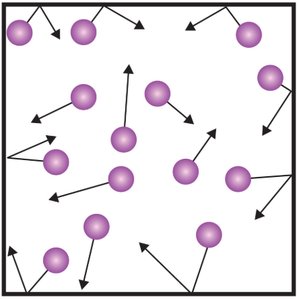
Each gas molecule moves at a different speed; kinetic energy is given by .
The temperature of a substance is a measure of the average kinetic energy of its particles.
Gases and Pressure
Gas pressure results from collisions of gas particles with the walls of their container. The frequency and force of these collisions determine the pressure exerted.
Increasing temperature increases the average kinetic energy, leading to more frequent and forceful collisions, thus increasing pressure.
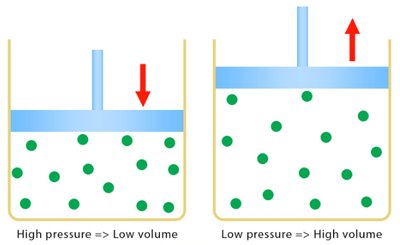
Decreasing the volume of a container increases pressure, and vice versa.
Gas Law Variables
Several variables are used to describe the state of a gas:
Pressure (P): Force per unit area, measured in Pascals (Pa), kilopascals (kPa), or atmospheres (atm).
Volume (V): Space occupied by the gas, measured in cm3, dm3, m3, or liters (L).
Temperature (T): Measured in Kelvin (K) or degrees Celsius (°C). Conversion: .
Number of moles (n): Amount of gas particles.
Boyle’s Law
Pressure-Volume Relationship
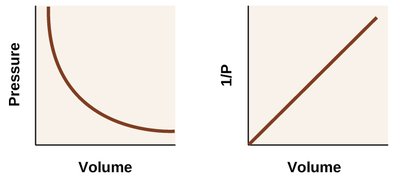
Boyle’s Law states that the pressure and volume of a confined gas are inversely proportional, provided temperature and the amount of gas remain constant.
If the volume of a gas decreases, its pressure increases, and vice versa.
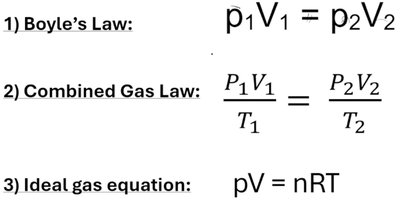
Mathematically:
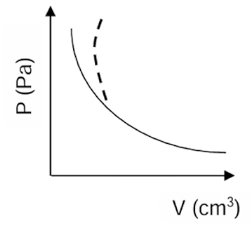
Graphically, the relationship is a hyperbola when plotting P vs. V, and a straight line when plotting 1/P vs. V.
Example: If a container’s volume decreases from 500 cm3 to 200 cm3 at constant temperature, the pressure increases accordingly.
Ideal Gas vs. Real Gas
Assumptions and Deviations
An ideal gas is a hypothetical gas that perfectly follows all gas laws under all conditions. Real gases approximate ideal behavior under many conditions but deviate at high pressures and low temperatures.
Property | Ideal Gas | Real Gas |
|---|---|---|
Intermolecular forces | None | Very small |
Particle volume | Zero | Very small but nonzero |
Collisions | Perfectly elastic | Not perfectly elastic |
Compressibility | Always compressible | Not compressible at high P |
At high pressures, real gases occupy more volume than predicted by Boyle’s Law.
At low temperatures, attractive forces cause gases to condense, which ideal gases do not predict.
Gas Law Equations
Ideal Gas Law
The ideal gas law combines all the variables into a single equation:
P: pressure (Pa), V: volume (m3), n: moles, R: universal gas constant (8.31 J·K-1·mol-1), T: temperature (K)
Example: Calculate the pressure of 2 mol of gas in a 0.5 m3 container at 300 K.
Charles’s Law
Charles’s Law states that the volume of a gas is directly proportional to its temperature (in Kelvin) at constant pressure and amount of gas.
As temperature increases, volume increases.
Example: A basketball left in the cold shrinks as its volume decreases with temperature.
Gay-Lussac’s Law
Gay-Lussac’s Law states that the pressure of a gas is directly proportional to its temperature (in Kelvin) at constant volume and amount of gas.
As temperature increases, pressure increases.
Example: Car tires gain pressure after a long drive due to increased temperature.
Combined Gas Law
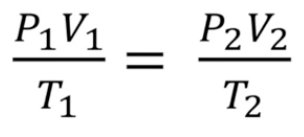
The combined gas law relates pressure, volume, and temperature when the amount of gas is constant:
Used when a gas undergoes changes in pressure, volume, and temperature.
Example: Calculating the temperature at which a weather balloon bursts given initial and final conditions.
Summary of Gas Laws
Boyle’s Law: (constant T & n; P and V are inversely related)
Combined Gas Law: (constant n; relates P, V, T)
Ideal Gas Law: (relates P, V, n, T for a single state)