 Back
BackIntermolecular Forces and Their Role in Chemistry
Study Guide - Smart Notes
 Tailored notes based on your materials, expanded with key definitions, examples, and context.
Van der Waals Forces and Intermolecular Interactions
Overview of Intermolecular Forces
Intermolecular forces are the attractive forces that exist between molecules, playing a crucial role in determining the physical properties of substances such as boiling points, melting points, and solubility. These forces are generally weaker than the covalent or ionic bonds within molecules but are essential for understanding the behavior of matter in different states.
Van der Waals forces refer collectively to several types of intermolecular attractions, including dipole-dipole, dipole-induced dipole, and dispersion forces.
Ion-dipole interactions are not classified as van der Waals forces but are important in solutions, especially when ionic compounds dissolve in polar solvents.
Types of Intermolecular Forces
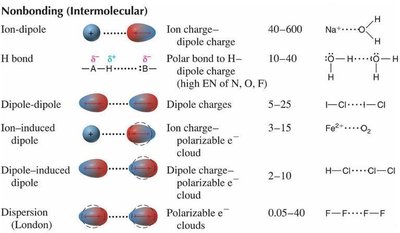
Dipole–Dipole Forces: These occur between molecules that have permanent dipoles (i.e., polar molecules). The positive end of one molecule is attracted to the negative end of another.
Hydrogen Bonds (H-bonds): A special, very strong type of dipole-dipole interaction that occurs when hydrogen is bonded to highly electronegative atoms (N, O, or F). Hydrogen bonds are responsible for many unique properties of water and biological molecules.
Dipole–Induced Dipole Forces: These arise when a polar molecule induces a temporary dipole in a nonpolar molecule by distorting its electron cloud.
Dispersion Forces (London Dispersion Forces): Present in all molecules, these are the only intermolecular forces in nonpolar substances. They result from temporary fluctuations in electron distribution, creating instantaneous dipoles. The strength increases with the number of electrons (molar mass) and the polarizability of the electron cloud.
Polarizability and Induced Dipoles
Polarizability refers to how easily the electron cloud of a molecule can be distorted to form a temporary dipole. Larger atoms or molecules with more electrons are generally more polarizable, leading to stronger dispersion forces.
Induced dipoles are temporary and result from the distortion of the electron cloud by a nearby ion or polar molecule.
Dispersion forces are always present but are the dominant force in nonpolar molecules.
Hydrogen Bonding and Molecular Polarity
Hydrogen Bonding
Hydrogen bonding is a particularly strong type of dipole-dipole interaction. It occurs when hydrogen is covalently bonded to a highly electronegative atom (N, O, or F), and this hydrogen is attracted to a lone pair of electrons on another electronegative atom in a neighboring molecule.
Hydrogen bonds are responsible for the high boiling point of water and the structure of DNA.
They are much stronger than regular dipole-dipole interactions but weaker than covalent or ionic bonds.
Molecular Polarity and Its Effects
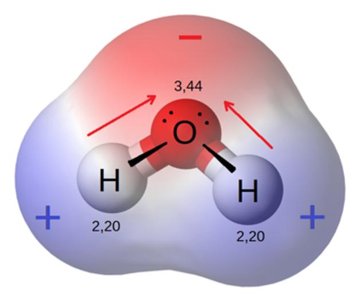
The polarity of a molecule depends on the difference in electronegativity between atoms and the geometry of the molecule. Polar molecules have a net dipole moment, leading to stronger intermolecular attractions.
Water (H2O) is a classic example of a polar molecule with strong hydrogen bonding.
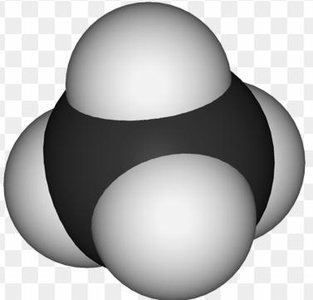
Nonpolar molecules, such as methane (CH4), interact mainly through dispersion forces.
Summary Table: Types of Intermolecular Forces
Type of Force | Particles Involved | Relative Strength (kJ/mol) | Example |
|---|---|---|---|
Ion-dipole | Ion and polar molecule | 40–600 | Na+ in H2O |
Hydrogen bond | H bonded to N, O, or F | 10–40 | H2O, NH3 |
Dipole-dipole | Two polar molecules | 5–25 | HCl, SO2 |
Ion-induced dipole | Ion and nonpolar molecule | 3–15 | Fe2+ and O2 |
Dipole-induced dipole | Polar and nonpolar molecule | 2–10 | Cl2 and HCl |
Dispersion (London) | All molecules | 0.05–40 | F2, CH4 |
Key Definitions
Van der Waals forces: Collective term for dipole-dipole, dipole-induced dipole, and dispersion forces.
Dipole: A molecule with a positive and negative end due to uneven electron distribution.
Induced dipole: Temporary dipole created by the influence of a nearby ion or polar molecule.
Dispersion forces: Weak intermolecular forces arising from temporary shifts in electron density.
Polarizability: The ease with which an electron cloud can be distorted.
Applications and Examples
Intermolecular forces explain why water is liquid at room temperature while methane is a gas.
Hydrogen bonding is critical for the structure and function of biological macromolecules like proteins and DNA.
Dispersion forces allow nonpolar substances like noble gases to condense into liquids at low temperatures.
