 Back
BackIntro to Chemistry Exam 2 Study Guide & Practice Problems
Study Guide - Smart Notes
 Tailored notes based on your materials, expanded with key definitions, examples, and context.
Q1. Naming Compounds
Background
Topic: Chemical Nomenclature
This section tests your ability to apply naming rules for ionic and covalent compounds using the periodic table and naming conventions.
Key Terms and Concepts:
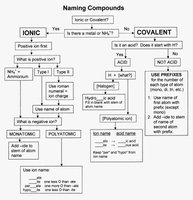
Ionic compounds: Metal + nonmetal, use Roman numerals for transition metals.
Covalent compounds: Nonmetal + nonmetal, use Greek prefixes.
Polyatomic ions: Charged groups of atoms (e.g., NO3-, SO42-).
Step-by-Step Guidance
Identify if the compound is ionic or covalent by checking the elements involved.
For ionic compounds, determine the cation (positive ion) and anion (negative ion). If the cation is a transition metal, use Roman numerals to indicate its charge.
For covalent compounds, use Greek prefixes to indicate the number of each atom present.
Apply the appropriate naming rules based on the compound type.
Try solving on your own before revealing the answer!
Q2. Electron Configuration Practice
Background
Topic: Electron Configuration
This section tests your understanding of how electrons fill atomic orbitals in both neutral atoms and ions, as well as recognizing ground and excited states.
Key Terms and Concepts:
Electron configuration: The arrangement of electrons in an atom's orbitals.
Ground state: Lowest energy arrangement of electrons.
Excited state: At least one electron is in a higher energy orbital than in the ground state.
Aufbau principle, Pauli exclusion principle, Hund's rule.
Step-by-Step Guidance
Determine the atomic number to find the number of electrons for the neutral atom.
Fill orbitals in order of increasing energy (1s, 2s, 2p, 3s, 3p, 4s, 3d, etc.).
For ions, add electrons for negative charges or remove electrons for positive charges.
For excited states, promote an electron from a lower to a higher energy orbital.
Try solving on your own before revealing the answer!
Q3. Lewis Structures and Molecular Geometry
Background
Topic: Lewis Structures & VSEPR Theory
This section tests your ability to draw Lewis structures and predict molecular geometry using the VSEPR model.
Key Terms and Concepts:
Lewis structure: Diagram showing valence electrons and bonds in a molecule.
VSEPR model: Predicts 3D shape based on electron domains around the central atom.
Electron domains: Bonds and lone pairs around the central atom.
Step-by-Step Guidance
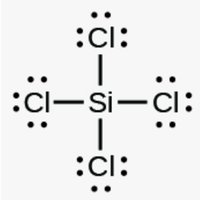
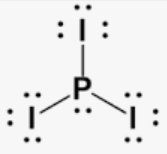
Count the total number of valence electrons for all atoms in the molecule.
Draw single bonds between the central atom and surrounding atoms, then distribute remaining electrons as lone pairs to satisfy the octet rule.
Count the number of electron domains (bonds + lone pairs) around the central atom to determine geometry.
Use VSEPR theory to predict the 3D shape (e.g., tetrahedral, trigonal pyramidal).
Try solving on your own before revealing the answer!
Q4. 3D Structure, Molecular Geometry, and Polarity
Background
Topic: Molecular Geometry & Polarity
This section tests your ability to identify molecular geometry and determine the polarity of bonds and molecules.
Key Terms and Concepts:
Molecular geometry: The 3D arrangement of atoms in a molecule.
Bond polarity: Determined by the difference in electronegativity () between atoms.
Molecular polarity: Depends on both bond polarity and molecular symmetry.
Step-by-Step Guidance
Identify the geometry of the molecule using VSEPR theory.
Calculate the electronegativity difference () for each bond to determine if it is nonpolar covalent, polar covalent, or ionic.
Assess the overall symmetry of the molecule to determine if the molecule is polar or nonpolar.
Try solving on your own before revealing the answer!
Q5. Lewis Structures, Molecular Geometry, and Polarity (CO2 and SO2)
Background
Topic: Lewis Structures, VSEPR, and Polarity
This section tests your ability to interpret Lewis structures, predict molecular geometry, and determine molecular polarity.
Key Terms and Concepts:
Lewis structure: Shows bonding and lone pairs.
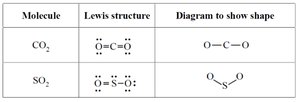
Linear geometry: 180° bond angle, usually nonpolar if symmetrical.
Bent geometry: Less than 180°, often polar due to asymmetry.
Step-by-Step Guidance
Examine the Lewis structure to count electron domains and determine geometry (linear or bent).
Calculate for each bond to assess bond polarity.
Evaluate the symmetry of the molecule to determine if it is overall polar or nonpolar.
Try solving on your own before revealing the answer!
Q6. Electronegativity Difference and Bond Type
Background
Topic: Electronegativity and Bond Classification
This section tests your ability to calculate the electronegativity difference () and classify bonds as pure covalent, polar covalent, or ionic.
Key Terms and Concepts:
Electronegativity: The tendency of an atom to attract electrons in a bond.
: Difference in electronegativity between two atoms.
Bond types: Pure covalent (), polar covalent (), ionic ().
Step-by-Step Guidance
Look up the electronegativity values for each element.
Subtract the smaller value from the larger to find .
Use the value to classify the bond type.
Try solving on your own before revealing the answer!
Q7. Molarity Calculation (Dilution)
Background
Topic: Solution Concentration and Dilution
This question tests your ability to use the dilution equation to calculate the volume of a concentrated solution needed to prepare a less concentrated solution.
Key Formula:
= initial (concentrated) molarity
= volume of concentrated solution needed
= final (diluted) molarity
= final volume of diluted solution
Step-by-Step Guidance
Identify the known values: M, M, mL.
Write the dilution equation: .
Rearrange to solve for : .
Plug in the known values, but do not calculate the final answer yet.
Try solving on your own before revealing the answer!
Q8. Molecular Weight Calculation
Background
Topic: Molar Mass Calculation
This question tests your ability to calculate the molecular weight (molar mass) of a compound by summing the atomic masses of all atoms in the formula.
Key Formula:
Step-by-Step Guidance
List the number of each type of atom in the formula (e.g., NaC2H3O2).
Multiply the number of each atom by its atomic mass.
Add the results to get the total molecular weight.
Try solving on your own before revealing the answer!
