 Back
BackIntro to Chemistry Exam Study Guide with Step-by-Step Guidance
Study Guide - Smart Notes
 Tailored notes based on your materials, expanded with key definitions, examples, and context.
Q1. Which of the following is not a state of matter?
Background
Topic: States of Matter
This question tests your understanding of the basic states of matter and the ability to distinguish between them.
Key Terms:
Solid: Definite shape and volume.
Liquid: Definite volume, takes the shape of its container.
Gas: No definite shape or volume.
Heat: A form of energy, not a state of matter.
Step-by-Step Guidance
Recall the three classical states of matter: solid, liquid, and gas.
Identify which option is not a physical state but rather a form of energy.
Eliminate the options that are actual states of matter.
Try solving on your own before revealing the answer!
Q2. Which of the following is a chemical compound?
Background
Topic: Elements, Compounds, and Mixtures
This question tests your ability to distinguish between elements, compounds, and mixtures based on their composition and properties.
Key Terms:
Element: A pure substance made of only one kind of atom.
Compound: A substance made from two or more elements chemically bonded together.
Mixture: A combination of two or more substances that are not chemically bonded.
Step-by-Step Guidance
Review the definitions of element, compound, and mixture.
Look for the option that consists of two or more elements chemically combined in a fixed ratio.
Eliminate options that are single elements or mixtures.
Try solving on your own before revealing the answer!
Q3. Which of the following is an example of a mixture?
Background
Topic: Mixtures vs. Pure Substances
This question tests your ability to identify mixtures as opposed to pure substances (elements or compounds).
Key Terms:
Mixture: Contains two or more substances physically combined.
Pure Substance: Has a uniform and definite composition (element or compound).
Step-by-Step Guidance
Recall that mixtures can be separated by physical means and do not have a fixed composition.
Identify which option contains more than one substance physically combined.
Eliminate options that are elements or compounds.
Try solving on your own before revealing the answer!
Q4. Which of the following statements regarding the solid state of matter is incorrect?
Background
Topic: Properties of Solids
This question tests your understanding of the characteristics of solids compared to other states of matter.
Key Terms:
Solid: Definite shape and volume, particles are closely packed.
Liquid: Definite volume, takes the shape of its container.
Gas: No definite shape or volume.
Step-by-Step Guidance
Review the properties of solids, such as particle arrangement and movement.
Read each statement and compare it to what you know about solids.
Identify the statement that does not accurately describe a solid.
Try solving on your own before revealing the answer!
Q5. An atom contains 1.50 × 1024 kg of sodium. What is this mass in units of grams?
Background
Topic: Unit Conversions (SI Units)
This question tests your ability to convert between kilograms and grams using the metric system.
Key Formula:
Step-by-Step Guidance
Write down the given mass in kilograms.
Recall the conversion factor between kilograms and grams.
Set up the conversion so that kilograms cancel and grams remain.
Try solving on your own before revealing the answer!
Q6. How many moles of Fe2O3 are in a can that contains 618 g?
Background
Topic: Moles and Molar Mass
This question tests your ability to convert mass to moles using the molar mass of a compound.
Key Formula:
Step-by-Step Guidance
Write down the given mass of Fe2O3.
Calculate the molar mass of Fe2O3 by adding the atomic masses of Fe and O.
Set up the calculation to divide the mass by the molar mass.
Try solving on your own before revealing the answer!
Q7. The proprietor of a rock shop insists that a nugget is pure gold. If the nugget occupies a volume of 5.40 mL, what would its mass have to be if it were truly pure gold? (density of gold = 19.3 g/mL)
Background
Topic: Density Calculations
This question tests your ability to use the density formula to find mass from volume and density.
Key Formula:
Rearranged:
Step-by-Step Guidance
Write down the given volume and density values.
Set up the formula to solve for mass.
Multiply the density by the volume to find the mass.
Try solving on your own before revealing the answer!
Q8. Which of the following is an example of a chemical property?
Background
Topic: Physical vs. Chemical Properties
This question tests your ability to distinguish between physical and chemical properties of substances.
Key Terms:
Chemical Property: Describes a substance's ability to undergo a specific chemical change.
Physical Property: Can be observed without changing the substance's identity.
Step-by-Step Guidance
Review the definitions of chemical and physical properties.
Identify which option describes a change in composition or the ability to react.
Eliminate options that only describe physical changes.
Try solving on your own before revealing the answer!
Q9. The number 0.009255 correctly expressed in scientific notation is:
Background
Topic: Scientific Notation
This question tests your ability to convert a decimal number into scientific notation.
Key Formula:
where and is an integer.
Step-by-Step Guidance
Move the decimal point so that only one nonzero digit remains to the left.
Count the number of places the decimal was moved; this determines the exponent.
Express the number in the form .
Try solving on your own before revealing the answer!
Q10. Match the type of measurement to the unit given below.
Background
Topic: SI Units and Measurement Types
This question tests your knowledge of which SI units correspond to which types of measurements.
Key Terms:
cm3: Volume
m: Distance
kg: Mass
273 K: Temperature
g/cm3: Density
Step-by-Step Guidance
Recall the SI base units for each type of measurement.
Match each unit to its corresponding measurement type.
Try solving on your own before revealing the answer!
Q11. Select the correct prefix to complete the equality: 1 g = ____ kg
Background
Topic: Metric Prefixes and Unit Conversions
This question tests your understanding of metric prefixes and how to convert between grams and kilograms.
Key Terms:
Kilo- (k): 1 kg = 1000 g
Step-by-Step Guidance
Recall the relationship between grams and kilograms.
Express 1 gram as a fraction or decimal of a kilogram.
Try solving on your own before revealing the answer!
Q12. Identify each of the following transformations as a chemical or physical change.
Background
Topic: Chemical vs. Physical Changes
This question tests your ability to distinguish between chemical and physical changes based on the process described.
Key Terms:
Chemical Change: Produces new substances with different properties.
Physical Change: Does not change the chemical identity of the substance.
Step-by-Step Guidance
For each transformation, ask if the chemical identity changes or if only the physical state/form changes.
Classify each as chemical or physical based on your reasoning.
Try solving on your own before revealing the answer!
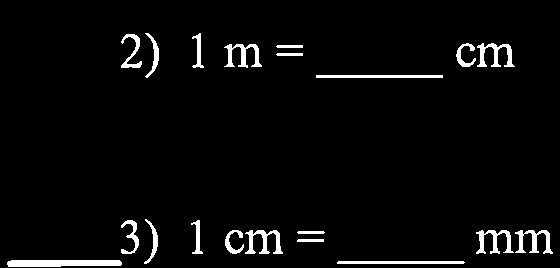
Q13. 1 m = ____ cm
Background
Topic: Metric Conversions
This question tests your ability to convert between meters and centimeters using metric prefixes.
Key Formula:
Step-by-Step Guidance
Recall the prefix 'centi-' means 1/100.
Determine how many centimeters are in one meter.
Try solving on your own before revealing the answer!
Q14. 1 cm = ____ mm
Background
Topic: Metric Conversions
This question tests your ability to convert between centimeters and millimeters using metric prefixes.
Key Formula:
Step-by-Step Guidance
Recall the prefix 'milli-' means 1/1000.
Determine how many millimeters are in one centimeter.
Try solving on your own before revealing the answer!
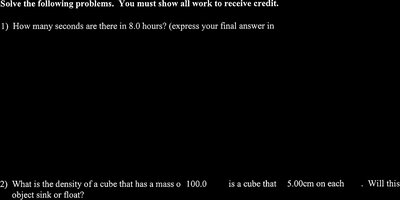
Q15. How many seconds are there in 8.0 hours? (Express your final answer in seconds.)
Background
Topic: Time Conversions
This question tests your ability to convert hours to seconds using unit factors.
Key Formula:
Step-by-Step Guidance
Start with the given number of hours.
Convert hours to minutes by multiplying by 60.
Convert minutes to seconds by multiplying by 60 again.
Try solving on your own before revealing the answer!
Q16. What is the density of a cube that has a mass of 100.0 g and is a cube that is 5.00 cm on each side? Will this object sink or float?
Background
Topic: Density Calculations and Buoyancy
This question tests your ability to calculate density and apply the concept to predict whether an object will sink or float in water.
Key Formula:
Volume of a cube:
Step-by-Step Guidance
Calculate the volume of the cube using the formula for the volume of a cube.
Divide the mass by the calculated volume to find the density.
Compare the density to that of water (1.00 g/cm3) to predict if it will sink or float.
Try solving on your own before revealing the answer!
Q17. How many calories of energy are required to increase the temperature of 25 grams of water from 10°C to 50°C?
Background
Topic: Heat Calculations (Specific Heat)
This question tests your ability to use the specific heat formula to calculate the energy required to change the temperature of a substance.
Key Formula:
= heat energy (calories)
= mass (grams)
= specific heat of water (1 cal/g°C)
= change in temperature (°C)
Step-by-Step Guidance
Calculate the change in temperature () by subtracting the initial temperature from the final temperature.
Plug the values for mass, specific heat, and into the formula.
Multiply to find the total energy in calories.

Try solving on your own before revealing the answer!
Q18. My 6-year-old was diagnosed with a sinus infection. She weighs 52.0 lbs. If the recommended pediatric dose of amoxicillin is 8.50 mg per kg, how many mg should she have in a day?
Background
Topic: Dosage Calculations and Unit Conversions
This question tests your ability to convert between pounds and kilograms and then calculate the correct medication dosage.
Key Formula:
Step-by-Step Guidance
Convert the child's weight from pounds to kilograms using the conversion factor.
Multiply the mass in kilograms by the recommended dose per kilogram.
Calculate the total daily dose in milligrams.

Try solving on your own before revealing the answer!
