 Back
BackIntro to Chemistry Study Guide: Atomic Structure, Electron Configuration, Polyatomic Ions, and Chemical Nomenclature
Study Guide - Smart Notes
 Tailored notes based on your materials, expanded with key definitions, examples, and context.
Q1. Match the correct name of the polyatomic ions with the formulas given.
Background
Topic: Polyatomic Ions and Nomenclature
This question tests your knowledge of common polyatomic ions, their formulas, and their names. Understanding these is essential for writing and naming chemical compounds.
Key Terms:
Polyatomic ion: An ion composed of two or more atoms covalently bonded, carrying a net charge.
Examples: Sulfate (), Nitrate (), Carbonate (), etc.
Step-by-Step Guidance
Review the list of polyatomic ions and their formulas. Make sure you recognize the charge and the arrangement of atoms in each formula.
Recall the names associated with each formula. For example, is sulfate, is nitrate, is carbonate.
Match each formula to its correct name by comparing the charge and the atoms present.
Pay attention to similar ions (e.g., nitrate vs. nitrite, sulfate vs. sulfite) and their differences in oxygen count and charge.
Try solving on your own before revealing the answer!
Final Answer:
Each polyatomic ion formula matches to its name as follows (examples):
: Sulfate
: Nitrate
: Carbonate
: Ammonium
: Hydroxide
Matching is based on memorization and recognition of the ion's formula and charge.
Q2. The number of electron levels (not sublevels) in a magnesium atom is ___
Background
Topic: Atomic Structure
This question tests your understanding of electron shells (energy levels) in atoms, specifically for magnesium.
Key Terms:
Electron level (shell): The principal energy level where electrons reside, denoted by n=1, 2, 3, etc.
Magnesium atomic number: 12
Step-by-Step Guidance
Determine the atomic number of magnesium (12), which tells you the number of electrons.
Recall the electron configuration for magnesium: .
Count the principal energy levels (shells) occupied by electrons in magnesium.
Try solving on your own before revealing the answer!
Final Answer: 3
Magnesium has electrons in the first, second, and third energy levels.
Q3. The visible light spectrum covers the wavelength range ____
Background
Topic: Electromagnetic Spectrum
This question tests your knowledge of the range of wavelengths for visible light.
Key Terms:
Visible light: The portion of the electromagnetic spectrum detectable by the human eye.
Wavelength: The distance between two consecutive peaks of a wave, measured in nanometers (nm).
Step-by-Step Guidance
Recall the typical wavelength range for visible light (in nm).
Compare the options given to the known range.
Identify the correct range that matches the visible spectrum.
Try solving on your own before revealing the answer!
Final Answer: 400 to 700 nm
The visible spectrum spans from violet (400 nm) to red (700 nm).
Q4. All electromagnetic radiation travels at the same ____
Background
Topic: Electromagnetic Radiation
This question tests your understanding of the properties of electromagnetic waves.
Key Terms:
Electromagnetic radiation: Includes light, radio waves, X-rays, etc.
Speed of light (): m/s
Step-by-Step Guidance
Recall that all types of electromagnetic radiation travel at the same speed in a vacuum.
Identify which property (velocity, wavelength, energy, frequency, color) is constant for all electromagnetic waves.
Try solving on your own before revealing the answer!
Final Answer: velocity
All electromagnetic radiation travels at the speed of light in a vacuum.
Q5. The energy of an infrared photon is ___ than that of ___
Background
Topic: Electromagnetic Spectrum and Photon Energy
This question tests your understanding of the relative energies of photons in different regions of the electromagnetic spectrum.
Key Formula:
= energy of the photon
= Planck's constant
= frequency
Step-by-Step Guidance
Recall the order of electromagnetic radiation by energy: gamma rays > X-rays > ultraviolet > visible > infrared > microwave.
Compare the energy of infrared photons to those of ultraviolet, microwave, X-ray, gamma ray, and visible photons.
Use the formula to relate energy to frequency and wavelength.
Try solving on your own before revealing the answer!
Final Answer: less than that of an ultraviolet photon
Infrared photons have lower energy than ultraviolet photons because they have lower frequency.
Q6. Which one of the following elements forms two or more ions with different ionic charges?
Background
Topic: Variable Oxidation States
This question tests your knowledge of elements that can form multiple ions with different charges, often transition metals.
Key Terms:
Variable oxidation state: Ability of an element to form ions with different charges.
Transition metals: Often form multiple ions (e.g., Fe and Fe).
Step-by-Step Guidance
Identify which elements in the list are transition metals or have variable oxidation states.
Recall common ions formed by each element.
Determine which element forms more than one ion with different charges.
Try solving on your own before revealing the answer!
Final Answer: Fe (Iron)
Iron forms Fe and Fe ions, showing variable oxidation states.
Q7. Which of the following polyatomic ions has a positive charge?
Background
Topic: Polyatomic Ions
This question tests your ability to identify the charge of common polyatomic ions.
Key Terms:
Polyatomic ion: An ion made of multiple atoms.
Positive charge: Cation (e.g., ammonium ).
Step-by-Step Guidance
Review the list of polyatomic ions and their charges.
Identify which ion has a positive charge (cation).
Recall that most polyatomic ions are anions, but ammonium is a common cation.
Try solving on your own before revealing the answer!
Final Answer: Ammonium ()
Ammonium is the only common polyatomic ion with a positive charge.
Q8. What is the formula of the nitrate ion?
Background
Topic: Polyatomic Ion Formulas
This question tests your ability to recall the correct formula for the nitrate ion.
Key Terms:
Nitrate ion: A polyatomic ion with the formula .
Step-by-Step Guidance
Recall the formula for nitrate, which contains one nitrogen and three oxygens, with a negative charge.
Compare the options to the correct formula.
Identify the formula that matches nitrate.
Try solving on your own before revealing the answer!
Final Answer:
Nitrate is , with one nitrogen and three oxygens.
Q9. Select the correct symbol for the element named.
Background
Topic: Periodic Table and Element Symbols
This question tests your knowledge of the symbols for elements on the periodic table.
Key Terms:
Element symbol: One or two letters representing an element (e.g., Na for sodium).
Step-by-Step Guidance
Review the element name and recall its symbol from the periodic table.
Compare the options and select the correct symbol.
Try solving on your own before revealing the answer!
Final Answer: (Varies by element; e.g., Na for sodium)
Each element has a unique symbol, usually derived from its English or Latin name.
Q10. Write the electron configuration in orbital notation for Oxygen.
Background
Topic: Electron Configuration
This question tests your ability to write the electron configuration for oxygen using orbital notation.
Key Terms and Formula:
Orbital notation: Shows the arrangement of electrons in orbitals (e.g., ).
Oxygen atomic number: 8
Step-by-Step Guidance
Determine the atomic number of oxygen (8), which tells you the number of electrons.
Fill the orbitals in order of increasing energy: , , .
Write the orbital notation, showing how electrons are distributed in each orbital.
Try solving on your own before revealing the answer!
Final Answer:
Oxygen's electrons fill the , , and orbitals.
Q11. Write the electron configuration in abbreviated notation for Vanadium.
Background
Topic: Electron Configuration (Abbreviated Notation)
This question tests your ability to write the electron configuration for vanadium using noble gas notation.
Key Terms and Formula:
Abbreviated notation: Uses the previous noble gas in brackets, followed by the remaining configuration.
Vanadium atomic number: 23
Step-by-Step Guidance
Identify the noble gas preceding vanadium (argon, ).
Write the remaining electron configuration after .
Combine the noble gas core with the rest of the configuration.
Try solving on your own before revealing the answer!
Final Answer:
Vanadium's configuration uses argon as the core, then fills and orbitals.
Q12. Name the following compounds: NaCl and ZnCl2
Background
Topic: Chemical Nomenclature
This question tests your ability to name ionic compounds based on their formulas.
Key Terms:
Ionic compound: Formed from a metal and a nonmetal.
NaCl: Sodium chloride
ZnCl2: Zinc chloride
Step-by-Step Guidance
Identify the cation (metal) and anion (nonmetal) in each compound.
Name the cation first, then the anion (with -ide ending).
For transition metals, check if a Roman numeral is needed for the charge.
Try solving on your own before revealing the answer!
Final Answer:
NaCl: Sodium chloride
ZnCl2: Zinc chloride
Both are named by identifying the metal and the nonmetal.
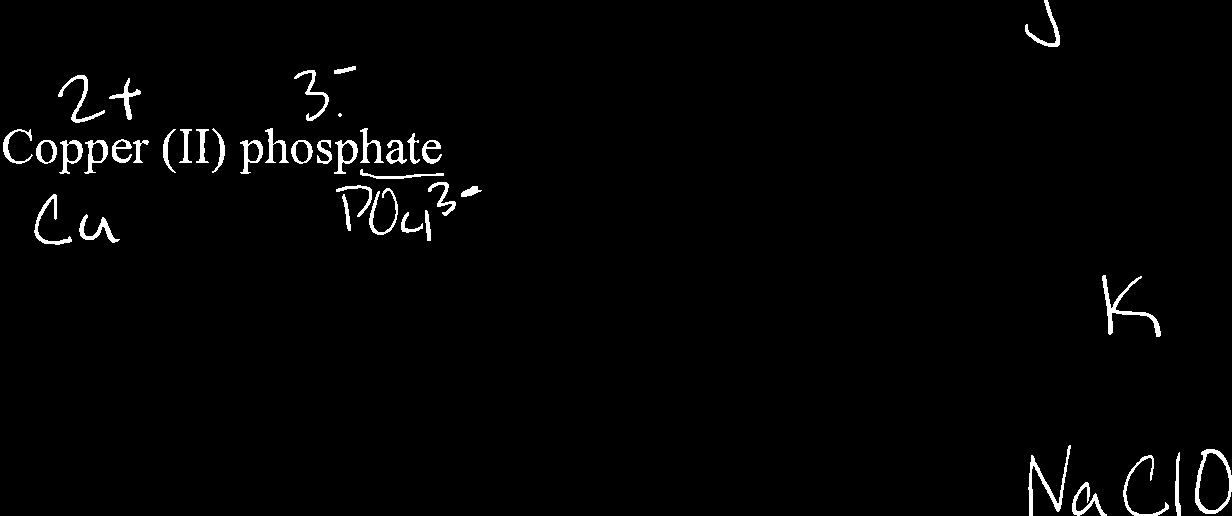
Q13. Copper (II) phosphate: Write the formula.
Background
Topic: Chemical Nomenclature and Formula Writing
This question tests your ability to write the formula for an ionic compound given the cation and anion names and charges.
Key Terms:
Copper (II):
Phosphate:
Step-by-Step Guidance
Write the charges for each ion: and .
Balance the charges to create a neutral compound.
Determine the correct ratio of ions to balance the charges.
Try solving on your own before revealing the answer!
Final Answer:
Three copper ions () and two phosphate ions () balance the charges.
